
Ancient Mathematics Uncovered: Sumerian Cuneiform Accounting & Egyptian Land Math
Picture a dusty Mesopotamian marketplace, 5,000 years ago. A Sumerian scribe hunches over a clay tablet, wedge-shaped stylus in hand, etching tallies of barley sacks and sheep herds. No grand theorems here—just the gritty arithmetic of survival. This is ancient mathematics in action: not the stuff of mystics, but the everyday engine of empires. Dive into cuneiform mathematics and Egyptian mathematics, where numbers tallied rations and measured flood-soaked fields, revealing the history of numbers as tools of the ordinary scribe.
The Birth of Numbers in Sumer: Clay Tablets as Ledgers
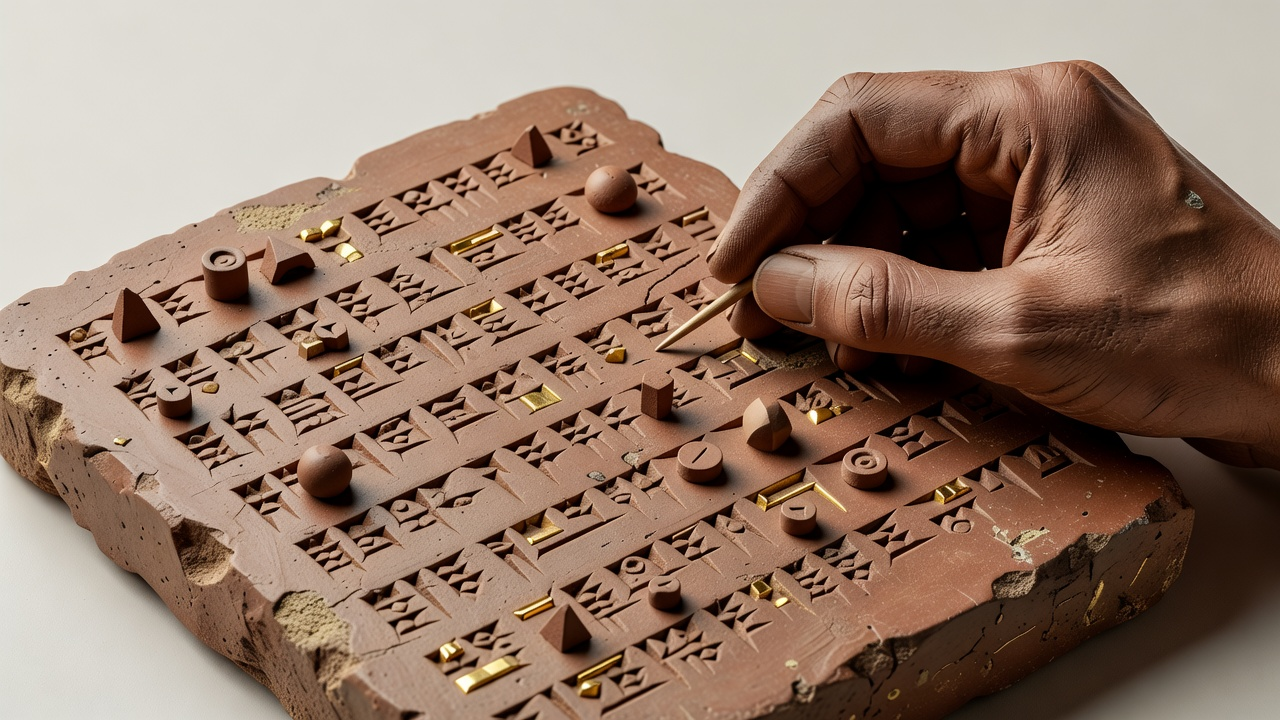
In the fertile cradle of Sumer, around 3200 BCE, cuneiform mathematics emerged not from abstraction, but necessity. Pre-cuneiform tokens—small clay balls and cones—evolved into impressed signs on tablets, recording goods flowing through Uruk's bustling temples. These weren't symbolic codes; they were brutal, practical accounts.
Take tablet MS 3956 from the Schøyen Collection, dated to ca. 3300 BCE. It lists measures in a proto-sexagesimal system: 10s and 60s for barley volumes. Scribes calculated rations like 1 gur (about 300 liters) per worker-month, scaling for teams hauling mud bricks. Another gem, from Shuruppak (ca. 2500 BCE), tallies goats and silver shekels—early ledgers balancing temple offerings against labor debts.
Ration Lists: Numbers Feeding Armies and Families
Administrative texts from Ur III period (2100–2000 BCE), like those excavated at Drehem, overflow with daily rations. A tablet might record: 5 sila (1 liter) of barley per person daily, multiplied for 1,200 corvée laborers. Translations by Marvin Powell highlight the limits—many tablets are fragmentary, signs eroded, forcing scholars to infer from context. No pi or Pythagoras; just division: total harvest divided by mouths to feed.
This practical arithmetic powered Sumer's economy, distinct from later formal math. Symbolic meanings? Mostly modern projections, as Nissen notes in Archaic Bookkeeping.
Egyptian Land Math: Surveying the Nile's Gift
Across the sands, Egyptian mathematics measured the Nile's annual flood, resetting boundaries erased by silt. Scribes used cubit rods (52 cm) and ropes knotted at 3-4-5 for right angles—practical geometry born of fields, not philosophy.
The Rhind Papyrus: Fields, Not Formulas
The Rhind Mathematical Papyrus (ca. 1650 BCE, now British Museum EA 10057/58), copied by scribe Ahmes from older sources, brims with land problems. Problem 50 approximates a circle's area as (8/9 diameter)^2—pi at 3.16—for granary silos. But most? Arable plots: divide a 2-setat field (about 2 acres) into shares post-flood.
Moscow Papyrus (ca. 1850 BCE) echoes this: volume of a truncated pyramid for grain heaps. Translations by R. J. Gillings reveal unit fractions (1/2 + 1/15 for slopes), but again, limits abound—papyri faded, contexts inferred from Middle Kingdom surveys like the Kahun papyri.
- Land surveys post-Akhet season: scribes paced perimeters, computed khu (acres) taxes.
- No sacred geometry certainties; just taxes owed to pharaohs.
Practical Arithmetic vs. Mythic Math: A Key Distinction
Both traditions wielded numbers for the mundane—Sumerian tallies invisible without clay's permanence, Egyptian surveys fleeting on waterlogged banks. Formal math? Rare; Old Babylonian texts (1800 BCE) introduce quadratics, but precursors stayed earthbound. Later eras imposed symbols, like Pythagorean mysticism, veiling this utilitarian core.
Source caveats: Cuneiform deciphered since Rawlinson (1840s), Egyptian since Champollion (1822), yet ambiguities linger—homophones, broken edges. Explore deeper in our Writing Memory Door or Ancient Civilizations Door.
Echoes Today: Numbers We Leave Behind
Ancient scribes etched permanence; we tap apps. What daily number use—your grocery app total, fitness tracker steps—would vanish archaeologically? Jot one down now, bridging history of numbers to your life. In these ledgers lies humanity's first calculus: counting to thrive.