
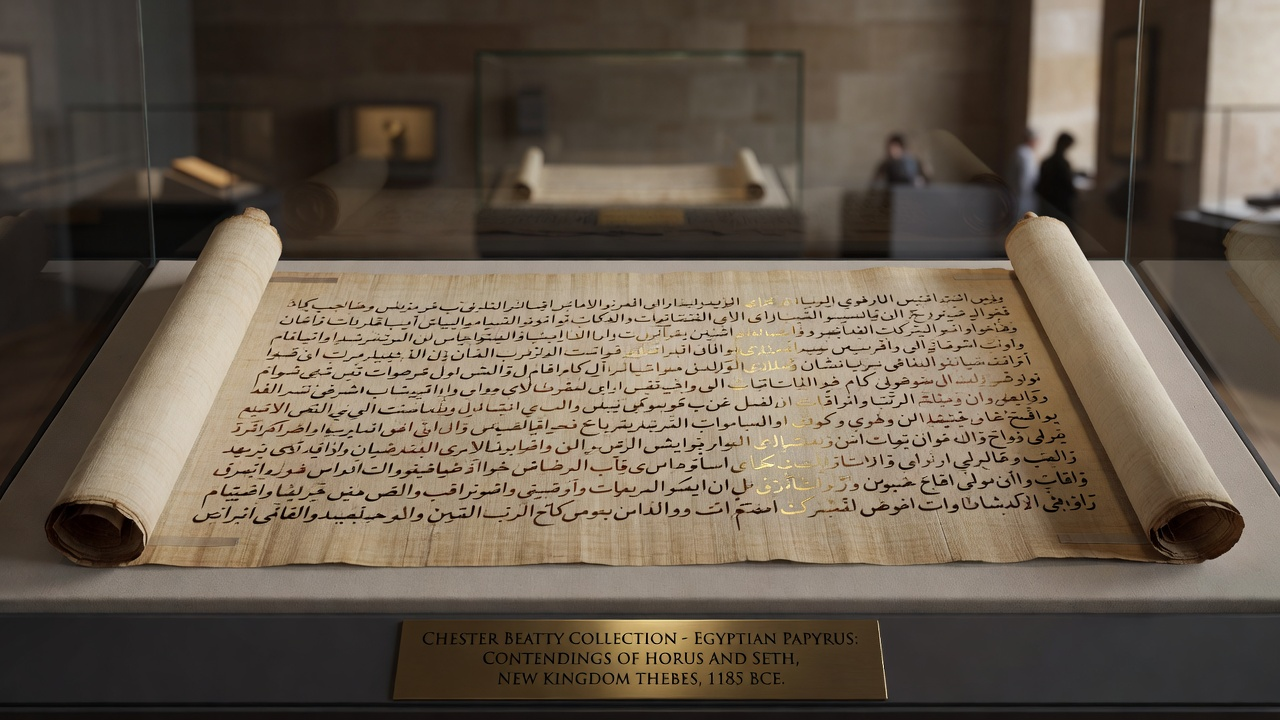
Contendings of Horus and Seth: Epic Egyptian Myth from New Kingdom Thebes Chester Beatty Papyrus
Picture a divine courtroom in chaos: falcon-headed Horus locks eyes with his murderous uncle Seth, the god of storms and disorder, as the assembled deities of ancient Egypt squabble over the throne of the slain Osiris. This isn't a somber epic of heroic triumph—it's a raucous, satirical brawl laced with trickery, bodily fluids, and bureaucratic farce. Welcome to the Contendings of Horus and Seth, one of the most vivid tales in Egyptian mythology from the Chester Beatty Papyrus, scrawled in a Theban temple scribal school around 1185 BCE during the twilight of the New Kingdom.
Preserved on the fragmented Chester Beatty Papyrus I, this mythological tale unfolds in Middle Egyptian language rendered in Late Egyptian script—a linguistic bridge reflecting Egypt's evolving scribal traditions. Discovered in the early 20th century by American collector Chester Beatty, these eleven pages from Deir el-Medina near New Kingdom Thebes offer students of Egyptian mythology a raw glimpse into elite temple life. Far from dry liturgy, the Contendings Horus Seth saga served dual purposes: rollicking entertainment for literate scribes and a sly meditation on sacred kingship.
The Chester Beatty Papyrus: A Window into New Kingdom Thebes
In the bustling worker village of Deir el-Medina, artisans who built the royal tombs doubled as scribes in temple schools. Around 1185 BCE, amid Ramesses III's reign, one such scribe copied this tale onto papyrus now housed in Dublin and London. The Chester Beatty I fragments—recto and verso—reveal a text marred by lacunae but brimming with wit. Unlike rigid hymns, this Egyptian mythology Chester Beatty gem mimics oral storytelling, complete with asides like "Now what does Seth say tomorrow morning?"
Dated to the 20th Dynasty, the papyrus ties directly to Theban theology. Horus, avenger of his father Osiris, embodies rightful rule, while Seth disrupts cosmic order (maat). Scribes transmitted such narratives in house-of-life institutions, blending education with amusement. For students, it's primary context: a Late New Kingdom artifact illuminating how myths reinforced pharaonic ideology without preaching.
Plot Unfolds: The Contendings of Horus and Seth Begin
The tale opens in the Ennead's tribunal. Ra, the sun god, presides, but favoritism toward Seth—his "son" in this variant—sparks outrage. Horus claims Osiris's throne; Seth counters he's stronger. Isis, ever protective, schemes from the sidelines, though the gods banish her meddling.
First Clashes: Battles and Betrayals
Contests escalate absurdly. They transform into hippopotami, diving into waters to seize the throne—echoing primordial chaos fights. Seth proposes iron ships for a race; Horus wins with a disguised reed boat, sinking Seth's stone fraud. Tension peaks in a notorious episode: Seth assaults Horus sexually to dominate him. Horus retaliates cleverly, smearing his own seed on lettuce Seth devours—a vegetable the storm god favors. Thoth later extracts Horus's semen from Seth's forehead as golden solar disks, proving Horus's potency.
Gods roar with laughter at these indignities. Ra weeps; Geb intervenes. The narrative's humor deflates divine pomposity, humanizing gods as feuding kin.
Judgment Day and Sacred Kingship Reflections
Divine Verdict in the Contendings Horus Seth
Shu fetches Osiris's ba-soul from the underworld for testimony: "How long shall I endure suffering?" The corpse-god's plea sways the tribunal. Thoth collects Seth's semen from Horus's thigh, manifesting as a bead necklace, affirming Seth's claim too—but Horus prevails. Ra concedes; Horus is crowned.
This resolution links to Egypt's sacred kingship doctrine. Pharaohs embodied Horus living, uniting Upper and Lower Egypt, taming Seth's chaos. The myth's entertainments—copied in scribal exercises—mirrored real succession disputes, like those post-Ramesses III. It bounded Egyptian cosmology: no foreign gods, just Nile Valley deities upholding maat.
- Legitimacy: Horus's trials validate inheritance over brute force.
- Order vs. Chaos: Seth's vitality tempers Horus's rule, as in pharaonic iconography.
- Scribal Wit: Parodic elements critiqued courtly excess.
Legacy of Egyptian Mythology Chester Beatty Tales
The Contendings Horus Seth endures as a outlier in Egyptian mythology—irreverent amid pious texts. Its Chester Beatty preservation underscores temple schools' role in myth transmission. For students tracing sacred kingship, it connects to temple reliefs where pharaohs spear Seth-Hippopotamus, affirming Horus's victory eternally.
Yet beneath the farce lies profundity: kingship demands endurance, wit, and divine sanction. In New Kingdom Thebes' fading glory, this tale reminded scribes—and rulers—that even gods must contend for harmony. Dive into the papyrus yourself; its lacunae invite endless scholarly battles, much like Horus and Seth's own.