Hesiod's Theogony: Boeotia's Archaic Greek Poet Unveils the Catalog of First Gods (700 BCE)
The Muse's Whisper on Helicon's Slopes
Picture a shepherd tending flocks on the rugged slopes of Mount Helicon in Boeotia, Greece, around 700 BCE. Suddenly, nine ethereal figures—the Muses—descend, their voices weaving a spell of divine genealogy. This is no mere fancy; it's the origin moment of Hesiod's Theogony, the cornerstone of Boeotia Greek mythology. As an archaic Greek poet, Hesiod didn't just recite tales; he systematized the cosmos's birth, delivering the first gods catalog in dactylic hexameter, bridging oral performance to enduring written verse.
Why does this matter for students dissecting Greek mythology sources? Hesiod's work stands apart from Homer's epics, offering a structured blueprint of divine origins rather than heroic exploits. It's poetry as cosmology, performed at festivals before scribes captured it for posterity.
Hesiod: The Voice of Boeotia
Hailing from Ascra, a humble village in Boeotia, Hesiod embodied the rustic wisdom of Archaic Greece. Unlike the wandering bards of Ionia, he rooted his authority in personal divine encounter. The Muses, daughters of Zeus and Mnemosyne, gifted him the honey-sweet voice to sing truths beyond mortal ken—a poetic claim that elevated the Hesiod Theogony above mere entertainment.
From Oral Tradition to Written Epic
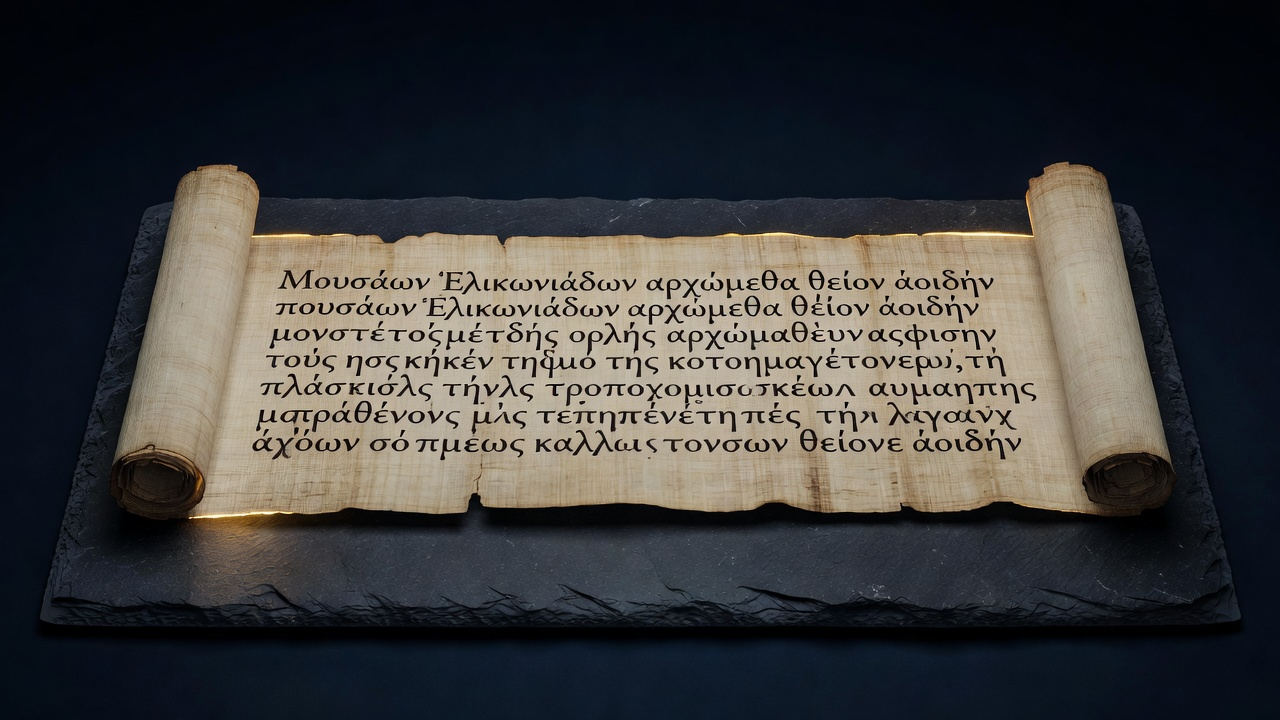
Composed in Archaic Greek hexameter, the same meter as the Iliad, Hesiod's 1,022-line poem transitioned from live recitations at Boeotian gatherings to a fixed text. This shift marked a pivotal genre evolution: the rhapsode's fluid performance hardened into a canonical source for Boeotia Greek mythology.
Unraveling the First Gods Catalog
At its heart, the Hesiod Theogony is a meticulous genealogy, tracing the universe from primordial void to Olympian triumph. Hesiod opens with Chaos—not a chaotic mess, but a yawning gap—followed by Gaia (Earth), Tartarus, and Eros. These abstract entities spawn a cascade: Night and Day from Chaos, Ouranos (Sky) from Gaia, and so on, culminating in Zeus's reign.
Key Figures in the Primordial Lineage
- Chaos: The first-born void, mother of Erebus (Darkness) and Nyx (Night).
- Gaia: Broad-breasted Earth, birthing mountains, sea, and heavens.
- Ouranos and Pontus: Sky and Sea, igniting the Titan generation.
This first gods catalog isn't chronological history but mythic precedence: first in story, establishing hierarchy and conflict. Hesiod catalogs over 300 deities, weaving alliances, castrations, and battles into a narrative tapestry.
Poetic Vision vs. Religious Reality
Crucial for source distinction: Hesiod's archaic Greek poet lens prioritizes poetic completeness over cult practice. No archaeological evidence shows worship of these abstract first gods like Chaos or Nyx. Greeks revered Olympians—Zeus at Olympia, Athena in Athens—with temples and sacrifices. Primordials remained literary constructs, invoked in the Hesiod Theogony to explain origins, not demand rituals.
This gap underscores mythology's layers: Hesiod provides the blueprint, but lived religion favored anthropomorphic gods. Students must distinguish the catalog's encyclopedic role from historical piety—first in verse, not altars.
Hesiod sings not to worship the void, but to map it.
Legacy: Opening the First Gods Door
Hesiod's Theogony endures as the definitive first gods catalog, influencing philosophers like Plato and poets across millennia. In Boeotia Greek mythology, it contrasts Homer's focus, offering systematic depth. For modern students, mastering this source distinction unlocks deeper comprehension: poetry shapes myth, but practice selects its stars.
Step through the First Gods Door with Hesiod—where Chaos yawns eternal, Gaia stirs, and the divine family tree branches wildly. Not history's dawn, but imagination's forge.