
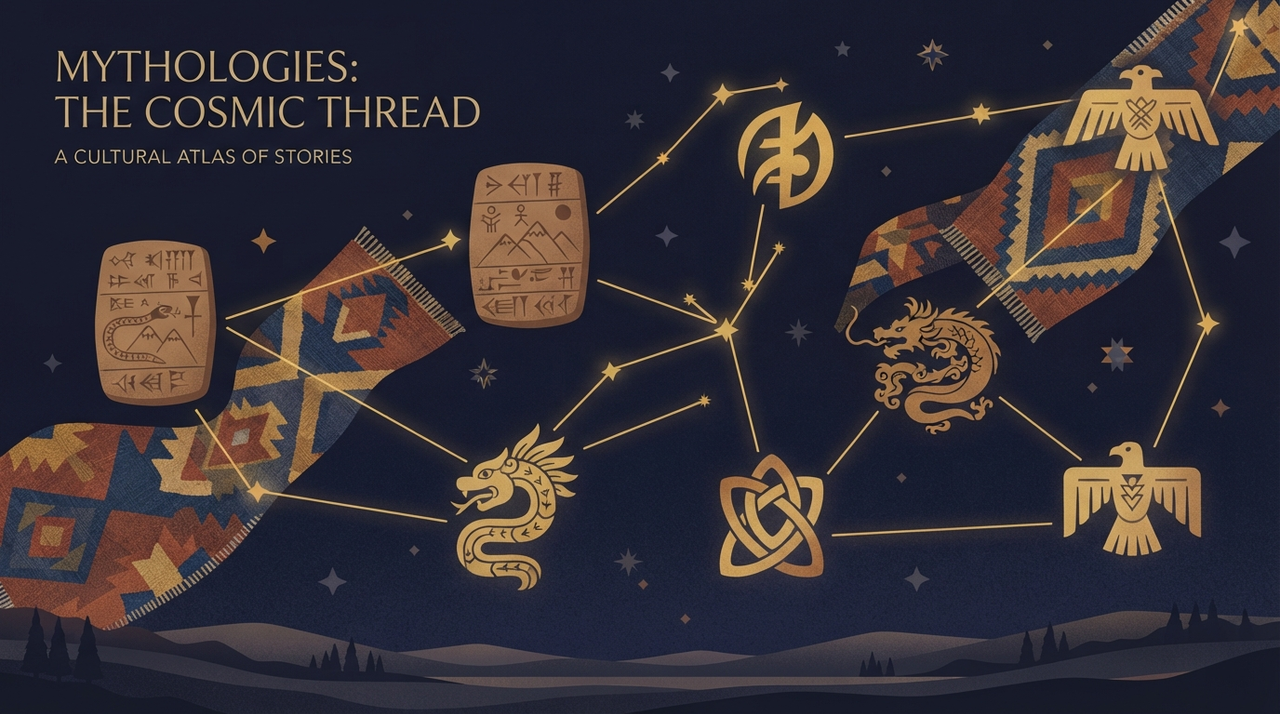
Mythology Door: Unlocking Cultural Meaning in Creation Stories, Gilgamesh, and Beyond
Picture yourself in the grand halls of the Aetheria Library, where ancient shelves groan under the weight of forgotten scrolls and whispered tales. Dust motes dance in shafts of light, and before you stands the Mythology Door—a threshold etched with symbols from every corner of the human story. Push it open, and you're not just entering a room of relics; you're stepping into a constellation of narratives that map the soul of cultures. Here, creation stories bloom like cosmic seeds, the Epic of Gilgamesh echoes through millennia, and comparative mythology reveals how humanity has always sought meaning through myth.
This door doesn't lead to fairy tales for children. It swings wide to a realm where stories constellate like stars, guiding seekers through the chaos of existence. In the Aetheria Library's mythology door, we gather these narratives not as curiosities, but as living keys to cultural meaning.
What the Mythology Door Holds: Layers of Culturally Situated Meaning
Myths aren't 'false stories' peddled to the gullible. They are profound acts of meaning-making, rooted deeply in their cultural soil. At the heart of comparative mythology lie cosmologies that explain the universe's birth—creation stories from the Babylonian Enuma Elish, where gods clash in primordial waters, to the Norse tales of Ymir's dismembered body forming the world.
Beyond origins, myths unfold heroes like Gilgamesh, who wrestles mortality; tricksters who upend order; descents into underworlds; and cycles of renewal that mirror seasons and societies. Their functions? Explanatory, weaving 'why' into the fabric of reality. Normative, modeling virtues and vices. Imaginative, sparking wonder. And communal, forging identity—'this is who we are, together.'
Through the mythology door, these aren't abstract; they're portals to how peoples have navigated fear, love, and the unknown.
A Brief Lineage: From Oral Tradition to Written Wonders
The Journey from Voice to Codex
Myths begin in oral tradition—elders by the fire, passing tales that shift with each telling, adapting to new audiences. Then came writing: in Mesopotamia around 2100 BCE, the Epic of Gilgamesh was inscribed on clay tablets, preserving floods and quests that predate the Bible.
Egypt's Pyramid Texts (c. 2400 BCE) etched spells for the afterlife. Greek compendiums like Hesiod's Theogony gathered cosmogonies. Mesoamerican codices, such as the Maya Popol Vuh, blended pictographs with narrative. Today, Indigenous traditions in Australia or the Amazon keep myths alive orally, resisting colonial erasure.
Fact: these texts exist, dated by archaeology. Interpretation: how we read them varies, layered by translation, collector biases—like 19th-century anthropologists favoring 'exotic' elements—and transmission changes. Myth and history intertwine, but the stories endure.
How Seekers Approach the Mythology Door
Enter humbly. Read with literary and cultural context: who told this? To whom? Avoid exoticizing distant myths as 'primitive' or flattening them into a single archetype system like Jung's—honor differences. Note the audience: a Sumerian farmer hearing Gilgamesh versus a modern reader spotting existential dread.
Comparative mythology thrives on respectful side-by-side study, preserving unique cultural meaning.
Common Misconceptions About Myths
- Myth = lie: No—it's symbolic truth, not literal history.
- All myths tell the same story: Similarities exist (flood motifs in Gilgamesh and Genesis), but differences reveal cultural specifics.
- Myths are relics of the past: Many pulse in rituals today.
- Comparison disrespects traditions: Thoughtful juxtaposition illuminates, doesn't diminish.
Connections: Myths Linking Worlds
Myths bridge disciplines. In religion, rituals embody them—like Easter's renewal echoing Persephone. Spirituality draws sustenance from mythic practice. Ethics gleans choice-models from heroes' dilemmas. History and anthropology trace context and transmission. Psychology notes motifs (the hero's journey) without reducing cultures to universals.
Through the mythology door, these threads weave a richer tapestry.
Concrete Ways to Begin Your Journey
- Compare flood narratives: Gilgamesh's Utnapishtim (cuneiform tablets, trans. Andrew George) versus Genesis—note shared ark, divergent morals.
- Trace a creation motif: Maori's separation of sky-father and earth-mother, versus Hindu's cosmic egg—preserve divergences.
- Journal: What question does this myth answer for its people? Fear of chaos? Hope in renewal?
Start small; let cultural meaning unfold.
An Invitation Through the Mythology Door
As the Aetheria Library's mythology door creaks shut behind you, carry this: myths invite curiosity, not conquest. Join the community of seekers—share your discoveries, trace your own narrative constellations. What story calls to you next? Step through, and find out.