
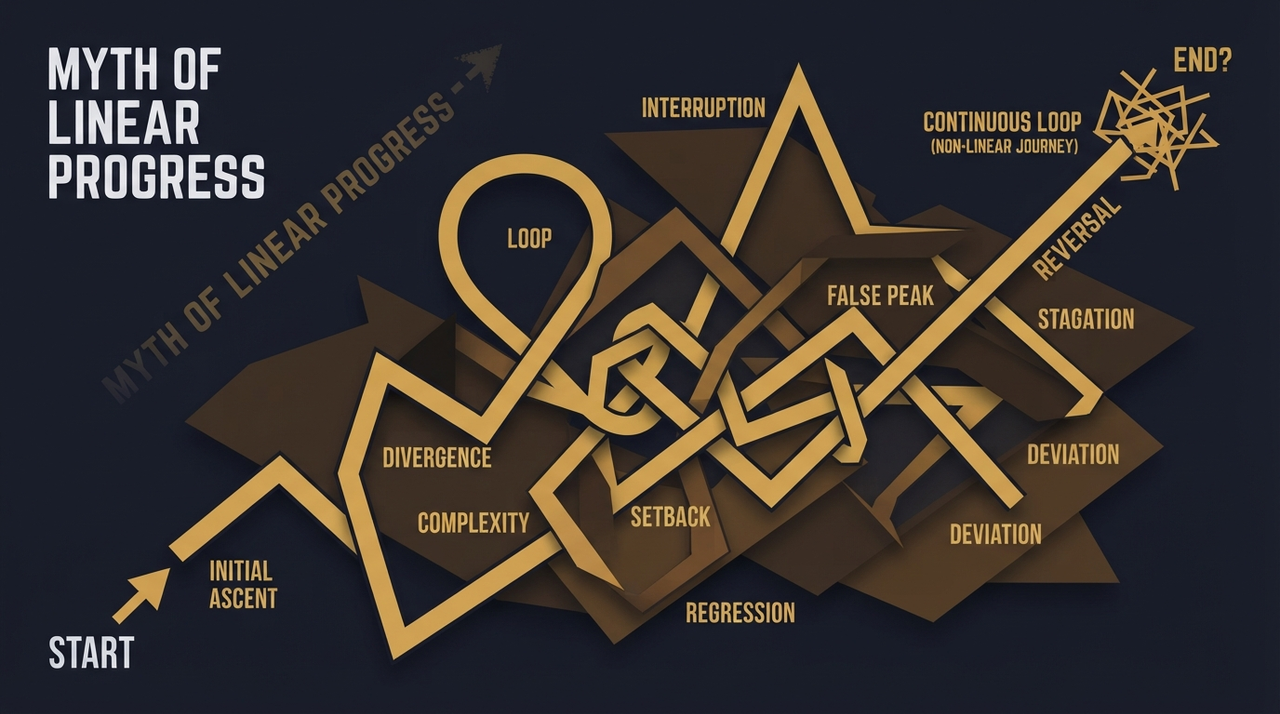
Aetheria: Busting the Education Progress Myth – No Straight Line from Ancient Edubba to Modern Schools
The Seductive Story of Educational Evolution
Picture a dusty clay tablet in ancient Sumer, a young scribe etching cuneiform under a reed-roofed edubba. Fast-forward millennia: fluorescent lights buzz over rows of desks in a compulsory high school. Historians often sketch a tidy arrow between them—a straight line of progress from primitive scribal schools to enlightened modern education. But what if that line is more myth than map? In the historiography of education, this history of education progress myth persists, tempting us with teleology: each era building inevitably toward today’s classrooms.
As educators and history seekers, we crave patterns. Yet Aetheria’s education critique urges caution. Ancient vs modern schooling reveals not unbroken ascent, but jagged peaks, forgotten valleys, and diverse paths. Presentism—the sin of judging the past by today’s yardstick—clouds our view, while sparse evidence leaves gaping holes. Let’s dismantle the narrative, uncovering discontinuities, regional riches, and reversals that defy linearity.
Sumer’s Edubba: Elite Cradle, Not Mass Enlightenment
Around 3500 BCE, Sumerian edubbas hummed in city-states like Nippur. These “house of tablets” trained a tiny elite—future administrators, priests, accountants—in copying hymns, math, and laws. Enrollment? Perhaps one in a hundred boys from scribal families. No universal curriculum, no playgrounds, no standardized tests. Harsh discipline ruled: tardiness meant beatings, failure exile from literate ranks.
Contrast this with the ancient vs modern schooling trope. Modern public schools promise equity, compulsory attendance, broad subjects. Edubba wasn’t a precursor; it was a vocational filter for bureaucracy in a temple economy. Archaeological finds—thousands of practice tablets—show rote memorization, not Socratic spark. The progress myth ignores this: no straight path from cuneiform to Common Core.
Medieval Missteps? Apprenticeships as Alternative Wisdom
Beyond the “Dark Ages” Delusion
The Middle Ages get branded a educational black hole—cathedral schools fading, universities embryonic. But was it regression? Guild apprenticeships enveloped millions: a blacksmith’s son hammered iron from dawn, absorbing geometry through forge sparks, ethics via master oaths. In Islamic madrasas, from Cordoba to Samarkand, scholars debated Aristotle amid algebra. China’s imperial exams sifted mandarins via poetry and classics, sustaining a meritocracy for centuries.
- Discontinuity: Roman literacy peaked, then plunged with empire’s fall—not failure, adaptation to feudal life.
- Regional diversity: Africa’s griot oral traditions preserved history sans scrolls; India’s gurukuls fused guru mentorship with Vedic lore.
- Reversals: Renaissance humanism revived texts, but mass literacy lagged until industrial print and state compulsion.
Historiography education warns against Whig history—viewing the past as marching to our perfection. Medieval paths weren’t dead ends; they were vibrant alternatives, lost in our compulsion for classrooms.
Colonial Shadows and the Birth of “Modern” Schooling
The 19th-century Prussian model—graded, compulsory, factory-timed—spread not organically, but via empires. British raj imposed English-medium schools in India, eroding pathshalas. French Algeria mandated laïcité over Quranic kuttabs. This wasn’t culmination; it was imposition, often disrupting indigenous pedagogies attuned to community needs.
Evidence limits abound: colonial records bias toward the conqueror’s gaze, burying pre-contact systems.
Risks of presentism loom: we hail standardization as salvation, scorning oral or apprenticeship modes as primitive. Yet alternatives thrived—think Montessori echoes in indigenous play-based learning.
Aetheria’s Invitation: Question Through History Door
Aetheria AI shatters the history of education progress myth with tools like History Door, a portal to unfiltered timelines. Dive into edubba tablets or medieval guild charters; simulate regional divergences. No teleological tunnel vision—embrace inquiry: What pedagogies suited eras we dismiss? How might forgotten paths inform today?
This Aetheria education critique doesn’t deny gains—literacy soars, access expands. But progress zigzags, enriched by multiplicity. Educators, history seekers: reject the straight line. Explore the mosaic. Your next lesson might rewrite the map.