
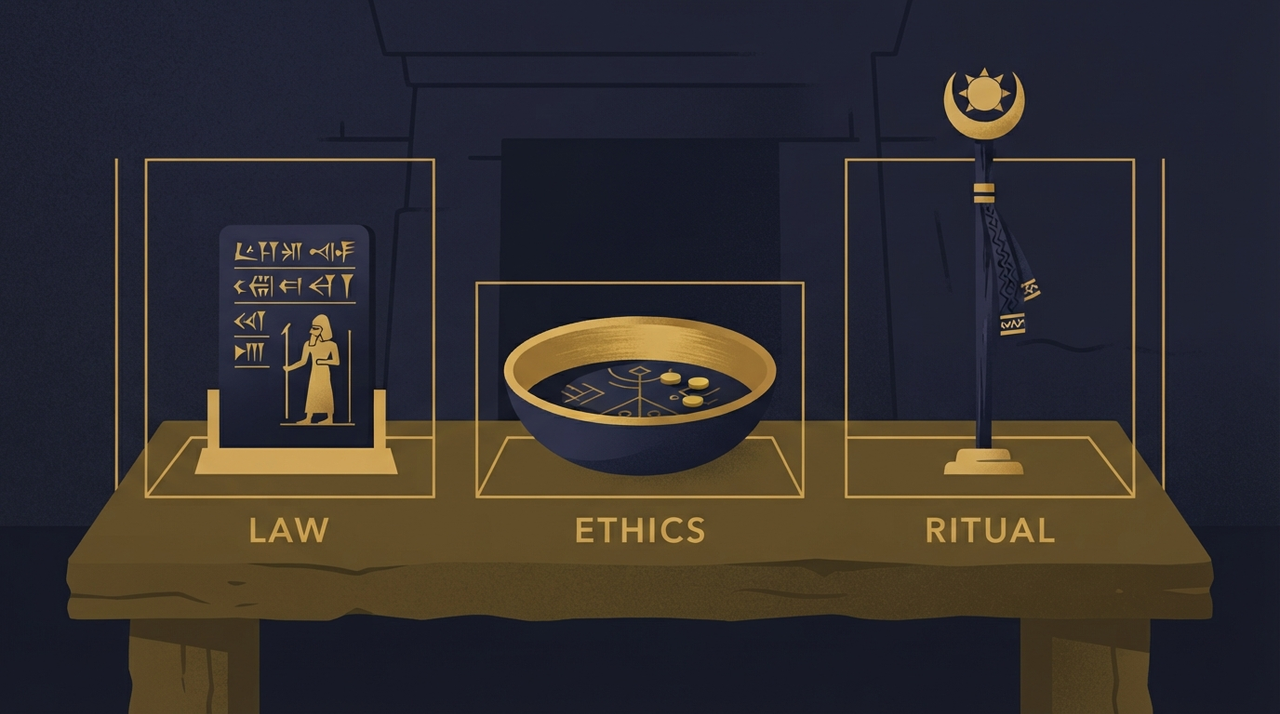
Aetheria Ethics: Decoding Ancient Law, Rituals, and Moral Order in Mesopotamia and Egypt
Unearthing the Stele: A King's Bid for Justice in Ancient Sumer
Picture a sun-baked plain in southern Mesopotamia, around 2350 BCE. A ruler named Uruinimgina stands before a towering inscribed stele, chisel in hand, proclaiming reforms to curb the excesses of officials. Widows spared from exploitation, orphans protected from seizure—these words etched in cuneiform weren't abstract ideals but targeted fixes for a society fraying at the edges. This is where ancient ethics meets raw power, not in timeless codes, but in the grit of palace politics and temple ledgers. Welcome to Aetheria Ethics, our journey through the moral tapestries of Mesopotamia and Egypt, distinguishing law from ritual, custom from decree.
These civilizations didn't flatten their worldviews into universal moral handbooks. Instead, ethics emerged layered: judicial rulings in one breath, divine offerings in the next. Uruinimgina's cone inscriptions from Lagash—a Sumerian city-state—offer primary evidence of this nuance, preserved on clay cones and fragments. Yet scholars like Thorkild Jacobsen note their limits: propagandistic boasts from the royal court, aimed at the temple community and elite, not everyday folk.
Mesopotamian Law: Dīn, Diptu, and the Weight of Judgment
From Sumerian Reforms to Akkadian Tablets
Mesopotamian law pulsed through terms like dīn—divine judgment rendered by kings or gods—and diptu, the inscribed tablets tallying dues and disputes. Uruinimgina's reforms targeted corrupt ensis (governors), freeing boats from arbitrary seizure and standardizing boat tolls. Genre: reform inscription. Period: Early Dynastic III. Institution: palace intertwined with the temple of Ningirsu. Community: urban elites and dependents in Lagash.
Fast-forward to the Akkadian era and beyond, where laws codified social hierarchies without moral absolutism. These weren't philosopher-kings dreaming of virtue ethics; they were pragmatic stewards of political order, balancing flood-prone rivers, trade caravans, and warring city-states. Primary sources—stelae like the later Code of Ur-Nammu—survive in palace archives, but their interpretation hinges on context: enforced by royal scribes, not debated in assemblies.
Ritual Obligations: Parṣu and the Kārum's Burden
Enter ritual obligation, the heartbeat of piety. Parṣu denoted cultic decisions, binding priests to offerings, while kārum assemblies oversaw merchant rituals. Schedules of lamb sacrifices to Enlil or barley for Inanna filled temple calendars, less about personal ethics than communal harmony with the divine. Evidence from Ebla tablets shows these as living authorities—temples as economic engines—yet fragmented by time, surviving only where dry soil preserved clay.
Egyptian Decrees: Ḥe, Kheper, and Ma'at's Eternal Balance
Pharaonic Commands in Stone and Papyrus
Across the Nile, Egyptian decree embodied ḥe—the pharaoh's commanding word—and kheper, the manifestation of cosmic order. Horemheb's Memphite stela from the late 14th century BCE blasted corrupt officials, much like Uruinimgina, but framed through Ma'at: truth, justice, balance. Genre: royal decree. Period: New Kingdom. Institution: royal court. Community: priests and bureaucrats in temple cities like Thebes.
These inscriptions on temple walls enforced political order via divine kingship, with viziers interpreting pharaonic will. Ritual offerings—daily bread and incense to Amun—structured time itself, distinct from judicial ḥe. Papyrus records from Deir el-Medina reveal workers' customs, blending ethics with survival, but sources skew elite: stelae for eternity, papyri for administration.
Threads of Distinction: Ethics Beyond the Universal
Contrast this with later Priestly Torah traditions, where torat (instruction) fused law and ritual under Yahweh's authority—echoing yet diverging from Mesopotamian dīn or Egyptian ḥe. No single moral code unites them; customs varied by river valley. Religious authority lived in temples and palaces, not scrolls alone. Aetheria Ethics invites seekers to parse these: law as corrective (Uruinimgina), ritual as obligatory (offering schedules), ethics as emergent custom.
- Primary Evidence Limits: Stelae weather; tablets shatter—survivors from royal hoards.
- Historical Context: Court-driven, not grassroots philosophy.
- Scholarly Lens: Translations evolve, revealing nuances lost to script.
In philosophy's long arc, these systems prefigure modern debates: deontology in ritual duty, virtue in kingly reform, without the Enlightenment's abstractions.
Echoes Across Millennia: Lessons for Today
Mesopotamia's floods and Egypt's inundations shaped resilient orders, reminding us that ancient ethics thrived amid chaos. Aetheria Ethics uncovers not blueprints, but mirrors—inviting reflection on our own laws, rituals, and fragile balances. What stele would you inscribe today?