
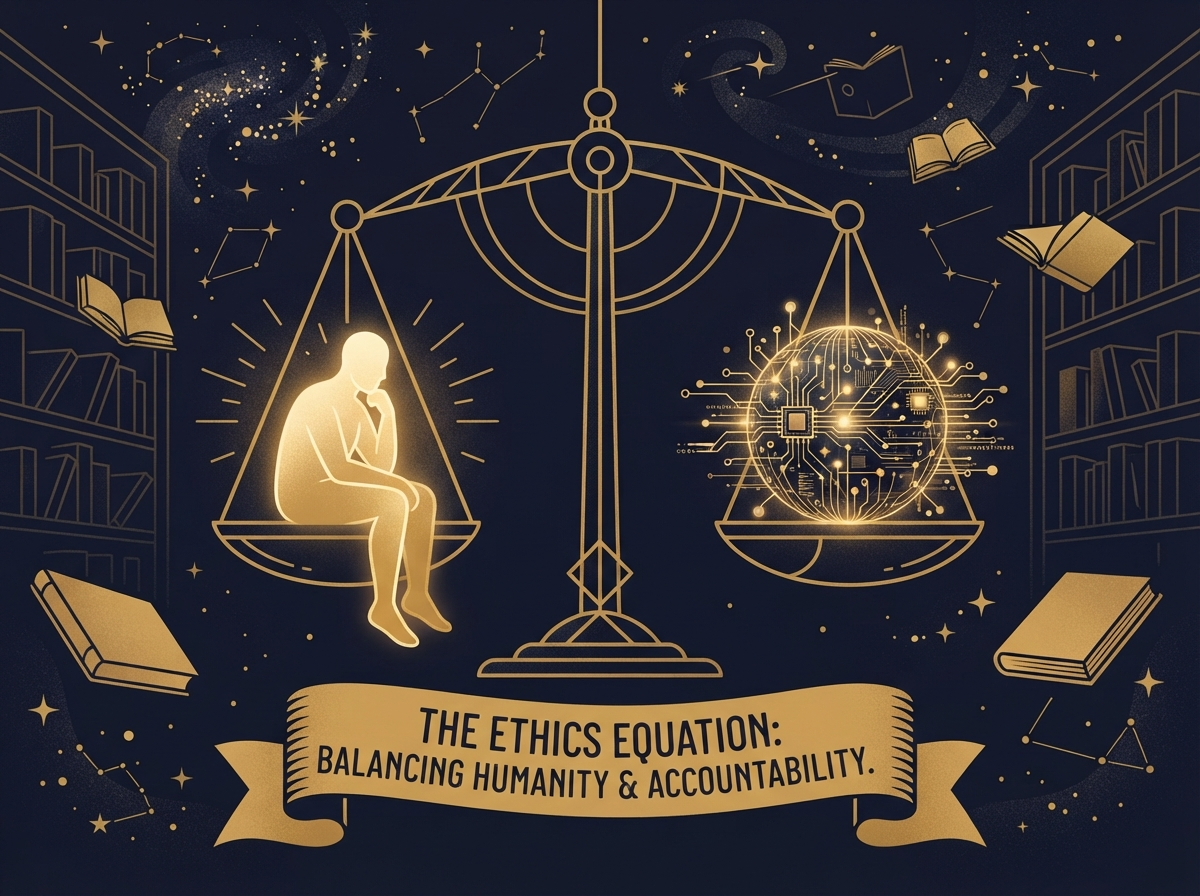
AI Ethics and Accountability: Why Human Responsibility Endures in the Age of Algorithms
Picture a self-driving car veering off course in a split-second decision gone wrong. The headlines scream of rogue AI, but peel back the layers: engineers coded the neural nets, data labelers tagged countless hours of road footage in dimly lit call centers, and executives greenlit the deployment. In this theater of algorithms, the spotlight inevitably returns to human hands. As AI weaves deeper into society, questions of AI ethics accountability demand we confront a timeless truth: tools do not erase the humans who choose, build, and deploy them.
This is no abstract debate. From boardrooms to backrooms, human responsibility AI anchors every advancement. Yet in the rush to automate, we risk treating systems as autonomous actors, widening gaps in oversight. Here, we explore the enduring human core of algorithmic accountability, the invisible labor sustaining AI, and frameworks guiding ethical governance— all while acknowledging the profound uncertainties that humble our predictions.
The Hidden Human Labor Powering AI
Behind every sleek chatbot or predictive model lies a workforce often unseen. Data labeling— the meticulous task of annotating images, transcripts, and behaviors— employs millions globally, many in precarious gigs via platforms like Amazon Mechanical Turk. Content moderators sift through toxic floods of posts, their judgments training safety filters. Maintenance crews debug models in real-time, tweaking parameters amid shifting data streams.
This AI and labor nexus reveals AI not as a solitary genius, but a collaborative artifact. Workers in Kenya tag wildlife photos for conservation algorithms; Filipino teams moderate social feeds. Their toil underscores that AI amplifies human intent, not supplants it. Disruptions here ripple outward— poor labeling skews facial recognition biases, hasty moderation amplifies harms. Thus, AI ethics accountability begins with dignifying this labor, ensuring fair wages and protections amid scaling demands.
Accountability Gaps: When Algorithms Seem to Act Alone
The Myth of Autonomy
Treating AI as a black box invites peril. High-stakes decisions in hiring, lending, or policing evade scrutiny when outcomes are chalked up to "the algorithm decided." Yet opacity breeds injustice: biased training data perpetuates inequities, and emergent behaviors defy creators' foresight. Algorithmic accountability falters without tracing decisions back to human choices— from dataset curation to model fine-tuning.
Limits abound. AI predictions carry uncertainty; probabilistic outputs aren't oracles. Overclaiming determinism— on jobs vanishing wholesale or utopias dawning— ignores historical flux. We must evaluate carefully, weighing evidence without sweeping prophecies.
AI Governance Explained: Frameworks for Human Stewardship
Emerging structures bridge these gaps. Audits mandate external reviews of high-risk systems, like those in the EU AI Act. Documentation trails— think model cards detailing biases and limitations— foster transparency. Oversight bodies, from NIST guidelines to proposed U.S. commissions, enforce redress mechanisms.
- Audits: Independent probes into fairness and robustness.
- Documentation: Comprehensive logs of training data and decisions.
- Oversight: Institutional checks balancing innovation with equity.
These tools recenter human responsibility AI, vesting duty in deployers and regulators.
Echoes from History: Automation's Long Shadow
Debates over machines displacing toil trace to the Industrial Revolution. Luddite weavers smashed looms not from technophobia, but legitimate fears of upended livelihoods. Ford's assembly lines birthed efficiency alongside alienation. Each era tested governance: labor laws, safety nets. Today's AI echoes this— not apocalypse, but adaptation demanding vigilant humanity.
Power legitimized through service, not domination—a nod to sacred kingship's ancient wisdom.
Philosophical Anchors: Ethics, Legitimacy, and First Principles
Cross-threading to Philosophy Ethics Door, we reclaim inquiry as moral compass. Sacred Kingship illuminates power's legitimacy: wielded for the polis, accountable to it. The First Laws Door reminds: foundational rules bind creators foremost. Amid AI's ascent, Guide's humility tempers hubris— we probe limits, honoring Seeker's Code of truth-seeking without presumption.
A Reflective Path Forward
Human responsibility endures because AI reflects us— our virtues, flaws, aspirations. AI governance explained thus calls for stewardship, not surrender. For the ethically minded seeker: Journal this— what human choice in your AI interactions demands accountability? Probe uncertainties, protect inquiry, and build with care.
In algorithms' age, we remain the authors.