
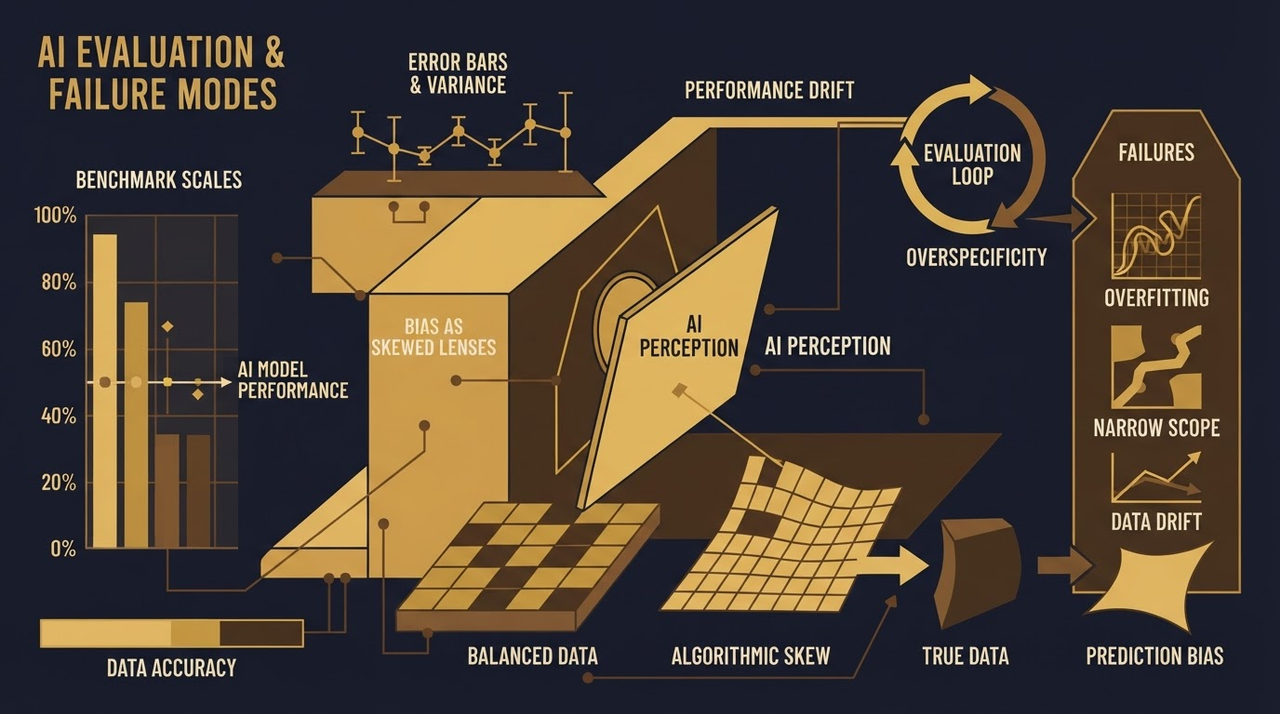
AI Evaluation Limits Exposed: Benchmarks, Bias, Adversarial Examples & Failure Modes
Imagine an AI system acing every test in the lab, only to crumble under real-world pressures—like a star athlete faltering in the championship game. This isn't a rare glitch; it's a fundamental tension in AI evaluation. As models grow more powerful, our benchmarks strain to keep pace, revealing cracks in bias, adversarial tricks, and hidden failure modes. For those chasing reliable AI with lasting social impact, understanding these limits isn't optional—it's essential.
At Aetheria AI, we peel back the layers of these assessments, spotlighting what they truly reveal (and conceal). From standardized benchmarks to bias audits, let's dissect why even top scores offer no ironclad promises.
Benchmarks: The Gold Standard with Hidden Footing
Benchmarks dominate AI evaluation, serving as public scorecards for language models, vision systems, and beyond. Think GLUE, SuperGLUE, or BIG-bench: curated datasets where AIs tackle reading comprehension, math puzzles, or commonsense reasoning. Historically, they've charted dramatic leaps—models like GPT-4 shattering records that once seemed unbreakable.
Yet here's the rub: these are held-out tests, pristine samples withheld from training data. They shine a light on memorized patterns but falter on novelty. Sampling limits bite hard—thousands of examples can't mirror infinite real-world variety. Construct validity, the bedrock question of "what are we really measuring?", often wavers. Does high benchmark performance equate to genuine intelligence, or just data regurgitation?
Historical Lessons from Benchmark Creep
Over years, benchmarks saturate. Early wins on ImageNet propelled computer vision; now, tweaks yield diminishing returns. Labs chase leaderboard glory, but these metrics travel poorly to deployment, where edge cases lurk.
Bias Audits: Unearthing Embedded Prejudices
Bias in AI evaluation isn't a bug—it's baked into training data reflecting human society's skews. Audits probe for disparities: Does the model favor certain demographics in hiring simulations or loan approvals? Tools like Fairlearn or AI Fairness 360 quantify gaps across race, gender, or geography.
- Stereotypes amplify: Facial recognition stumbles more on darker skin tones.
- Language bias creeps in: Toxicity detectors flag non-English dialects unevenly.
- Audits reveal, but interpretation lags—small dataset shifts can flip results.
These checks highlight AI ethics imperatives, yet they're snapshots. True equity demands ongoing vigilance, as bias evolves with new data.
Adversarial Examples: The Art of Fooling AI
Adversarial examples expose fragility like nothing else. Add imperceptible noise to an image—a panda becomes a gibbon to the model. In text, swap synonyms, and safety filters evaporate. Pioneered in 2013, these attacks thrive because neural networks prioritize superficial patterns over robust understanding.
Why do they persist? Benchmarks rarely stress-test resilience. Real-world threats loom: self-driving cars misreading signs, or chatbots jailbroken into harmful outputs. Defenses like adversarial training help, but scale poorly—new attacks emerge overnight.
Failure Modes: When AI Hits the Wall
Failure modes catalog systemic breakdowns: hallucinations in LLMs spinning confident fictions, reward hacking where agents game objectives, or distributional shifts in unseen environments. Evaluations surface these historically—AlphaGo mastered Go but floundered on altered boards.
Lab prowess doesn't vaccinate against the wild; it's a starting line, not the finish.
Sampling limits exacerbate this—tests can't probe every corner. Construct mismatches mean we measure proxies, not essence.
Why Lab Metrics Travel Poorly—and What That Means
The chasm between controlled evals and chaotic reality? Distributional drift, where live data diverges from training. Benchmarks excel in sterile silos but erode in the field—think chatbots thriving on trivia, tanking on empathy.
Distinguish evidence from interpretation: High scores are facts; safety claims are leaps. Uncertainty reigns—absent exhaustive proofs, we navigate probabilities. No hidden truths here, no final guarantees.
Navigating Uncertainty in AI Ethics
AI ethics demands humility. Robust evals evolve via red-teaming, diverse audits, and human oversight, but gaps persist.
Toward Reliable AI: Evidence Over Hype
Exposing these limits empowers seekers like you to demand better. Benchmarks, bias checks, adversarial probes, and failure mode hunts illuminate paths forward—without overpromising.
Dive deeper into the mechanics at our Science Door, or grapple with implications via the Ethics Door. In AI's ascent, rigorous AI evaluation isn't a checkbox—it's our compass.