
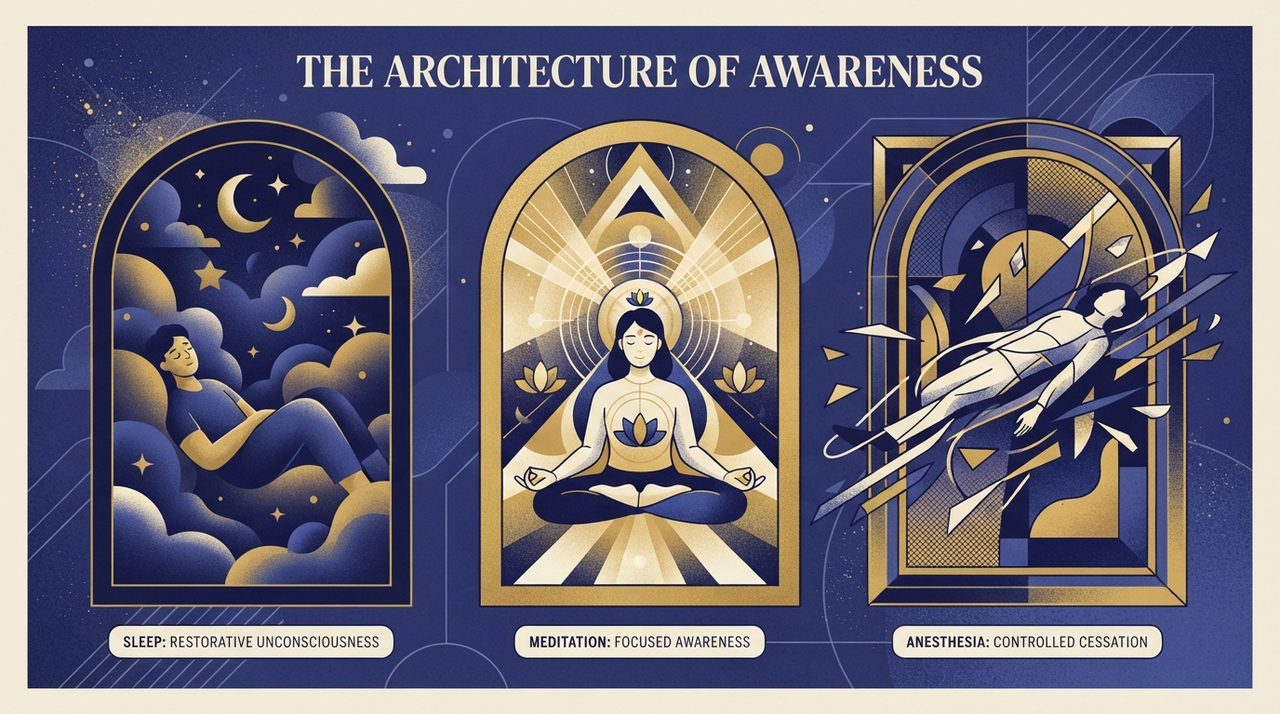
Altered States of Consciousness: Sleep Stages, Dreams, Meditation, and Anesthesia Explained
Have you ever wondered what happens when your mind slips from the sharp focus of daily life into the hazy realms of sleep, or the profound stillness of meditation? These altered states of consciousness challenge our everyday sense of self, blurring the lines between waking reality and something deeper. For students diving into psychology's frontiers, understanding sleep, dreaming, meditation, and even anesthesia reveals how the brain crafts our inner worlds. This exploration separates hard physiological data—like brain waves and heart rates—from the vivid, subjective reports that color human experience.
The Rhythms of Sleep: Stages and Physiology
Sleep isn't a uniform blackout; it's a symphony of stages, each with distinct brain activity measured by EEG. Non-REM sleep unfolds in three phases: light stage 1, where theta waves emerge as muscles relax; deeper stage 2 with sleep spindles guarding against wakefulness; and slow-wave stage 3, dominated by delta waves, vital for restoration. Then comes REM, the paradoxical phase where eyes dart rapidly, heart rate spikes, and vivid dreaming often ignites.
Physiologically, these shifts conserve energy, consolidate memories, and regulate emotions. Yet first-person reports vary wildly—some recall nothing, others fragments of bizarre narratives. Cycle through four to six times nightly, and you've traversed multiple altered states, each serving the brain's quiet labors.
Dreaming: Physiology Meets Imagination
The Science of REM and Beyond
Dreaming peaks in REM, when the brainstem paralyzes muscles to prevent acting out scenarios, while the cortex buzzes with activity akin to wakefulness. Neuroimaging shows deactivated prefrontal areas—explaining dream logic's leaps—and heightened amygdala firing, fueling emotional intensity. Non-REM dreams, more mundane, arise in slow-wave sleep.
Subjective accounts paint dreams as portals: flying through neon cities or reliving lost moments. Lucid dreaming adds control, with practitioners reporting awareness amid the chaos. But science cautions—these are brain simulations, not prophecies, bridging measurable neural fireworks to personal myth-making.
Meditation: Waves of Awareness
Research on Brain Changes
In meditation, practitioners shift from beta waves of active thought to alpha and theta rhythms, slowing respiration and enhancing focus. Studies using fMRI note reduced default mode network activity—linked to mind-wandering—and thickened prefrontal cortices in long-term meditators. Yet evidence for sweeping benefits like anxiety reduction remains mixed; short-term effects shine brighter than long-term claims.
First-person reports evoke boundless peace or unity, but physiology grounds this in parasympathetic activation. Approaches vary—mindfulness scans the breath, loving-kindness cultivates compassion—each nudging consciousness into quieter altered states.
Anesthesia: Engineered Absence
Anesthesia plunges the mind into reversible oblivion, distinct from sleep. Propofol and similar agents hyper-sync brain waves into delta bursts, disrupting thalamocortical loops essential for awareness. Patients report blank voids upon emergence—no dreams, no time—contrasting sleep's rich undercurrents.
This engineered altered state underscores consciousness's fragility: tweak neurotransmitters, and the self dissolves. Surgeons rely on monitors tracking these shifts, ensuring safe return from the void.
Cross-Cultural Contexts: Traditions and Caution
Yogic traditions frame meditation as paths to samadhi—absorptive states mirroring deep sleep's physiology but reported as ecstatic union. Contemplative practices across Buddhism and Sufism describe similar dissolutions of ego. These first-person maps enrich psychology, yet respect community authorities: interpretations demand cultural embedding, not casual appropriation. Science measures overlaps, like shared gamma waves, without endorsing metaphysics.
Connections to Perception and Spirituality
These altered states echo in The Eye Door's perceptual shifts and Spirituality Door's transcendent quests. Sleep and dreaming prime us for questioning reality; anesthesia humbles our sovereignty. At Aetheria AI, we probe these frontiers neutrally, inviting empirical curiosity.
Today, journal one transition in awareness—waking from a nap, emerging from breath focus. What flickers in the shift? Your log becomes the next data point in understanding the universe's most elusive puzzle: consciousness itself.