
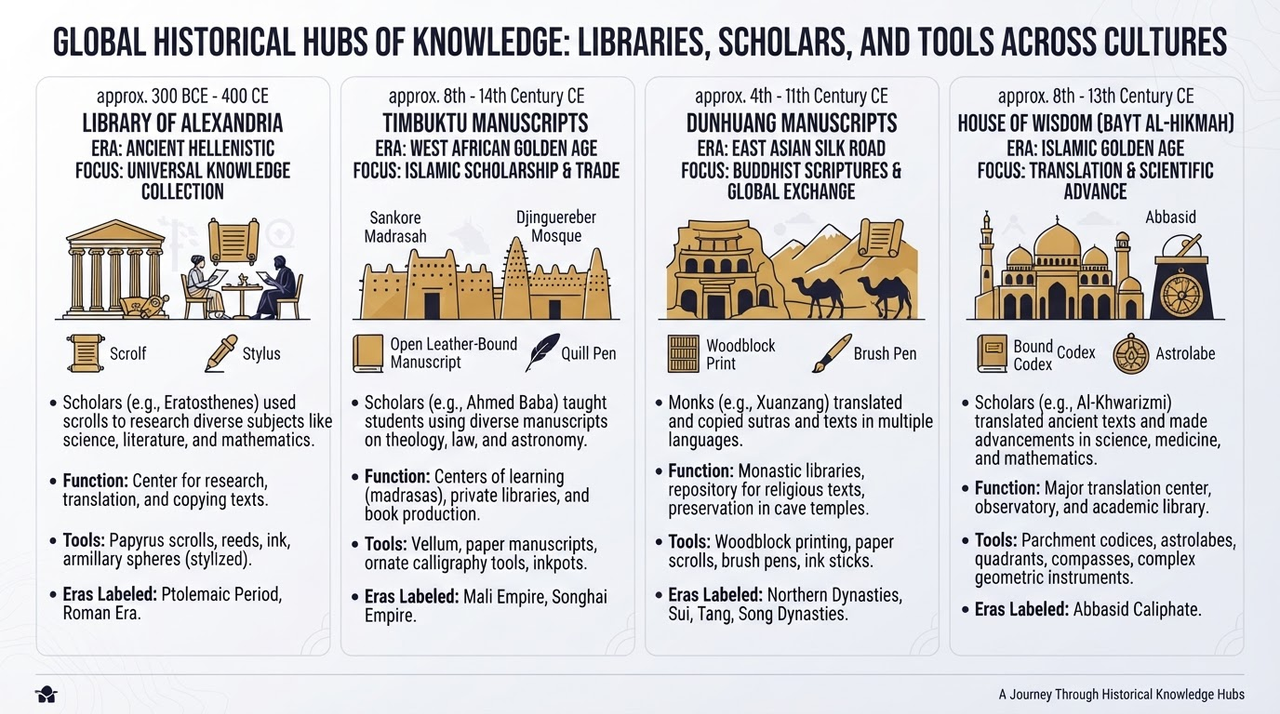
Ancient Libraries Unveiled: Teachers, Tools & Cross-Door Secrets of Eternal Learning Infrastructure
Picture this: a dimly lit chamber in Nineveh, circa 650 BCE, where King Ashurbanipal's scribes etch cuneiform prayers onto clay tablets, stacking them like forgotten dreams in colossal clay archives. These were no mere bookhouses—they pulsed as the beating hearts of ancient libraries, gateways to eternal knowledge. For seekers like you, tracing threads across education and material culture, these repositories reveal profound cross-Door connections: portals linking past wisdom to our digital age. In Aetheria AI's lens, they unveil the blueprint of learning infrastructure, where teachers, tools, and hidden transmissions forge humanity's intellectual spine.
But who built these bastions? Who tended their flames? Who wielded the keys—and who lingered outside? As we journey through history, we'll connect education's ancient roots to technology, linguistics, and the alchemy of writing as memory. Source fragments tease tantalizing glimpses, their limits a reminder of lost voices echoing across millennia.
Pillars of the Past: Iconic Ancient Libraries
Ashurbanipal's Library in Nineveh stands as Assyria's crowning glory. The king himself commissioned it, amassing over 30,000 tablets through conquest and copying campaigns. Scribes—elite history of teachers trained in temple schools—maintained it, cataloging omens, epics like Gilgamesh, and medical texts. Royal priests controlled access, excluding slaves and women from its shadowed halls, preserving power in cuneiform's wedge-shaped grip.
Across the Mediterranean, the Library of Alexandria's fragments whisper of Ptolemaic ambition. Ptolemy I Soter founded it around 300 BCE, scholars like Callimachus curated scrolls, but fires and sieges scattered its millions. Control rested with Greco-Egyptian elites; common folk and non-citizens peered from afar.
Hidden Gems: Ben Ezra Geniza and Beyond
In Cairo's Ben Ezra Synagogue, the Geniza—a medieval repository of discarded sacred texts—hid 300,000 Hebrew, Arabic, and Aramaic fragments. Jewish scholars built and guarded it, merchants and rabbis maintained it, while non-Jews were largely excluded. The House of Wisdom in Baghdad, under Abbasid Caliphs like Harun al-Rashid (8th century), drew Persian, Greek, and Indian minds; viziers controlled its translations, sidelining the illiterate masses.
Nalanda's ruins in India evoke monastic might. Founded by Gupta kings in the 5th century CE, Buddhist monks sustained its vast collections until 12th-century raiders torched it. Access favored ordained scholars; laypeople and rival sects watched from the periphery.
The Architects of Wisdom: Teachers in History
Beyond stone and scroll, human conduits shaped this learning infrastructure. Craft masters in Mesopotamian workshops apprenticed boys with hands-on drills, passing metallurgy and weaving via oral demos and clay models—exclusively for sons of freemen. Ritual specialists, like Egyptian priests, guarded hieroglyphic secrets in temple scriptoria, training acolytes in star-lore and spells, barring women and foreigners.
University founders bridged eras: Nalanda's monastic heads formalized curricula in logic and medicine; Baghdad's al-Khwarizmi mentored in algebra amid House of Wisdom debates. These teachers built invisible networks, their lineages threading cross-Door connections from Sumer to Silicon Valley.
Instruments of Insight: Educational Tools
From Styli to Paper Mills
- Styli: Wedge-tipped reeds impressed wet clay in Nineveh, tools of scribes who pressed eternity into mud.
- Inkwells and Papyrus: Alexandria's reed pens dipped into soot-black inks, gliding over Nile-sourced sheets—portable power for peripatetic scholars.
- Paper Mills: Islamic innovators in Samarkand (8th century) pulped rags into folios, scaling the House of Wisdom's output and fueling Eurasian knowledge trade.
These educational tools weren't neutral; elites controlled their craft, from royal reed farms to guild monopolies, weaving technology into learning's fabric.
Cross-Door Connections: Education's Eternal Web
Here, Aetheria AI illuminates the matrix. Ancient libraries bridged linguistics—cuneiform evolving to alphabets—and writing as external memory, offloading minds onto media. Nalanda's logic texts seeded algorithms; Baghdad's star-charts prefigured data viz. These cross-Door connections link education to technology: paper mills birthed scalable info systems, much like today's neural nets. Yet sources falter—burned scrolls, buried tablets—visible gaps urging us to reconstruct.
Echoes for Today: Journal Your Thread
In the quiet after the archive's dust settles, what learning infrastructure do you build? Grab a notebook—echoing those ancient inkwells—and trace your own cross-Door links.
From Ashurbanipal's clay to Aetheria's code, the quest endures. Who will you exclude? Who invite? The infrastructure awaits your mark.