
Archaeological Convergence: Why Pyramids Worldwide Prove Independent Invention, Not Ancient Contact
Imagine standing at the base of the Great Pyramid of Giza, its limestone flanks rising like a colossal stairway to the gods, then flashing to the misty jungles of Mexico, where Teotihuacan's Pyramid of the Sun looms in stepped majesty. The resemblance strikes like lightning—pyramids dotting the globe, from Nubian sands to Indonesian hills. Do these towering echoes whisper of ancient mariners crossing oceans, weaving a lost web of global contact? Or is this archaeological convergence, a testament to human ingenuity reinventing the wheel under universal pressures?
For comparative thinkers drawn to the allure of vanished super-civilizations, the siren song of diffusion—ideas hopping continents via forgotten fleets—feels intoxicating. Yet comparative archaeology reveals a humbler truth: independent invention. Pyramids worldwide emerge not from contact, but from shared physics, materials, and aspirations. Let's dissect this convergence, pyramid by pyramid, to see why similarity breeds illusion, not evidence.
The Physics of Piling Stone: Why Pyramids Converge Naturally
Build tall with stone, and gravity dictates terms. A narrow base crumbles; a wide one sways. The pyramid form—broad bottom tapering skyward—offers stability, distributing weight like a child's block tower gone monumental. No blueprints needed; Neolithic builders worldwide hit this solution independently.
Materials seal the deal. In Egypt's quarries, limestone blocks stacked into smooth-sided behemoths. Mesoamerica's Maya chiseled volcanic tuff and limestone into steep steps. Sudan's Meroitic pyramids used red brick for steeper angles. Each region's stone whispered the same form: stack, step, stabilize. Purpose amplified parallels—tombs in Egypt and Sudan, temples atop in Mexico. Skyward reach for gods or eternity, universally human.
This isn't coincidence; it's engineering convergence. Like fish evolving fins separately, pyramids swam into existence under identical constraints.
Egypt vs. Mesoamerica: Counterexamples to the Contact Myth
Worlds Apart in Time, Technique, and Tenets
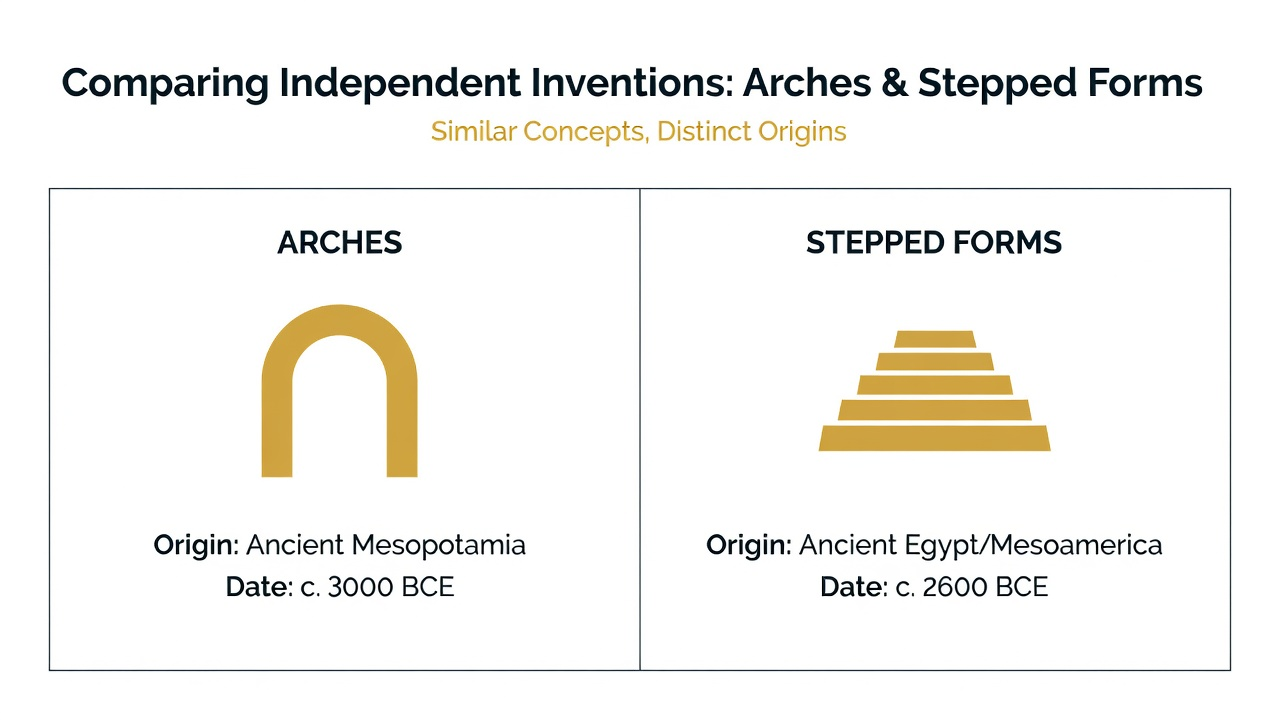
Egypt's pyramids peaked around 2600 BCE with Khufu's marvel—true pyramids, polished casing stones gleaming like man-made mountains, pure tombs for pharaohs' afterlife voyage. No stairs, no summits for priests; just a sealed ascent to stars.
Contrast Teotihuacan (200 BCE–550 CE) or Chichen Itza's El Castillo (800–1200 CE): stepped platforms, flat tops for rituals, blood sacrifices echoing down feathered-serpent balustrades. Construction diverged wildly—Egyptians hauled million-ton blocks via ramps and levers; Mesoamericans used adobe cores sheathed in cut stone, corbelled vaults absent in Nile works.
- Timeline gap: Egypt predates Mesoamerica by millennia, with no overlap.
- Purpose rift: Tombs versus living temples.
- Tech mismatch: No Egyptian corbel arches in Mexico; no Mayan glyphs on Nile sands.
Nubian pyramids (800 BCE–350 CE) hugged Egyptian styles but shrank smaller, steeper—local tweaks, not transoceanic transplants. Even China's ancient tumuli or Peru's huacas? Mounded earth, not stone ziggurats. Similarity fades under scrutiny.
Diffusion vs. Independent Development: The Evidence Bar
In diffusion vs independent development debates, contact demands proof beyond shapes. Shared artifacts—tools, pottery, scripts—must align stratigraphically, dated precisely via carbon or dendrochronology. Egyptian scarabs in Mayan digs? Absent. Olmec jade in Sahara strata? Vanished.
Absence of evidence isn't evidence of absence, true—but extraordinary claims of ancient contact crave extraordinary convergence: metallurgical matches, linguistic loans, genetic traces. Pyramids offer silhouettes, not substance. Comparative archaeology thrives on dissecting these voids.
Dive deeper into patterns with our Ancient Civilizations Door or explore rhythmic echoes in the Patterns Door.
A Careful Comparison Exercise: Test Your Own Convergence Lens
Pause here. Sketch Giza and Tenochtitlan side-by-side. Note angles (51° vs. 45°+ steps), ramps (internal/external), summits (pointed/flat). Hunt shared motifs—solar boats? Feathered gods? Scarce. Now ask: What minimal evidence would flip independent invention to diffusion? A Nile jade mask? Transatlantic wheat pollen?
Pyramids dazzle as archaeological convergence, humanity's chorus of stone under gravity's baton. Not lost contacts, but parallel geniuses. In this mirror, we see ourselves—builders unbound by oceans, only ideas.