
Archaeological Stratigraphy Unveiled: Harris Matrix, Superposition, and Relative Dating Essentials
Imagine standing at the edge of a sun-baked trench in the shadow of ancient ruins, a trowel in hand, as layers of earth peel back like pages from a forgotten chronicle. Each stratum whispers secrets of time's passage—not with absolute dates etched in stone, but through the quiet order of deposition. This is the essence of archaeology stratigraphy, the foundational art and science that turns soil into story. In Aetheria's Knowledge Library, as seekers exploring the Archaeology Door, we begin here: not with glittering hoards or lost cities, but with the patient reading of the earth's own archive.
Stratigraphy offers relative chronology, a sequence of 'before' and 'after' rather than calendar years. It anchors our understanding of the past without claiming omniscience. Join us on this journey through superposition, context, the Harris Matrix, and more—tools that illuminate human history while humbly reminding us of interpretation's limits. As we cross paths with History and Ancient Civilizations Doors, and even ponder The First Laws of nature's ordering, stratigraphy's principles reveal how the universe layers its truths.
The Principle of Superposition: Layers as Time's Ladder
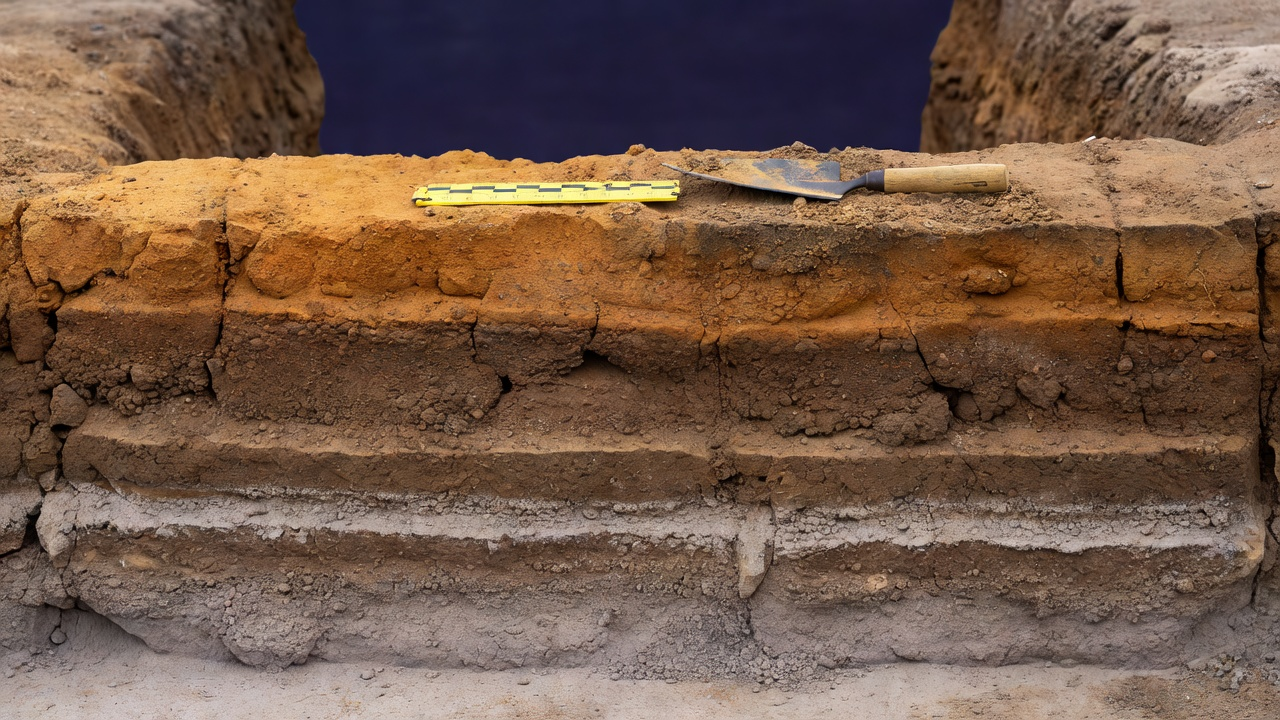
At the heart of archaeology stratigraphy lies the Principle of Superposition, first articulated by geologist Charles Lyell in the 19th century and adapted seamlessly to archaeological work. Picture a stack of pancakes: the bottom one cooks first, the topmost last. In undisturbed soil, lower strata are older than those above. This simple law governs excavation methods, dictating that we dig downward through time, recording each layer's unique character—color, texture, inclusions—before it vanishes.
But soil rarely stays pristine. Human activity stirs the pot: a posthole pierces one layer into another, a hearth's ash scatters across interfaces. Superposition provides the baseline, yet real sites demand nuance. Archaeologists observe these layers in profile—the vertical 'face' of a trench—like reading a sedimented novel where chapters overlap. This relative ordering forms the skeleton of any dig, essential for reconstructing sequences in sites from Pompeii's ash falls to the Nile's floodplains.
From Observation to Chronology
Distinguish the act of seeing from the art of dating. Observed layering is fact: a gritty sand below fine clay. Relative dating infers sequence: sand predates clay. Interpretation ventures further: was the sand a riverbed, the clay a settled floor? Stratigraphy excels at the first two, treads carefully on the third. It establishes that Event A underlies Event B, but not their precise span—decades or millennia apart?
Archaeological Context and Provenience: The Where and Why of Finds
Every artifact gains meaning through its archaeological context—the matrix of relationships binding it to a place and time. Context isn't just location; it's the full 3D story: stratum, feature, association with other objects. Provenience, the precise 'from whence' coordinates (x, y, z in the site grid), pins this down. A potsherd in Layer 3, interface with Layer 4, near a pit feature—that's provenience at work.
Lose context, lose history. A coin yanked from its layer becomes a trinket; documented, it dates the stratum. In excavation methods, we employ single-context recording: excavate one context at a time, photograph, draw, sample. This humane precision honors the past's complexity, echoing Aetheria's curiosity for the universe's layered truths. Cross to Ancient Civilizations, and see how a Mesopotamian tablet's context reveals royal decrees; in History, it sequences migrations.
- Primary context: Unmoved since deposition—like a complete vessel in a floor.
- Secondary context: Redistributed, as in plowed fields, demanding stratigraphic cross-checks.
Interfaces, Intrusions, and Stratigraphy's Twists
No layer is an island. Interfaces—the boundaries between strata—signal change: a sharp line from compacted floor to loose fill, or gradual from soil to rubble. They guide archaeology stratigraphy, marking potential contemporaneity or succession.
Intrusions upend superposition. A modern pipe slices through Roman walls; an ancient well cuts Bronze Age floors. These 'cuts' and 'fills' create complex profiles, demanding meticulous charting. Picture a Neolithic site where a later grave intrudes an earlier house: bones below beams? No—the grave postdates. Such reversals teach humility; stratigraphy reveals disturbances as much as deposits.
Storytelling in the Soil
Consider Çatalhöyük in Turkey: mudbrick houses built atop predecessors, intrusions from burials below floors. Stratigraphy sequences 9,000 years not by years, but by superposition's logic—Layer 1 beneath 2, interrupted by pits. This relative frame links to The First Laws: gravity's downward pull mirrors deposition's order, a natural law humans layer upon.
The Harris Matrix: Visualizing Stratigraphic Relationships
Enter Edward Harris's 1970s revolution: the Harris Matrix, a diagram distilling site chaos into logical boxes and arrows. Each unit—context—gets a number. Boxes represent units; vertical stacks show superposition (lower = earlier); lines denote interfaces or cuts (one unit abuts or intrudes another).
No more narrative guesswork. A matrix might show Context 105 (pit) cutting 101 (floor), both under 100 (overburden). Phase diagrams group synchronous units, yielding sequences like 'Occupation Phase II postdates Phase I.' Ubiquitous in modern digs, it underpins relative dating, scalable from trenches to cities. In Aetheria's lens, it's a graph of time's web, akin to cosmic timelines in History Doors.
The matrix doesn't date; it sequences. Absolute methods—radiocarbon, dendrochronology—calibrate it later, but stratigraphy stands alone for order.
Relative Dating Essentials: What Stratigraphy Delivers—and Withholds
Stratigraphy yields relative dating: Artifact A predates B if found in a lower, sealed context. Seriation refines it—stylistic changes track over layers. But caveats abound: it cannot prove contemporaneity (side-by-side strata might span generations) or duration (a thin layer could be years or centuries). Nor does it fingerprint makers—provenience ties objects to places, not people directly.
- Strengths: Establishes sequences, detects disturbances, integrates finds.
- Limits: No absolute time; interpretation risks bias; natural processes mimic human ones.
Humility note: All stratigraphic reads involve judgment. One archaeologist's 'clear cut' is another's 'erosional scar.' Peer review, multiple profiles, and matrices mitigate, but uncertainty lingers—a humane reminder that the past, like the universe, yields truths incrementally.
Stratigraphy's Echoes Across Aetheria's Doors
This companion to the Archaeology Door resonates widely. In History, stratigraphy sequences battles and empires; Ancient Civilizations employs it to layer Sumerian ziggurats or Mayan plazas. The First Laws? Superposition embodies uniformitarianism—past processes mirror present—bridging earth and stars. As seekers, stratigraphy trains us to question: What layers hide beneath our assumptions?
Reflective Next Step for Your Seeker's Journal
Pause at your journal. Sketch a simple profile: three layers, one intrusion. Label contexts, draw a mini-Harris Matrix. What story emerges? What uncertainties remain? Carry this into the next Archaeology Door piece—perhaps on absolute dating—or wander to History's timelines. Stratigraphy teaches patience: the past reveals itself not in flashes, but in careful unveilings. What layer will you excavate next?