
Archaeology Door: Material Evidence, Stratigraphy & Stewardship Ethics – Aetheria Journal's Foundation Stone
Imagine standing in the vast cosmic library of Aetheria, where shelves stretch into infinity, holding not just words but the silent echoes of time itself. Here, amid the stars' faint glow, material traces emerge as quiet witnesses—shards of pottery etched with forgotten hands, stone tools worn smooth by generations, layers of earth whispering of ancient lives. These are the artifacts of the Archaeology Door, inviting students of existence to listen closely. In this Foundation Stone of the Aetheria Journal, we orient ourselves to a realm where physical remnants ground our curiosity, revealing the delicate dance between what survives and what we dare to understand.
This Door does not promise glittering treasures or definitive answers. Instead, it opens to a disciplined inquiry into the material past, urging us to protect the journey with humility and care. As seekers drawn to ancient texts and hidden histories, we step through, ready to explore material evidence vs interpretation, stratigraphy and context, stewardship ethics, and the limits of reconstruction.
What the Archaeology Door Actually Holds
At its core, the Archaeology Door safeguards the study of material evidence—the tangible remnants left by human activity. These are not mere objects but clues embedded in their context, the irreplaceable web of associations that breathe meaning into them. A single coin, for instance, gains its story not from its shine alone but from the soil layer where it lay, the structures nearby, and the debris mingled with it.
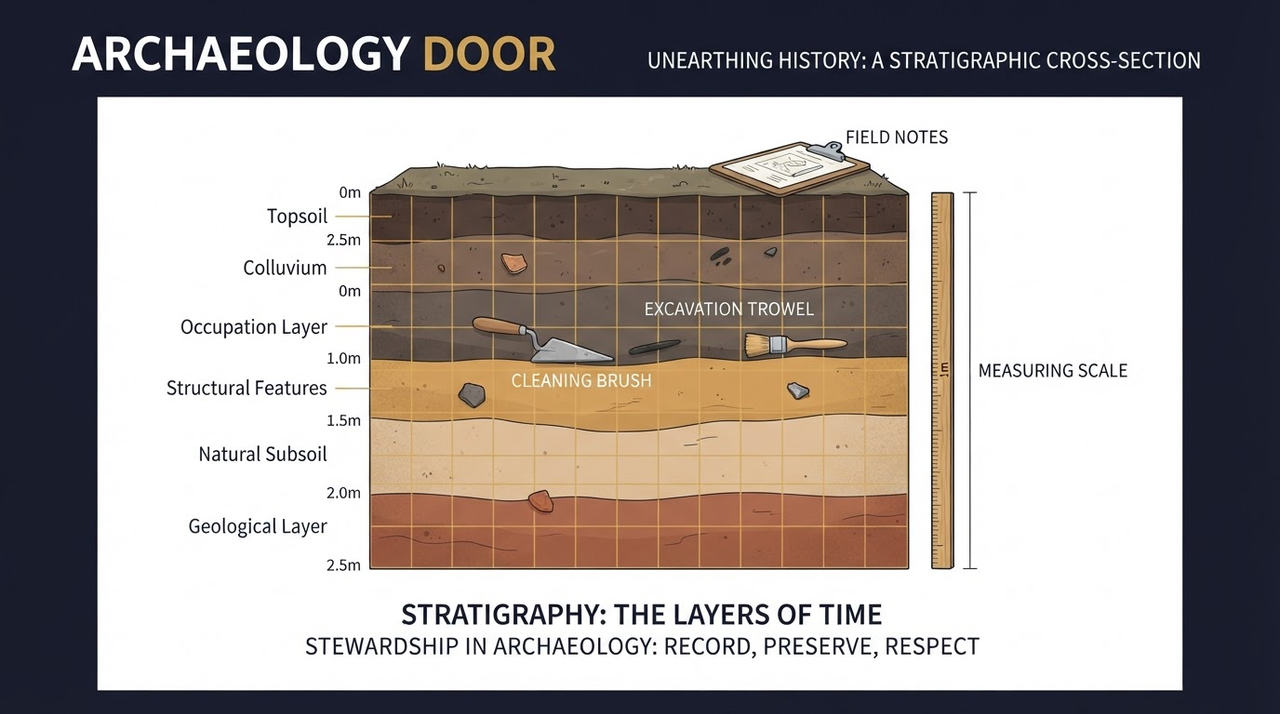
Stratigraphy and context form the bedrock here. Stratigraphy reads the earth's vertical story, like pages in a book stacked by time: lower layers older, upper ones newer, disturbed only by later intrusions. Context encompasses horizontal relationships—how artifacts cluster, what they touch, their position relative to features like hearths or walls. Without this, an object is adrift, its interpretation unmoored. Archaeology in Aetheria rejects treasure hunting's plunder; it honors stewardship ethics, ensuring sites remain for future study and communities reclaim their heritage.
Context is meaning. Uproot an artifact, and you sever its narrative thread. This Door teaches us to approach with reverence, recognizing that stewardship extends beyond excavation to conservation, documentation, and ethical sharing.
A Brief Lineage: From Fact to Interpretation
Archaeology's path winds from antiquarian collecting—enthusiasts amassing curios without record—to the stratigraphic revolution of the 19th century. Pioneers like Pitt Rivers emphasized systematic excavation, sketching plans, noting depths, preserving sequences. Today, it encompasses recording via photography and 3D scanning, conservation to halt decay, and community archaeology, where local knowledge guides the work.
Yet material evidence vs interpretation remains a tension. Facts are the preserved fragments: a pot's sherds, a tool's wear patterns. Interpretation builds hypotheses—trade routes from ceramics, diets from bones—but limits arise from preservation biases (organic materials rot), recovery methods (sieves miss tiny seeds), and dating techniques (radiocarbon's ranges, not pinpoint dates). The past filters through these sieves; what reaches us shapes our view, but never wholly.
In Aetheria, we honor this lineage without inventing discoveries or anointing phantom experts. No extraordinary claims without extraordinary evidence. Instead, we trace how careful recovery sets the bounds of what we can know.
How Seekers Can Approach Archaeology in Aetheria
Students of existence, enter with open hands. Read objects through their findspot and association: Where was it buried? With what? Hold reconstruction lightly, knowing stratigraphy and context offer probabilities, not certainties. Respect stewardship ethics by questioning provenance—did this artifact come from ethical digs, or colonial extraction that ignored Indigenous knowledge?
Avoid extracting objects from their stories; a museum piece without site data is a ghost. Reference the Aetheria Guide with a humility note: our understandings evolve as methods improve. Repatriation movements remind us that material past belongs to descendant communities first.
- Examine photos or reports: Note layer, grid coordinates, associated finds.
- Layer interpretations skeptically: What does the evidence support? What gaps remain?
- Champion ethical practice: Support community-led projects, advocate for site protection.
Common Misconceptions in Archaeological Inquiry
Archaeology Proves Single Texts Literally?
No. Material evidence checks narratives but rarely confirms word-for-word. A site's dates might align with a chronicle, yet details diverge—texts embellish, archaeology grounds.
Absence of Finds Means Events Didn't Happen?
Far from it. Preservation is fickle; acid soils dissolve bones, floods bury or erase. Absence evidences nothing definitive.
Romanticized Narratives Erase Labor?
Adventure tales gloss the tedium: screening dirt ton by ton, cataloging shards, weathering rain. Local and Indigenous knowledge often anchors true insights, overshadowed by outsider heroes.
Full Reconstruction of the Past?
Limits of reconstruction loom large. We glimpse fractions—1% of a site excavated, biases in what endures. Archaeology illuminates patterns, not panoramas.
Adventure Over Responsibility?
It's a profound duty, entwined with ethics amid repatriation calls and climate threats to sites.
Connections Across Batch 3 Humanity and the Wider Door Map
The Archaeology Door interlaces with History's written records, offering material checks against biases. In Ancient Civilizations, it reveals societies beyond texts—daily crafts, inequalities in graves. Anthropology bridges to living communities, honoring descendant ties and oral traditions.
Ethics Door echoes stewardship concerns, from colonial loot to fair sharing. Environment Door forewarns of rising seas swallowing coasts, urging protection. Together, they map humanity's material thread in the cosmic library.
Concrete Ways to Begin Your Inquiry
- Describe One Object: Pick a published find. Ask: Findspot? Layer? Associations? Sketch its context.
- Compare Stratigraphy: Study a diagram against a timeline. Where do layers align or gap?
- Journal Preservation: What survives (stone, metal)? What perishes (wood, cloth)? Ponder biases.
- Community Question: Post in Aetheria: "How do stewardship ethics shape interpretation?" Learn from diverse voices.
These practices ground you, turning curiosity into disciplined wonder.
A Reflective Invitation Back to the Aetheria Community
Protect the journey, for in the fragile layers of earth, we touch our shared becoming.
Dear seeker, as you close this Foundation Stone, carry the Archaeology Door's lessons into the cosmic library. Embrace open inquiry, honor the Seeker's Code with its call to truth and care. Bring gentle stewardship to the material past—question boldly, reconstruct lightly, collaborate widely. Return to Aetheria often; together, we unearth not just artifacts, but understanding. What quiet witness calls to you next?