
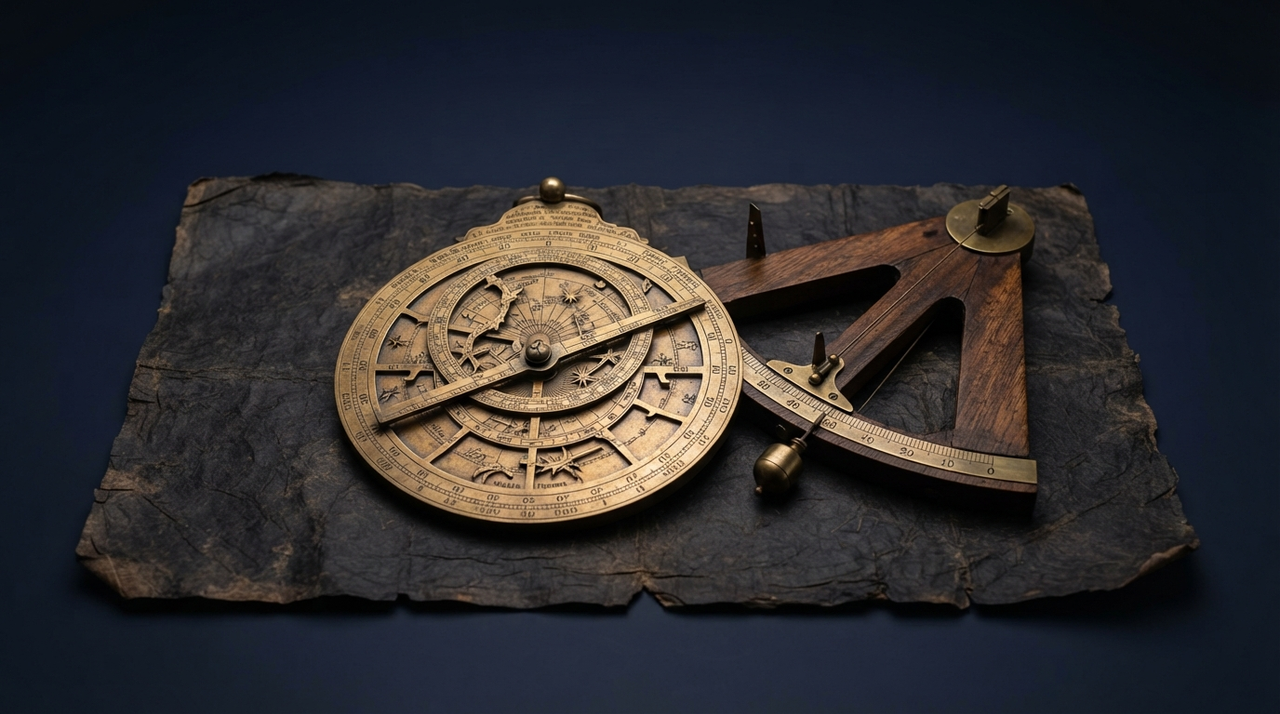
Instruments That Taught the Sky to Speak: Astrolabe, Quadrant, and the Edge of Precision
Imagine a desert night, stars wheeling overhead like scattered jewels on black velvet. The unaided eye grasps patterns, intuits cycles—but falters at measurement. Enter the astrolabe history's quiet revolutionaries: quadrant instruments, armillary spheres, and their kin. These tools did not supplant human vision; they amplified it, turning fleeting glances into enduring records. From Ptolemy's Almagest to Islamic observatories, they whispered the sky's secrets in degrees and minutes, bridging philosophy and precision for seekers of cosmic truth.
Artifacts from the Dust of Time: Tangible Evidence
Our story begins with fragments, survivors of fire and flood. The Antikythera mechanism, dredged from a Greek shipwreck around 100 BCE, gleams in corrosion: gears mimicking planetary dances, a mechanical oracle predating astrolabes yet echoing their logic. No mere toy—this analog computer tracked lunar phases and eclipses, its bronze teeth etched with Hipparchan precision.
Fast-forward to the 2nd century CE: Ptolemy's Almagest, that monumental star catalogue, lists over a thousand luminaries with coordinates refined to arcminutes. Papyrus ghosts and medieval copies preserve his tables, born from quadrant sightings in Alexandria's shadowed courtyards.
Brass Wonders of Baghdad
By the 9th century, Baghdad's workshops birthed brass astrolabes—planispheric marvels, inscribed with rete grids for altitude and azimuth. Surviving specimens, like the one in Istanbul's Museum of Turkish and Islamic Arts, bear Arabic script and Greek zodiacs, their mother-of-pearl insets framing solstitial lines. These were not solitary inventions but products of craft guilds, hands callused from lathes and etchers.
Maragheh's Massive Quadrant
Peak at the 13th-century Maragheh Observatory in Persia: a quadrant instrument, 4 meters tall, carved from stone and plastered for stability. Ilkhanid astronomers like Nasir al-Din al-Tusi sighted stars along its arc, data flowing into tables rivaling Ptolemy's. Ruins whisper of plumb lines and sights, limits etched in mortar cracks.
Contexts of Craft and Transmission
These instruments thrived in communities—Alexandrian scholars debating with ivory styli, Baghdad's House of Wisdom translating Sanskrit and Syriac texts into Arabic. Armillary spheres, those skeletal orreries of rings representing celestial equator and ecliptic, migrated via Silk Road caravans. From China to al-Andalus, translation movements fused Hellenistic geometry with Persian mechanics, quadrant instruments evolving from wooden planks to brass.
Craft guilds guarded secrets: division marks incised with dividers, plates pierced for alidades. Islamic observatories like Samarkand's Ulugh Beg complex later scaled them up, armillary spheres dwarfing men, yet rooted in the same humble astrolabe lineage.
The Edge of Precision: Achievements and Limits
What accuracy did they claim? Ptolemy's stars hover within 10 arcminutes of modern positions—stellar for naked-eye work. Astrolabes from Islamic observatories notched altitudes to 1 arcminute, debates raging over alidade wobbles. Yet limits loomed: thermal expansion warped brass on hot nights, division errors from hand-filed scales crept in. Quadrants fought flexure; armillary spheres tangled in atmospheric haze.
Precision was ever the sky's teasing horizon, instruments its patient pursuers.
Embracing Uncertainty: The Seeker's Code
Survival bias shadows us—bronze endures, wood perishes. Reconstructions in modern labs, like those at Oxford's Museum of the History of Science, test replicas against stars, revealing quirks Ptolemy never voiced. Museum conservation labs wield X-rays on Antikythera shards; experimental archaeology swings alidades under LED moons. Per the Seeker's Code, we approach with humility: what we know is scaffold, not stone.
Echoes Today: From Sacred Places to Personal Sight
These tools resonate in Sacred Places observatories and Writing & Memory star charts. No ancient telescopes here—just eyes honed by brass and stone, prelude to Hubble's gaze.
Pause now: What tool shapes your seeing today? Journal it—telescope app or neural net?—and trace its lineage to that first astrolabe, turning sky to speech.