
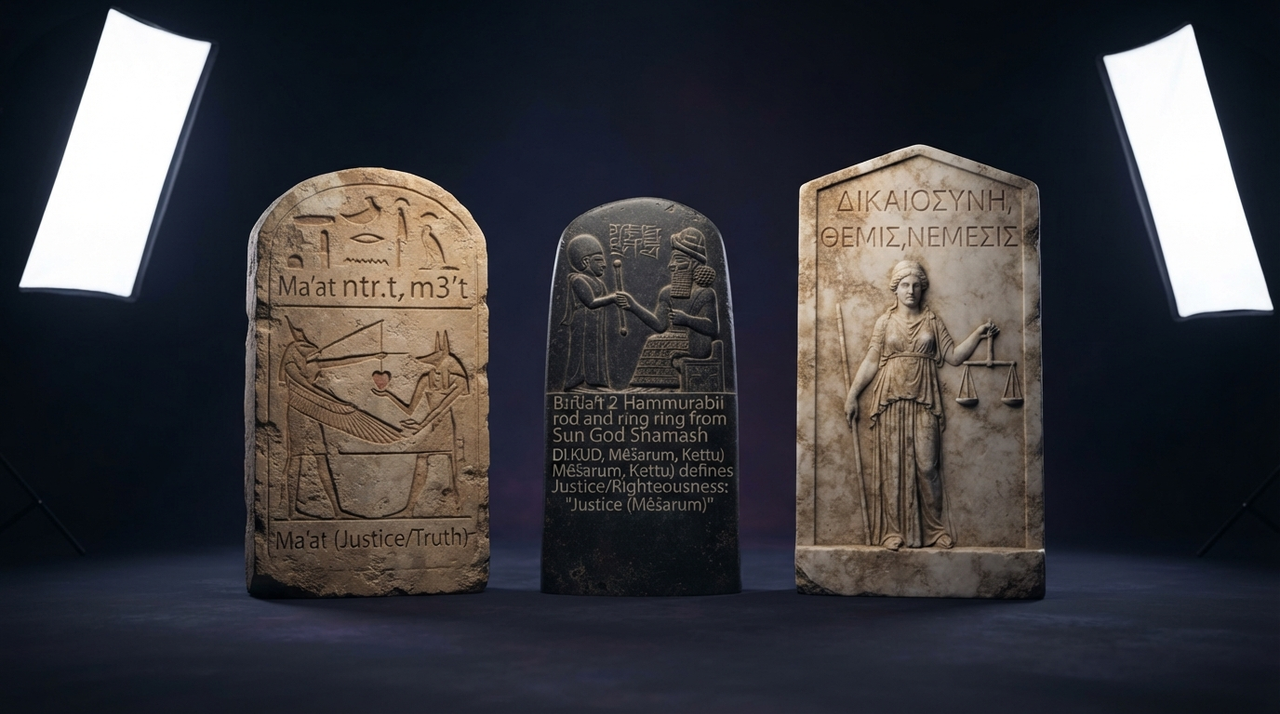
Beyond 'Justice': Unraveling Maat, Sumerian Me, Greek Dike, Dharma & Ṣidq in Ancient Virtue Ethics
Picture a feather trembling in the balance against a human heart, the fate of a soul hanging on cosmic equilibrium. This vivid scene from ancient Egypt captures Maat, a concept far richer than our modern word "justice." In the quest for virtue ethics ancient, scholars and students alike stumble when translating these local terms—Maat, Sumerian Me, Greek Dike, Dharma, and Ṣidq—into English. Why? Because slapping "justice" on them drags in assumptions of punishment, rights, and equality that these cultures never envisioned. Let's unpack each on its own terms, noting periods, texts, institutions, and communities, before grappling with the perils of justice translation.
Maat: Egypt's Cosmic Harmony (c. 2686–2181 BCE, Old Kingdom Onward)
Maat emerges in the Pyramid Texts of the Fifth Dynasty, etched into royal tombs. Not mere fairness, she embodies truth, order, balance—the very fabric holding chaos (isfet) at bay. Pharaohs wore her ostrich feather; judges invoked her in temples like Karnak. The community? All Egyptians, from scribes to farmers, lived Maat through rituals, honest dealings, and royal decrees. Scholarly consensus sees Maat as a divine principle personified as a goddess, yet debate swirls over its evolution: was it always political propaganda, or a grassroots ethic? Evidence from stelae and papyri limits full clarity, but one thing's sure—Maat resists flattening into retributive justice.
Me Sumerian: Divine Ordinances of Mesopotamia (c. 3000–2000 BCE)
The Powers That Be in Myth and Kingship
In Sumerian cuneiform on clay tablets from Uruk and Nippur temples, the Me Sumerian appear as 50 divine decrees—think kingship, truth, crafts, even "the Me of the shepherd." Enki bestows them on Inanna in epic poetry, empowering civilization. Institutions: ziggurat priesthoods and ensi rulers enforced them. Community-wide, from potters to priests, Me structured society. Consensus holds Me as cosmic blueprints, not moral codes per se, though debates rage on their number and sex (some erotic). Fragmentary tablets underscore evidence gaps, warning against modern "duty" overlays that ignore their ritual potency.
Dike Greek: Custom and Cosmic Right (Archaic Period, 8th–6th Century BCE)
Hesiod's Works and Days and Homer's Iliad personify Dike as Zeus's daughter, the path of right over crooked Hybris. In emerging poleis like Athens, her scales symbolized customary law in agoras and early courts. The warrior-aristocrat community prized her as social glue. Scholars agree Dike fuses natural order with human custom—pre-Socratic roots—but debate her shift toward forensic justice by Plato's time. Vase paintings and oratory provide evidence, yet oral traditions obscure origins. Translating as "justice" imports equality absent in her hierarchical world.
Dharma: Order and Duty in Indic Traditions (Vedic Period, c. 1500–500 BCE)
Dharma, from Rigveda hymns to Mahabharata epics, means sustaining cosmic law—your role in varna (caste) and ashrama (life stage). Brahmanic institutions like forest academies and royal sabhas upheld it; communities spanned kings to outcastes. Consensus: Dharma is relational duty, not abstract virtue, though Buddhist reframings spark debate. Palm-leaf manuscripts reveal context-specificity, limiting universal claims. Beware "justice translation" here—it erases karma's weave.
Ṣidq and Ṣedāqâ: Righteousness in Semitic Covenant (c. 1000 BCE, Hebrew Bible)
In prophetic books like Amos and Isaiah, Hebrew ṣedeq/ṣedāqâ denotes covenant fidelity—right relations with Yahweh and kin. Temple priests and prophetic circles in Judah enforced it; the covenant community embodied communal equity. Arabic ṣidq echoes as truthfulness. Consensus views it as relational righteousness, debated in translation ("justice"? "piety"?). Scroll fragments from Qumran highlight evidential bounds. Modern lenses risk projecting legalism onto its holistic piety.
Why Local Terms Trump 'Justice' in Virtue Ethics
These aren't interchangeable: Maat balances worlds, Me empowers gods, Dike rights wrongs customarily, Dharma duties one's station, Ṣidq fulfills covenants. Translation choices smuggle modern individualism or statism, distorting virtue ethics ancient. Consensus urges contextual study; debates thrive on lacunae. At Aetheria AI, we invite you—students of comparative ethics—to explore these untranslatables further. Query our tools for nuanced justice translation alternatives, and unravel the universe's moral tapestry anew.