
Beyond the Monolith: Comparing Ancient Civilizations – Mesopotamia, Egypt, Indus Valley, and Andes in Aetheria Journal
Stepping Through the Ancient Civilizations Door in Aetheria's Cosmic Library
Imagine standing in the vast halls of Aetheria's cosmic library, where shelves stretch into infinity, holding the fragmented whispers of humanity's deepest past. Dust motes dance like distant stars as you approach a particular door—one etched with symbols from forgotten scripts: cuneiform wedges, hieroglyphic birds, Indus seals, and Andean motifs of stepped pyramids. This is the Ancient Civilizations Door, not a gateway to some singular lost golden age, but an invitation to encounter distinct worlds that shaped our species. For students of existence, seekers of ancient wisdom, this threshold promises comparative understanding, free from mystical stereotypes. Here, in Aetheria Journal, we open inquiry into ancient societies compared, urging you to avoid the monolith and see each civilization on its own vivid terms.
Picture a clay tablet from Mesopotamia tumbling into your hands, its wedge-shaped marks recounting floods and kings. Nearby, a papyrus unrolls to reveal Egypt's ordered Nile world. An Indus Valley brick, perfectly standardized, hints at unseen planners. From the arid Andes coast, a reed bundle evokes communal labors under vast skies. These are no interchangeable ruins but living echoes of human ingenuity, bound by geography, craft, and ritual, yet profoundly asymmetric. As we step through, protect the journey: let curiosity guide, not preconceptions.
What the Ancient Civilizations Door Holds: Distinct Societies Unveiled
Beyond this door lies no uniform tapestry of mystery, but four vibrant clusters: Mesopotamia, Egypt, Indus Valley, and the early Andean civilizations. Each flourished in dialogue with its ecology, birthing cities, systems of writing or record-keeping, laws, crafts, and rituals that defined complex life. Mesopotamia Egypt Indus Andes—these names evoke rivers of silt, predictable floods, monsoon grids, and desert ingenuity, respectively.
Mesopotamia's Tigris and Euphrates valleys demanded mastery over unpredictable waters. Here arose Sumerian city-states with ziggurats piercing the sky, cuneiform on clay immortalizing epics, laws like those etched in stone, and bustling markets of barley and bronze. Egypt, hugging the Nile's steady pulse, built enduring pyramids and temples, hieroglyphs scripting pharaohs' divine orders, with granaries and scribes weaving a centralized realm. The Indus Valley's twin rivers nourished grid-planned cities like Harappa and Mohenjo-Daro, where standardized bricks, intricate seals, and vast baths spoke of hygiene and trade, though their script remains undeciphered. In the Andes' Supe Valley, sites like Caral reveal monumental platforms amid coastal deserts, irrigation channeling scarce water, cotton textiles traded afar—no palaces, but communal platforms suggesting shared power.
Ancient societies compared reveal asymmetry: Mesopotamia's polytheistic pantheon clashed in wars; Egypt's pharaoh unified under Ma'at; Indus uniformity lacked overt kings; Andean forms emphasized reciprocity with the land. Crafts varied—Mesopotamian wheels, Egyptian faience, Indus beads, Andean gourds. Rituals tied to rivers: floods as divine caprice or gift. These were not monolithic precursors to us, but adaptive human experiments in scale and meaning.
A Brief Lineage: Civilization Definition Amid Fact and Interpretation
Scholarship's Foundation Stone vs. Popular Echoes
What defines a civilization? In scholarship, it's no vague aura but concrete markers: urban centers, social stratification, monumental architecture, specialized crafts, and often writing or symbolic systems for administration. Popular use blurs this into any 'advanced' ancient group, risking the monolith trap. These societies meet the criteria distinctly: cities from Uruk's walls to Caral's pyramids, hierarchies in temple priesthoods or valley lords, crafts from metallurgy to weaving.
We know them through layered evidence. Texts and inscriptions—cuneiform letters tallying sheep, Egyptian tomb autobiographies, Indus seals stamped on goods. Administrative records reveal daily grind: grain rations, labor rosters. Material culture grounds it: pottery styles, tool kits, burials whispering beliefs. Archaeology unearths the bulk, from Egypt's tombs to Indus drains. Yet chronologies are constructed, debated—relative sequences from stratigraphy, calibrated by rare imports or later histories. No absolute dates invented here; uncertainties remind us knowledge evolves.
Fact versus interpretation: A Mesopotamian law code reflects order amid chaos, but whose voice? An Indus weight system implies equity, yet unseen enforcers. This lineage invites open inquiry, tracing how these Foundation Stones of complexity arose independently, around riverine necessities.
How Seekers Approach Ancient Civilizations: Lens of the Seeker's Code
Students of existence, heed the Seeker's Code: compare with care, honoring asymmetry in evidence. Mesopotamia and Egypt overflow with deciphered texts; Indus script eludes us; Andean early sites whisper through stones and quipu precursors. Respect each on its terms—don't force Egypt's solar cult onto Andean earth rites. Avoid extracting timeless lessons sans context; a ziggurat's base isn't mere 'progress.'
Translations carry power—who deciphers, what biases seep in? Colonial hands once claimed these heritages, but today, global scholars reclaim nuance. Protect the journey: let comparisons illuminate differences, like Indus urban equality versus Mesopotamian kingship. Approach as constellation, not ladder to modernity.
Common Misconceptions: Avoiding the Shadows of the Monolith
- The ancient world as primitive: These societies engineered canals rivaling modern feats, scripted philosophies of justice.
- Uniformly mystical or hyper-advanced: No aliens or secret tech; rituals were practical, tied to seasons and floods.
- Treating Mesopotamia, Egypt, Indus, Andes as interchangeable ruins: One's cuneiform epic isn't another's hieroglyphic spell.
- Collapse as failure: Shifts came from drought, invasion, adaptation—not moral lapse.
- Reading modern values into texts: Equality in Indus layout doesn't mirror today's democracy.
Shatter these to see clearly: ancient societies compared thrive in specificity.
Connections: This Batch in the Wider Ancient Civilizations Door Map
This batch—Mesopotamia Egypt Indus Andes—links to History's remembrance through selective myths; Archaeology's traces complicating royal boasts; Anthropology's varied kinships and economies. Echoes ripple to Philosophy Doors (justice codes), Religion (god-kings vs. ancestors), Mythology (flood tales anew). In Aetheria's map, they form a cluster, inviting cross-Doors wandering.
Concrete Ways to Begin Your Inquiry
- Compare foundation accounts: Sumer's kings list versus Egypt's Menes unification.
- Map environmental context: Sketch Tigris floods against Nile regularity.
- Follow one administrative text: Trace a Mesopotamian ration tablet's ripples.
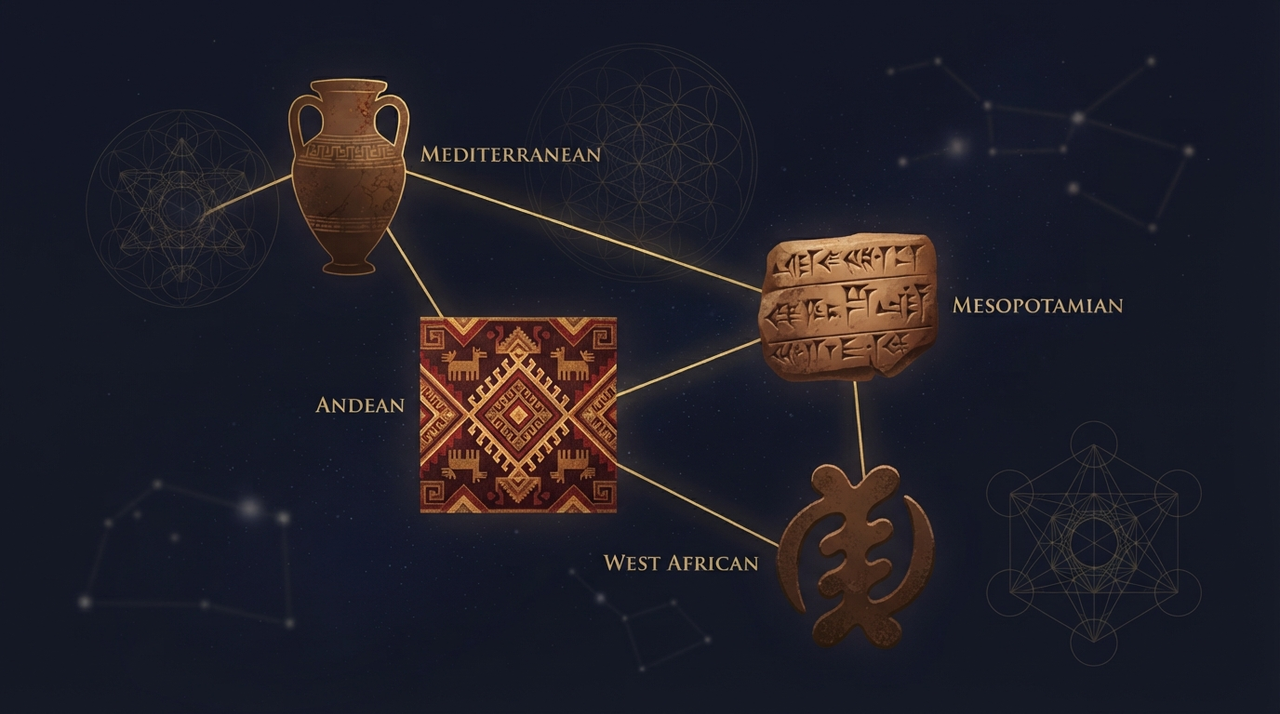
- Practice visual linking via Constellation Maps: Link ziggurat to Caral platform.
- Journal a question: How did Indus planners enforce grids without palaces?
These sparks ignite open inquiry.
Reflective Invitation: Return to the Aetheria Community
As cosmic library echoes fade, carry this: beyond the monolith lies humanity's plural dawn. Join Aetheria Journal's seekers—share your journaled questions, constellation sketches. Protect the journey together; the Ancient Civilizations Door awaits your return.