
Beyond the Walls: How Ancient Cities Like Uruk, Mohenjo-Daro, Thebes, and Teotihuacan Held Societies Together Through Urban Institutions
Picture a dusty dawn in the late fourth millennium BCE, the air thick with the scent of baked mudbrick and river silt. Thousands stir in Uruk's sprawling precincts—not bound by towering ramparts, but by the inexorable rhythm of temple ledgers and irrigation canals. Walls might delineate a city, but what truly held these ancient urban experiments together? Not stone alone, but the invisible scaffolding of institutions: coordinated labor, shared storage, ritual calendars, and administrative oversight. In the story of ancient cities, urbanism reveals itself as a dance between material necessity and social ingenuity.
This exploration delves into four emblematic hubs—Uruk in Mesopotamia, Mohenjo-Daro in the Indus Valley, Thebes in New Kingdom Egypt, and Teotihuacan in Mesoamerica. We'll sift archaeology's tangible traces from textual whispers and scholarly inferences, uncovering how city institutions emerged to tame floods, hoard grain, and marshal multitudes. No linear march from 'first city' to pinnacle; each arose in isolation, solving its own earthly puzzles. Step inside these worlds, where urban life pulsed beyond the perimeter.
Uruk: Temples as the Heartbeat of Mesopotamian Urbanism
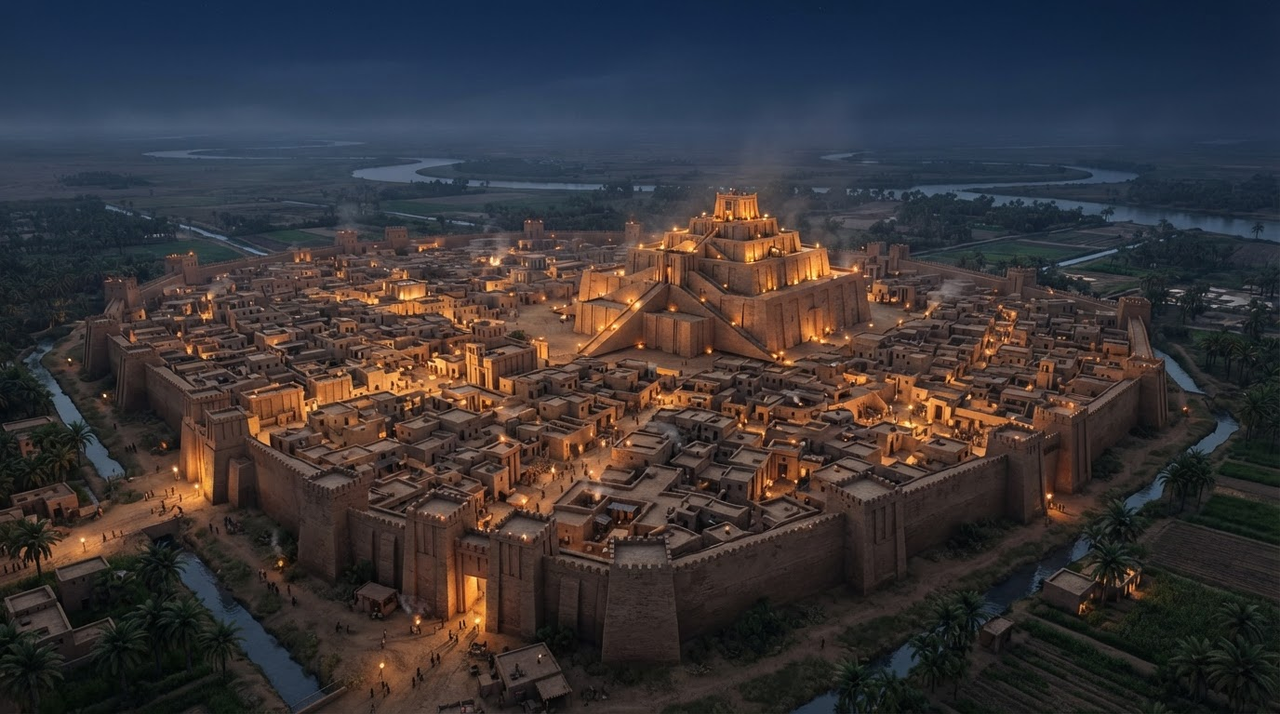
By around 3500–3100 BCE, Uruk in southern Mesopotamia swelled to perhaps 50,000 souls, its 5.5 square kilometers a mosaic of mudbrick ziggurats and alleys. Archaeological evidence dominates here: the Eanna temple complex, with its layered platforms and cone mosaics unearthed by German excavators in the 1920s–30s, stands as a monumental anchor. Cone-shaped artifacts, embedded in walls like colorful teeth, signal ritual investment on a scale demanding organized labor—hundreds hauling bitumen and reeds under priestly direction.
Deeper still, over 5,000 clay tablets from the Uruk IV period—proto-cuneiform scratches on soft clay hardened by accident or fire—offer textual records of barley rations, sheep tallies, and labor assignments. These aren't mere lists; scholars like Denise Schmandt-Besserat reconstruct them as tools of a temple economy, where Inanna's cult coordinated surplus from distant fields. Institutions crystallized around storage: massive granaries adjacent to temples held the harvest, binding farmers to urban cores through debt and divine obligation.
Modern interpretations highlight emergence from material crises. The Euphrates' fickle floods demanded canal networks; archaeology traces these in silt layers and canal cuts. Priests, as reconstructed from tablet hierarchies, weren't tyrants but problem-solvers, their ledgers ensuring water flowed and grain didn't rot. Uruk's urbanism thus knit society via temple bureaucracies, a model echoed in later Sumerian polities. For deeper ritual layers, explore our Sacred Places Door.
Mohenjo-Daro: Engineered Order in the Indus Valley
Fast-forward to 2500–1900 BCE, where Mohenjo-Daro in Pakistan's Indus floodplain housed 40,000 amid baked-brick precision. No palaces or kings proclaim dominance; instead, archaeological evidence paints a city of equity and hygiene. Street grids—orthogonal and cardinally aligned—crisscross 250 hectares, with wells in nearly every house and a metropolis-spanning drainage system channeling waste to covered sewers. The Great Bath, a watertight pool of brick and bitumen, hints at communal rituals, its steps worn by countless feet.
Institutions from Infrastructure
Seals—miniature masterpieces of steatite stamped with unicorns and script—number in the thousands, found in hoards. These textual records, undeciphered Indus script, likely tracked trade in carnelian beads and lapis from afar. Granaries on citadel mounds, with ventilation shafts, managed monsoon harvests, coordinating labor across the valley. Scholarly reconstructions posit decentralized councils or merchant guilds, inferred from uniform brick sizes (ratio 4:2:1) suggesting standardized oversight.
Water was the crux: seasonal floods birthed fertility but risked ruin. Platforms elevated elite structures, while drains forestalled stagnation. City institutions thus arose organically—no edicts survive, but the bricks whisper of guilds enforcing codes. Modern views, from Iravatham Mahadevan's seal studies, see a literate trade network binding Mohenjo-Daro to Harappa. This Indus Valley urbanism prioritizes resilience, a quiet counterpoint to Mesopotamian pomp. Link to our Writing and Memory Door for script enigmas.
Thebes: Divine Administration on the Nile
In New Kingdom Egypt (ca. 1550–1070 BCE), Thebes—modern Luxor—commanded as imperial heart, its east-west sprawl hugging the Nile. Temples like Karnak, expanded over centuries into a forest of pylons, covered 200 acres. Archaeological evidence abounds: foundation deposits of model tools and scarabs under corners invoke stability, while quarries miles away attest massive labor drafts.
Pharaohs, Priests, and Papyrus
Textual records illuminate: hieroglyphic inscriptions on Karnak's walls boast Amun-Ra's endowments, while papyri from nearby Deir el-Medina detail worker villages—strikes, wages, beer rations. Institutions orbited the temple-state: the Amun priesthood ballooned to 80,000, managing estates via scribal accounts. Storage magazines brimmed with emmer wheat, redistributed in lean Nile years.
Labor coordination peaked in monuments; corvée systems, scholarly pieced from tomb reliefs, rotated peasants for flood control and pyramid precursors. Modern interpretations, like Barry Kemp's, view Thebes as a 'service city,' where piety fueled economy. Yet humility tempers: graffiti from workers humanizes the machine. Thebes' urbanism fused Nile rhythm with divine hierarchy, institutions as eternal as the river.
Teotihuacan: Cosmic Harmony in Mesoamerican Splendor
Across oceans, ca. 100–500 CE, Teotihuacan near Mexico City peaked at 125,000, its 20 square kilometers gridded by the Avenue of the Dead. Pyramids of the Sun and Moon loom, talud-tablero facades a signature style. Archaeological evidence reveals apartment compounds housing kin groups, talavera pottery standardized across barrios, and obsidian workshops churning tools for trade empires.
Markets, Mounds, and Multiethnic Bonds
No texts survive—archaeology speaks via murals of feathered serpents and market plazas inferred from vendor models at sites like the Ciudadela. The Great Compound, a sunken plaza, likely hosted rites coordinating diverse ethnic enclaves, from Otomi to Maya traders. Institutions tackled altitude's aridity: aqueducts from springs, chinampas-like fields, and talud canals managed water, sustaining density.
Scholarly reconstructions posit elite superscription over barrio autonomy, with the Pyramid of the Feathered Serpent's 200+ burials signaling sacrificial legitimation. Teotihuacan's genius lay in scalable city institutions: craft guilds, per isotope studies of immigrant bones, fostered unity amid growth. Decline around 550 CE underscores fragility, yet its blueprint radiated to distant Maya capitals.
Threads of Necessity: Water, Grain, and Collective Will
Across these ancient cities, patterns emerge not from edict, but exigency. Water management—Uruk's canals, Mohenjo-Daro's drains, Thebes' Nile barrages, Teotihuacan's aqueducts—spawned overseers and rosters. Storage vaults warded famine, demanding trust in redistributors. Labor coordination, from corvée to guilds, scaled humanity beyond villages.
- Distinguishing Evidence: Bricks and drains are hard fact; tablets and inscriptions, direct voice; reconstructions bridge gaps with ethnographic analogy.
- Modern Lens: Processual archaeology quantifies inputs, while post-processual views unearth agency in the overlooked.
These city institutions weren't imposed but incubated, humane responses to nature's caprice. Cross to Sacred Places for temples' sacral glue, or Writing and Memory for ledgers' legacy.
Beyond the Blueprint: Echoes and Enigmas
Urban plans map power, yet settle little of the heart—what songs echoed in Mohenjo-Daro's baths? What jokes lightened Teotihuacan haulers' loads? Archaeology gifts bones and ledgers; voices elude. These cities teach resilience, reminding us that today's megacities grapple the same: equity amid flows.
Institutions, like rivers, carve channels through time—shaping societies, yet ever reshaped by them.
Next, wander Aetheria's Ancient Civilizations Door: probe Harappa's seals or Babylon's gates. In uncertainty lies curiosity's thrill—what unseen institution awaits your gaze?