
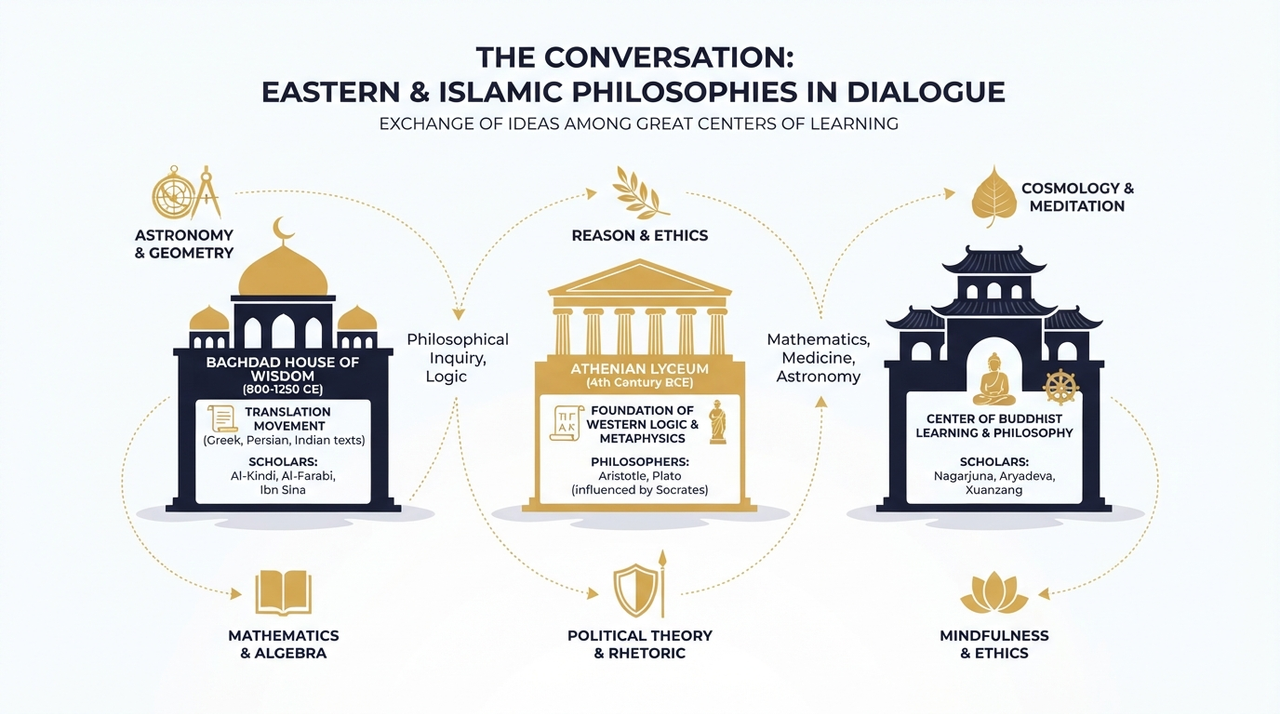
Beyond the West: Comparing Islamic, Indian, and Chinese Philosophies Through Time, Trade, and Thought
Picture a dusty Silk Road caravan in the 9th century, laden not just with silk and spices, but scrolls of Aristotle and Euclid, ferried from Baghdad to the edges of India and China. These were no mere commodities—they were vessels of thought, igniting comparative philosophy across continents. While Western narratives often spotlight Plato and Kant, the intertwined legacies of Islamic philosophy, Indian philosophy, and Chinese philosophy reveal a richer, more global tapestry of inquiry. This exploration peers beyond Eurocentrism, tracing their evolutions through chronology, trade routes, language, and ecology, while noting interpretive debates and textual limits.
The Baghdad Crucible: Foundations of Islamic Philosophy
In the 8th and 9th centuries, the Abbasid Caliphate's House of Wisdom in Baghdad became a translation powerhouse. Scholars rendered Greek, Persian, and Syriac texts into Arabic, blending them with indigenous insights. This movement birthed luminaries like Ibn Sina (Avicenna, 980–1037), whose Canon of Medicine fused logic and empiricism, and Ibn Rushd (Averroes, 1126–1198), who reconciled Aristotle with faith through razor-sharp commentaries. Later, Mulla Sadra (1571–1640) wove existential motion into Shi'ite thought, emphasizing reality's flux.
Yet sources pose challenges: many originals are lost, surviving via Arabic intermediaries, sparking debates on fidelity. Was Ibn Sina's essence-existence distinction purely Aristotelian, or infused with Neoplatonism via Plotinus translations?
Threads of Inquiry: Indian Philosophy's Logical and Metaphysical Weave
Nyaya, Vedanta, and Madhyamaka
Rooted in antiquity, Indian philosophy spans the Vedic hymns (c. 1500 BCE) to medieval sutras. Nyaya, the school of logic, dissected inference with tools like pramana (valid knowledge), influencing debates on causality. Vedanta, via Shankara's (8th century) Advaita non-dualism, posited Brahman as ultimate reality, dissolving self-other divides. Meanwhile, Buddhist Madhyamaka, led by Nagarjuna (2nd century CE), wielded emptiness (shunyata) to deconstruct extremes, echoing paradoxes millennia ahead.
Interpretive rifts abound—did Shankara's monism erase ethics, or elevate compassion? Texts like the Brahma Sutras invite layered readings, limited by oral traditions later codified.
Harmony in Flux: Chinese Philosophy's Confucian and Daoist Currents
From Confucius (551–479 BCE), whose Analects stressed ren (benevolence) and li (ritual) for social harmony, to Laozi's enigmatic Dao De Jing (6th century BCE), advocating wu wei (effortless action) amid nature's rhythms, Chinese philosophy emphasized relationality. Neo-Confucians like Zhu Xi (1130–1200) later integrated Buddhist and Daoist elements, probing li (principle) and qi (vital force).
Challenges persist: bamboo-slip discoveries reshape timelines, and commentaries multiply meanings—was the Dao a metaphysical force or poetic metaphor?
Comparative Lenses: Time, Trade, Language, Ecology
Chronologically, China's axial age (6th century BCE) predates Islam's synthesis (8th century CE), with India bridging via Buddhism's spread. Trade routes like the Silk Road linked them: Indian numerals reached Baghdad, Daoist alchemy influenced Islamic esotericism. Arabic unified Islamic thought across deserts; Sanskrit's precision fueled Indian logic; Classical Chinese's brevity mirrored ecological cycles of Yellow River floods, fostering harmony over conquest.
- Contact: Xuanzang's 7th-century pilgrimage carried Madhyamaka to China.
- Ecology: Arid steppes honed Islamic communal ethics; monsoon India, pluralistic debate.
No universals here—these lenses reveal resonances, like shared skepticism of absolutes, without claiming supremacy. Debates rage: did trade dilute or enrich originals?
Echoes in History and Science
These traditions propelled history—Mongol conquests disseminated Ibn Rushd's works to Europe, Nyaya logic sharpened Islamic kalam theology. In science, Ibn Sina's optics presaged experiments; Vedantic holism paralleled quantum intuitions (though anachronistic); Confucian bureaucracy enabled astronomical feats. Explore Aetheria's History and Science Doors for deeper ties, from Tang observatories to Mughal observatories.
Your Guided Map Forward
Chart your own path: Start with Ibn Sina's floating man thought experiment, contrast with Madhyamaka's void, then Daoist flow. Dip into primary texts via translations, mindful of gaps. In this non-dogmatic voyage through comparative philosophy, the real wonder lies not in rankings, but in how these voices—separated by oceans of sand and time—whisper shared human quests. What thread will you pull next?