
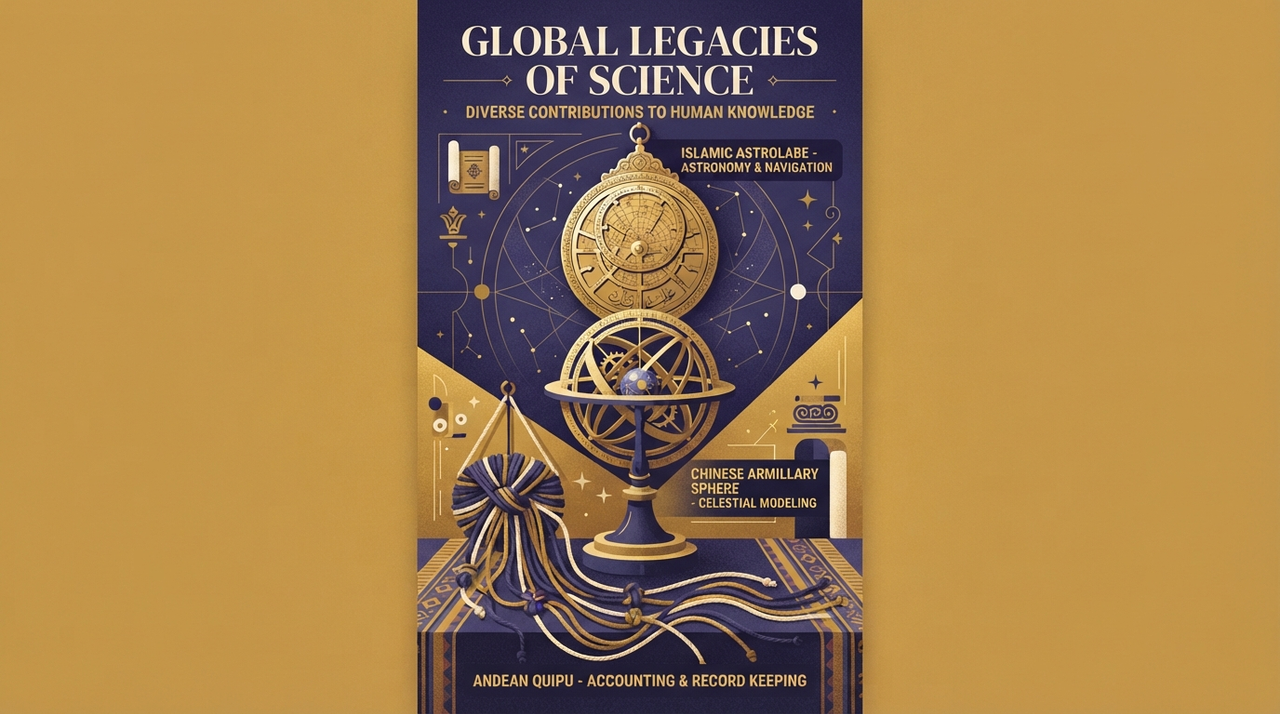
Beyond the West: Global History of Science from Islamic Golden Age to Indigenous Innovations
What if the story of science wasn't a straight line from ancient Greece to Enlightenment Europe, but a vibrant web of ingenuity spanning continents? The history of science, often told through a Western lens, overlooks the global science that pulsed through Islamic cities, Chinese workshops, Andean terraces, West African forges, and indigenous landscapes. This under-told narrative reveals not isolated geniuses, but interconnected pursuits shaped by time, trade, and terrain.
From the 8th to 13th centuries, these traditions flourished amid material constraints—scarce metals in deserts, fertile but fragile soils in mountains—driving adaptive brilliance. Yet sources remain fragmented: Arabic manuscripts endure, while oral indigenous knowledge fades without written records. By comparing chronologies, contact routes like the Silk Road, and environmental limits, we uncover a fuller global science tapestry, linking back to ancient civilizations' foundations and forward to ecological wisdom.
The Islamic Golden Age: Bayt al-Hikma's Translational Revolution
Picture Baghdad in 830 CE, where the House of Wisdom (Bayt al-Hikma) hummed like a medieval think tank. Under Abbasid caliphs, scholars translated Greek, Persian, and Indian texts into Arabic, preserving and expanding the history of science. Al-Khwarizmi birthed algebra from Indian numerals; Ibn al-Haytham pioneered optics with experiments on light refraction, laying groundwork for cameras.
This era's alchemy refined distillation, influencing chemistry worldwide. Papermaking, adopted from China via Samarkand, enabled mass knowledge production. Chronologically bridging antiquity and Europe—texts flowed west via Toledo—Islamic golden age innovations thrived despite arid constraints, using aqueducts for irrigation-fueled observatories.
China's Song Dynasty: Engineering the Mega-Scale
Fast-forward to 11th-century China, where Song dynasty engineers scaled ambition amid rice paddy abundance and iron ore plenty. Su Song's astronomical clock tower, a 12-meter behemoth with escapement mechanisms, automated star tracking—predating mechanical clocks in Europe by centuries. Gunpowder, refined for fireworks and bombs, stemmed from alchemical quests.
Movable type printing by Bi Sheng democratized knowledge, while chain-drive pumps irrigated vast fields. Silk Road contacts carried these to the Islamic world; material bounty—bamboo, coal—fueled iron production hitting 125,000 tons yearly, dwarfing Europe's output. This global science pinnacle connected ancient Chinese metallurgy to later industrial sparks.
Andean Agronomy: Terraces Against the Mountains
In the Andes, Inca and pre-Inca peoples from 1000 BCE engineered agronomy miracles. Waru waru raised fields—floating potato plots in Lake Titicaca—stabilized yields against frosts, feeding millions. Quipu knotted strings encoded crop data, a proto-data science without paper.
Chronologically paralleling Song hydraulics but isolated by oceans, Andean methods countered steep slopes and erratic rains via stone terraces channeling microclimates. Spanish conquests destroyed records, limiting sources to ethnoarchaeology, yet this indigenous knowledge echoes ancient Mesoamerican calendars, adapting to harsh altitudes where European plows failed.
West African Metallurgy: Forging Empires from Dust
Across the Sahara, from 1000 CE, West African smiths in Ife and Gao mastered bloomery furnaces, smelting iron without bellows via termite-mound clay. Bloom iron fueled Bantu expansions; gold trade via trans-Saharan caravans built Mali's wealth, with Mansa Musa's pilgrimage showcasing refined alloys.
Contact routes—camel trains—linked to Islamic optics traders, exchanging techniques. Material constraints like wood-scarce savannas spurred efficient charcoal use. Oral griot histories supplement sparse Arabic accounts, revealing global science roots in ancient Nok terracottas.
Indigenous Knowledge: Ecology's Silent Architects
From Australian Aboriginal fire-stick farming regenerating eucalyptus to Amazonian terra preta soils—biochar-enriched earth sustaining crops for millennia—indigenous knowledge embodies adaptive global science. Polynesians navigated by stars and swells; Native Americans selectively bred maize from teosinte.
These span chronologies, often pre-contact, constrained by oral transmission vulnerable to colonization. They tie to environmental doors—sustainable amid climate flux—and ancient civilizations' biodiversity stewardship.
Comparing Pathways: Time, Trade, and Terrain
- Chronology: Islamic golden age (8th-13th C) relays ancient texts; Song peaks concurrently with Andean heights.
- Contact Routes: Silk Road fuses Chinese paper with Arab math; Sahara caravans blend African iron lore.
- Material Constraints: Deserts demand hydraulics; mountains, terraces—spurring ingenuity.
Source limits abound: Islamic libraries burned, indigenous lore unwritten. Still, archaeology bridges gaps, connecting to ancient Sumerian wheels or Egyptian geometry.
This global history of science invites reflection: Western triumphs built on these foundations. Trace one pathway yourself—sketch a map from China's Song papermaking through Baghdad's Bayt al-Hikma to medieval Europe's scriptoria. What lost threads might you uncover?