
Big Five Personality Traits Exposed: Validity, Cultural Bias, and Narrative Identity Alternatives
Picture this: You complete a 50-question quiz online, ticking boxes about your love for adventure or preference for solitude. Minutes later, a colorful graph spits out your Big Five profile—high openness, low neuroticism, the works. It feels revelatory, like a mirror to your soul. But what if that mirror is cracked, reflecting a Western lens on a global psyche? In the realm of personality psychology, the Big Five model reigns supreme, yet cracks in its foundation invite us—students of existence—to probe deeper into trait theory, measurement validity, and bolder alternatives like narrative identity.
This exploration isn't just academic dust-gathering. It's a doorway to understanding personhood, where traits meet stories, and data dances with lived experience. Let's unravel the threads.
The Lexical Hypothesis: Birthplace of Modern Trait Theory
It all traces back to the lexical hypothesis, the idea that the most important personality differences embed themselves in everyday language. Pioneers like Gordon Allport and Henry Odbert scoured dictionaries in the 1930s, extracting thousands of trait-descriptive terms. Raymond Cattell crunched them into 16 factors; Hans Eysenck boiled it down to three: extraversion, neuroticism, psychoticism.
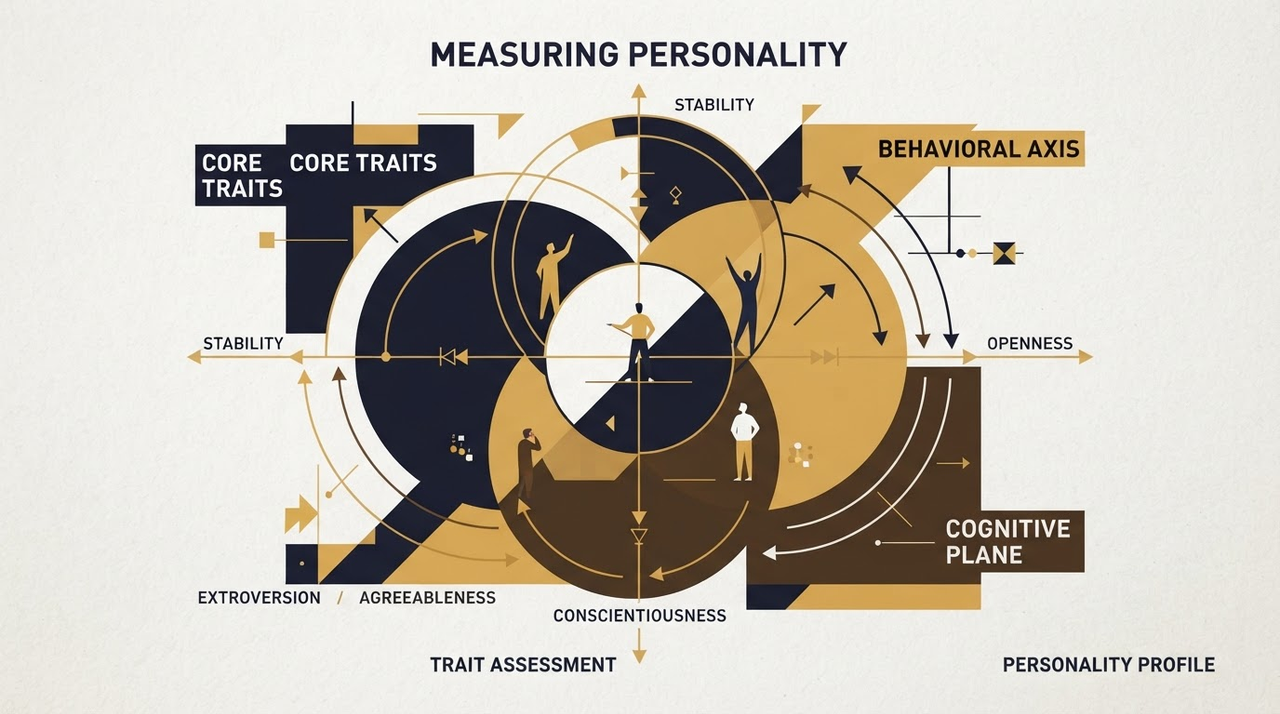
Enter the Big Five around the 1980s, forged from factor analysis of those lexical riches. Openness, Conscientiousness, Extraversion, Agreeableness, Neuroticism—OCEAN for short—emerged as robust dimensions. Twin studies and cross-situational consistency lent credence, positioning trait theory as the gold standard in personality psychology. But robustness isn't universality.
The Big Five Under the Microscope: Reliability Meets Reality
Measurement Validity—What the Numbers Capture
Self-report inventories like the NEO-PI-R boast high test-retest reliability—scores stay stable over decades for many. They predict life outcomes: job performance, relationship satisfaction, even longevity. Yet measurement validity falters. Traits explain only 10-30% of behavior variance; context reigns. A conscientious person might slack in a toxic office. Scores snapshot dispositions, not dynamisms.
Factor analyses replicate across methods—ratings, behaviors—but interpretations vary. Is high extraversion sociability or energy? Evidence abounds, yet the map isn't the territory.
Cultural Bias and the WEIRD Trap
Here's the sting: Big Five research skews WEIRD—Western, Educated, Industrialized, Rich, Democratic. U.S. undergrads dominate samples. In collectivist cultures like Japan or Kenya, agreeableness splinters; extraversion blends with dominance. Meta-analyses show partial replication globally, but honesty and modesty dimensions fade or flip.
Cultural transportability? Middling. Traits may be emic (culture-bound) more than etic (universal). Sample bias amplifies this—does a Brazilian's "agreeableness" match a Swede's? Scores illuminate within cultures, obscure across them. Lived experience whispers: personality blooms in context, not vacuum.
Alternatives Rising: HEXACO and Narrative Identity
HEXACO's Honest Expansion
Enter HEXACO, tweaking Big Five with Honesty-Humility. Derived from multilingual lexicons, it captures greed avoidance and sincerity better, especially cross-culturally. A step toward universality?
Narrative Identity: Stories Over Scores
But traits are static; lives are plots. Narrative identity, championed in life-story interviews, posits self as authored tale—redemptive sequences, turning points, imagoes. Dan McAdams' framework reveals how we integrate traits into coherent arcs. Unlike quizzes, it honors agency, culture, change. Evidence? Narratives predict well-being beyond traits.
Traits, Tales, and the Human Core
What do scores tell? Dispositions, yes—probabilities, not prophecies. They don't capture growth, crises, or the philosophical riddle of personhood: Am I my traits, or the narrator thereof? Link to philosophy's door: Locke's bundles versus narrative selves (Dennett, Schechtman). Linguistics beckons too—language forges identity, lexical roots revisited.
Distinguish: Evidence grounds traits; interpretation spins them; experience transcends. In Aetheria AI's quest to decode existence, blend them—AI parses patterns, humans pen poems.
Step Through the Door: Your Invitation
Big Five endures, a sturdy scaffold. Yet bias and blindness urge evolution. Probe your narrative: What story do your traits serve? Explore Philosophy Door for personhood depths, Linguistics Door for word-woven selves. Share your arc—what if your quiz was just the prologue?
The universe unfolds in questions. What's yours?