
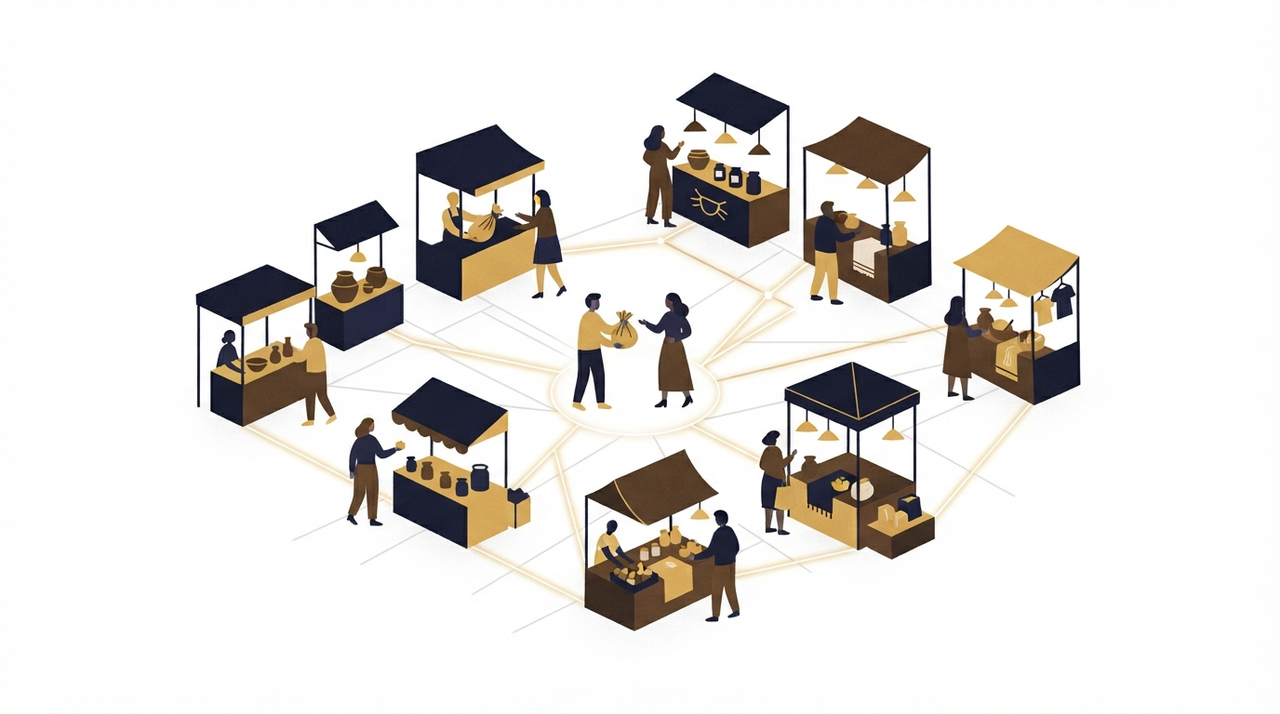
Business as Institution: From Ancient Assyrian Traders to Song China Markets and Modern Cooperatives
Redefining Business: Beyond the Timeless Myth
Imagine a caravan creaking across the Anatolian plains around 1900 BCE, laden with tin and textiles, its Assyrian merchants scribbling contracts on clay tablets under the relentless sun. This wasn't abstract capitalism— it was a fragile web of family trusts, temple oaths, and community debts. What if we viewed business as institution, not a universal engine of profit, but a patterned human endeavor shaped by place, era, and shared survival?
In the history of business, we often chase sleek models: supply-demand curves, shareholder value, agile startups. Yet these eclipse the messier reality of economic sociology—pre-modern marketplaces humming with barter and gossip, guilds enforcing craft standards, temple economies blending worship and warehouse. Business emerges as layered: institutional practices rooted in local laws and customs; legal structures from partnership scrolls to corporate charters; management theories born of trial, not textbooks; lived work etched in callused hands and dawn markets; normative arguments over fair exchange versus extraction.
Seeing business as institution keeps the variables visible: ownership by kin or commune; labor relations as patronage or partnership; measurement in weighed silver or ledgers; assumptions about trust drawn from kinship, not contracts alone. This lens invites comparative business thinking, revealing pathways from ancient trade outposts to bustling dynastic towns, and contrasts with today's giants. It ties to Economics through resource flows, Politics via power in markets, Ethics in who thrives. Students of existence, let's trace these threads.
The Old Assyrian Traders: Kanesh as Commercial Frontier
A Family Affair in Bronze Age Anatolia
Around 1900 BCE, in the dusty trading hub of Kanesh—modern Kültepe in Turkey—Assyrian merchants from the city of Assur established the ancient world's first known commercial colony. Over 23,000 cuneiform tablets unearthed there paint a vivid scene: family-run firms dispatching caravans 800 miles westward, swapping Mesopotamian tin and wool for Anatolian silver and cloth.
Ownership was intimate—fathers like Elam-Naṣir headed partnerships with sons and brothers, pooling capital through loans from kin back home. Labor relations blended hierarchy and reciprocity: agents in Kanesh managed warehouses, advanced wages to local porters, but faced audits via tablet dispatches. Measurement relied on shekels of silver, weighed on balances, with interest rates hovering around 20-30% on loans, not for endless accumulation but to cover caravan risks like banditry or drought.
Community context was key. Temples in Assur and Kanesh guaranteed contracts via oaths to gods like Aššur; disputes went to local Anatolian kings or merchant assemblies. This wasn't profit-maximizing frenzy but risk-sharing in a perilous world—merchants reinvested in rituals and family alliances. Counterevidence abounds: tablets record bankruptcies, where failed traders returned home indebted, their networks fraying. Here, business and community intertwined, commerce as social glue amid empire's shadow.
Song China Market Towns: Commerce in the World's Largest Economy
Periodic Markets and Paper Promises
Fast-forward to the Song dynasty (960-1279 CE), when China boasted the globe's most advanced economy—perhaps half of world GDP. In market towns dotting the Yangtze Delta and beyond, like those near Hangzhou, commerce pulsed through periodic fairs: every five or ten days, farmers, artisans, and long-distance traders converged on open squares.
Ownership varied—small family shops for rice wine or silk, larger brokerages handling grain futures. Labor drew from free peasants and itinerant workers, with relations shaped by Confucian ideals of mutual benefit over exploitation. Measurement evolved dramatically: state-issued paper money (jiaozi) circulated alongside copper cash, enabling trade volumes unseen elsewhere. Taxes in kind funded canals linking markets, but private guilds—hygui—set prices and standards, mediating with officials.
Place mattered profoundly. Urban-rural circuits formed ecosystems: rural surpluses fed city demand, while towns hosted teahouses for deal-making amid poetry recitals. Assumptions hinged on abundance— bumper rice harvests fueled spending—yet counterevidence lurks in famines, where markets hoarded or collapsed. Business as institution here fostered business and community, embedding trade in imperial harmony, contrasting Assyrian isolation with networked density.
Comparative Business: Threads Across Millennia
Chronology charts the pathway: Assyrian outposts (19th c. BCE) pioneered long-distance agency amid scarcity; Song markets (11th-13th c. CE) scaled via innovation in a prosperous realm. Functions overlapped—exchange of goods for sustenance—but differed sharply. Assyrians managed risk through kin ties in foreign soil; Song traders leveraged state infrastructure and monetary tools for volume.
Differences illuminate economic sociology: ownership scaled from family clans to proto-corporate guilds; labor from bonded agents to market wage labor; measurement from metal weights to abstract currency. Counterevidence tempers: both eras saw failures—Assyrian colonies burned in revolts, Song inflation eroded paper notes. Community context evolved—from temple-centric Assur to bureaucratic Song—yet both wove business and community, commerce sustaining social bonds, not eroding them.
This comparative business view disrupts timeless narratives. Profit served varied ends: Assyrian wealth funded city walls, Song trade imperial granaries. Assumptions shifted with ecology and polity, echoing Economics' scarcity debates, Politics' rule of law, Ethics' just exchange.
Contemporary Echoes: Cooperatives Versus Public Retailers
Grocery Co-ops and Shareholder Empires
Today, contrast a neighborhood cooperative grocery—member-owned, perhaps sourcing from local farms—with a publicly traded supermarket chain. In the co-op, ownership disperses via shares or patronage, echoing Assyrian family stakes; decisions via assemblies prioritize community needs over quarterly earnings. Labor relations emphasize worker input, wages tied to surplus sharing, measured in retained earnings reinvested locally.
The retailer, listed on exchanges, centralizes ownership among distant shareholders; executives optimize for stock price, labor often contractual with metrics like inventory turns. Assumptions diverge: co-op trusts member loyalty for resilience, retailer scales via efficiencies. Community ties? Co-ops anchor neighborhoods, fostering business and community; chains extract value upward. Yet counterevidence: co-ops struggle against scale, retailers face boycotts over ethics.
This mirrors historical shifts—Assyrian kin to Song guilds to modern forms—urging history of business as guide for business as institution.
Ripples into Economics, Politics, and Ethics
Viewing business institutionally bridges Doors: Economics probes efficiency myths; Politics, regulatory scaffolds; Ethics, distributive justice. Assyrian tablets prefigure agency theory; Song markets, monetary policy's double edge. Today, cooperatives challenge shareholder primacy, inviting humane alternatives.
Toward a Seeker's Horizon
Business, as patterned institution, hums with human contingency—place-bound, era-scarred, community-woven. Protect the journey by questioning models against lived histories. Journal prompt: Chart a business you know—its ownership, labors, measures. How does its institutional form serve or strain its community? What ancient echo might reshape it?
In this curiosity, we unravel the universe's economic weave.