
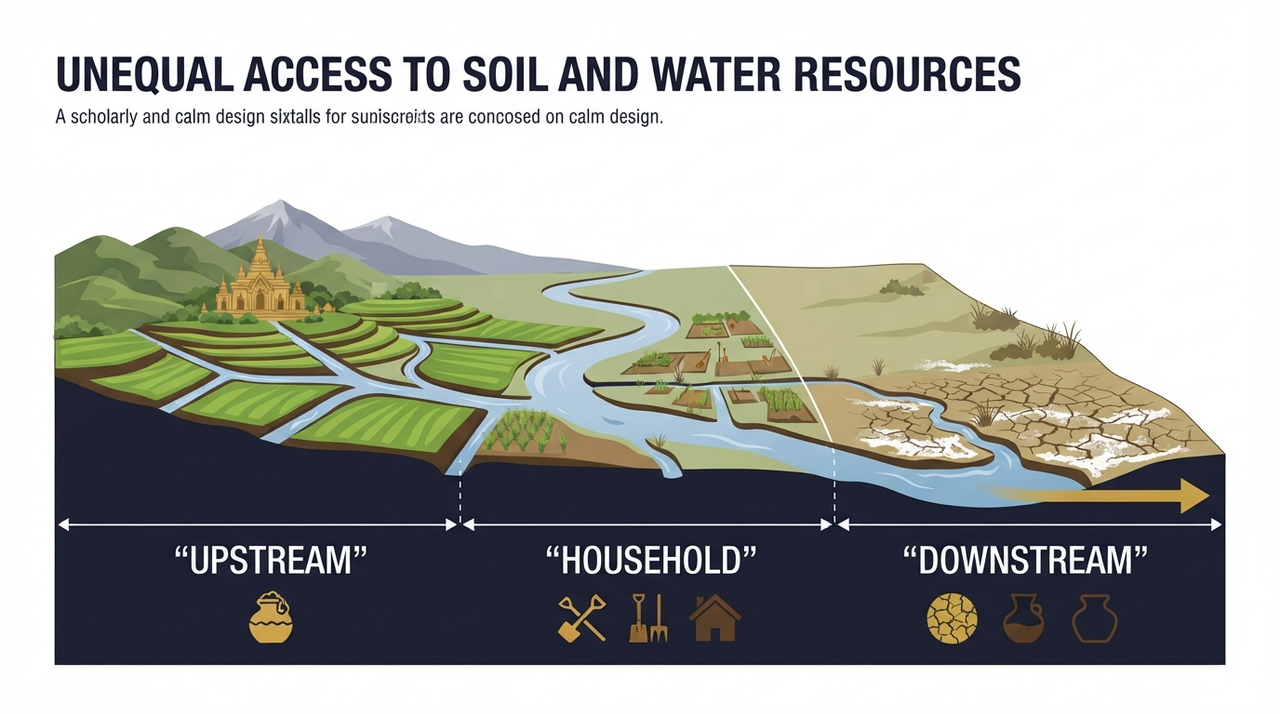
Canal Banks and Contested Soils: Unequal Irrigation Access, Salinization, and Agrarian Inequality in Ancient Histories
Picture a farmer knee-deep in the mud of a Mesopotamian canal bank, around 2000 BCE. The water rushes from upstream, carrying life-giving silt that builds soil fertility with each flood. Yet this same flow demands constant labor to dredge channels, repair levees, and fight encroaching salt. Who digs the ditches? Who claims the richest fields? These questions reveal irrigation access not as a neutral resource, but as an economic relation forged by households, temples, palaces, and raw power. In ancient agrarian worlds, water rights intertwined with soil fertility, labor coercion, and unequal exposure to ecological limits like salinization.
Access here means more than pipes or pumps. It spans property claims on canal head-gates, temple redistributions of grain, household terrace-building, and downstream struggles for scraps. Far from uniform downfall, these patterns show how ecological limits played out unevenly, shaping agrarian inequality through specific institutions and dirt-level contests.
Alluvial Mesopotamia: Silt, Salt, and Contested Flows
In the Tigris-Euphrates alluvial plain, during the third millennium BCE, city-states like Uruk and Lagash organized irrigation access through palace and temple bureaucracies. Cuneiform tablets record corvee labor gangs clearing canals, while elites held prime lands near headworks. Silt from seasonal floods renewed soil fertility, but poor drainage invited salinization, where salts accumulated in fields, stressing crops like barley.
Scholars debate salinization's role. Soil cores and pollen records suggest rising salt levels by the late third millennium BCE, yet texts show yields persisting for centuries. Was it a slow creep hitting tail-end users hardest, or elite mismanagement? Temples taxed labor and grain, redistributing to priests and kings first. Households at canal ends faced drier soils and brackish water, their barley output halved while upstream kin prospered. This environmental economic history underscores irrigation access as a lever of power, not just a technical fix.
Nile Basin: Seasonal Floods and Layered Claims
Unequal Shares in a Shared Inundation
Further west, pharaonic Egypt relied on the Nile's annual inundation for basin agriculture. From the Old Kingdom onward, around 2600 BCE, floods deposited black silt across fields, resetting soil fertility without canals. Yet water rights emerged in claims to basin edges and labor for dikes. Temples and nobles controlled prime alluvial plots, while peasant households sowed and harvested under corvee drafts for royal works.
Texts from the Middle Kingdom describe disputes over field boundaries post-flood. Elite estates thrived on reliable moisture, while marginal kin diverted less water to higher ground. Ecological limits appeared in low floods, exposing agrarian inequality: palaces stored surplus grain, households bartered informally or starved. Subsistence care work by women grinding emmer wheat vanished from tallies, yet underpinned it all.
Terraced Highlands: Labor as Soil-Maker
Shift to the Andes, where Inka subjects from the 1400s CE built vast terraces in highland valleys. Stone-faced platforms captured runoff, mixing gravel with organic waste to combat erosion and build soil fertility. This was no pristine harmony, but grueling labor: communities rotated shifts hauling earth, herding llamas for manure, under state quotas.
Mediterranean uplands echoed this, from Bronze Age Crete's olive terraces to Roman hillside vineyards. Property claims favored kin groups with headwater springs, while lower households toiled on thinner soils. Irrigation access meant communal pacts enforced by oaths or force, revealing ecological limits lived through unequal burdens. Tail-end users waited longest, their quinoa or wheat yields lagging.
Head-Gates Versus Canal Tails: A Timeless Divide
Across these worlds, the canal bank image sharpens: controllers at head-gates skim clearest water, leaving silt-choked or salty flows for those below. In Mesopotamia, texts name pašāru disputes over shares. Andean mit'a labor funneled resources upward. Such divides persisted, embedding agrarian inequality in infrastructure itself.
Tracing Soils, Texts, and Silences
Archaeology offers glimpses: pollen in Iraqi lakebeds flags weedier fields signaling salinization stress; Nile papyri tally elite yields; Andean lithics mark terrace phases. Yet evidence gaps loom. Soil fertility proxies miss household plots. Texts privilege temples, obscuring informal trades or women's canal mending. Chronologies blur: did salinization spike in decades or centuries?
Resist tidy collapse tales. Human agency, from labor revolts to drought tweaks, mediated limits. Nonhuman silt and salt shaped paths, but unequal access decided who navigated them. Environmental economic history invites scrutiny of scale: palace granaries versus hidden subsistence.
Stand again at that canal bank. Who wielded the hoe to maintain the water? Who ate first from fertile soils? Records whisper of kings and gods, but fall quiet on tail-end lives. These ancient contests urge us to probe further: how did coercion and custom carve ecological limits into human fortunes?