
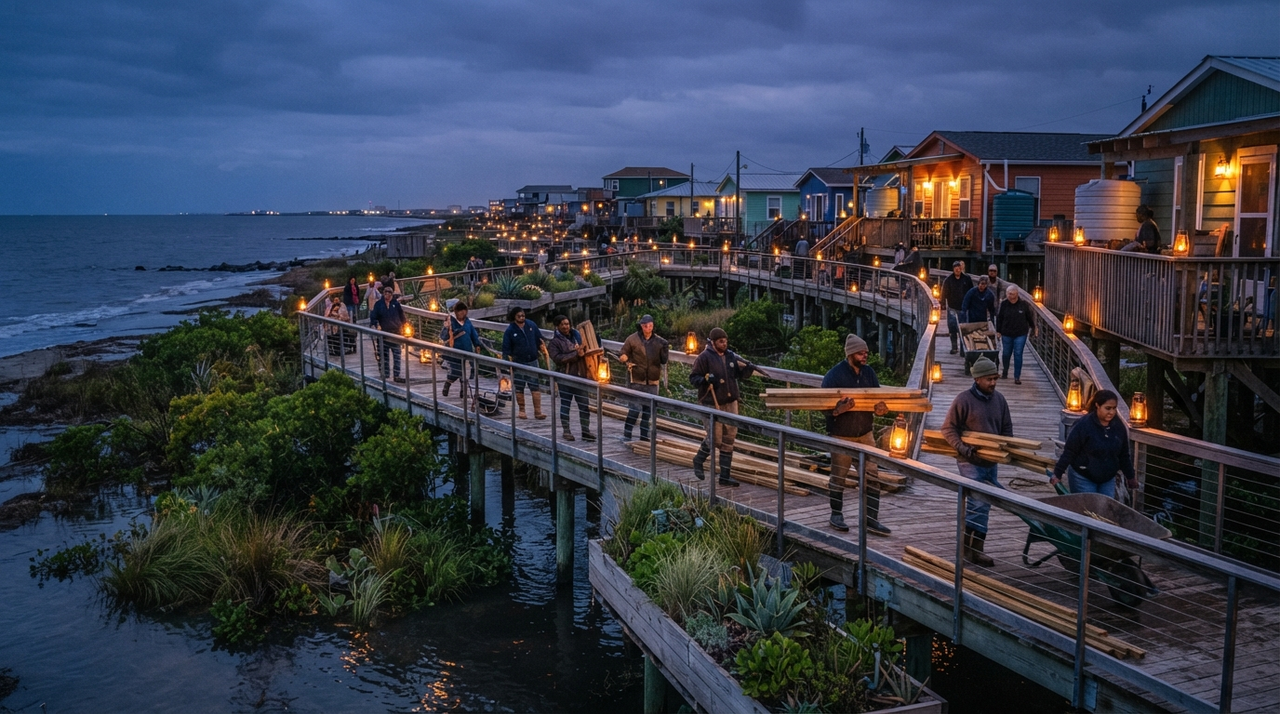
Climate Adaptation Communities: Historical Ingenuity and Resilient Futures for Living with Change
Echoes of Ingenuity: The Roots of Collective Adaptation History
Imagine a city of towering temples, its lifeblood a vast network of canals and reservoirs pulsing under the tropical sun. In the 14th century, as the Khmer Empire at Angkor grappled with shifting monsoons and erratic rains, communities didn't flee—they reengineered their world. Hydraulic systems were rerouted, dikes rebuilt, fields reshaped. This wasn't heroic individualism but collective adaptation history in action: ordinary people, through shared labor and evolving knowledge, authoring a response to environmental flux.
Fast-forward to the misty lowlands of the Netherlands in the 12th century, where windmills creaked against relentless seas. Water boards—early forms of climate adaptation communities—emerged as grassroots governance. Farmers and villagers pooled resources to dig dikes, manage polders, and reclaim land from the waves. These weren't abstract models or dire forecasts; they were tangible proofs of human tenacity, honed over centuries. Closer to home, in the arid Southwest of what's now the United States, Puebloan peoples mastered dryland techniques. Check dams captured fleeting runoff, waffle gardens trapped moisture in sunken grids, and mesa-top settlements blended with the landscape. These societies didn't predict apocalypse; they observed, experimented, and endured.
What sets these stories apart from today's scenario models—those probabilistic projections of sea-level rise or drought intensification—is their grounding in lived precedent. Climate adaptation communities have always existed, not as reactions to catastrophe but as ongoing authorship of place. Modern governance choices, from policy levers to local bylaws, echo this: do we centralize control or devolve it? Invest in hard infrastructure or soft knowledge-sharing? History whispers that resilience blooms where decisions are proximate, iterative, and communal.
Who Holds the Reins? Scale, Power, and the Makers of Adaptation
Adaptation isn't a monolith; it's sculpted by scale—neighborhood to nation—place—from delta to desert—period, from seasonal shifts to generational tides—resources at hand, and crucially, power dynamics. In the Dutch water boards, power was distributed: each household had a vote, stakes tied to the land they tilled. Contrast that with imperial Angkor, where royal decrees funneled labor, yet local ingenuity filled the gaps when central systems faltered.
Deciders and Doers in Climate Adaptation Communities
Who adapts? Often those most exposed: smallholders in flood-prone valleys, fishers eyeing encroaching tides. Who decides? That's the rub. Top-down mandates might impose seawalls, ignoring cultural ties to the shore. Bottom-up councils, like those Puebloan kivas where elders and farmers deliberated, foster ownership. Resources matter too—abundant timber for Dutch dikes, sparse stone for Ancestral Puebloan terraces. Power imbalances persist: colonial legacies sidelined indigenous knowledge, much as today's global north funds adaptation in the south, sometimes overlooking local wisdom.
Living with climate change demands interrogating these layers. Community resilience future hinges on hybrid models: governments setting boundaries, communities filling them with context-specific strategies. It's stewardship—tending the commons—not saviorism from afar.
Frontline Realities: The Lived Pulse of Adaptation
Picture a tidal community worker at dawn, hip boots sinking into salt marsh as they tend oyster beds reshaped by rising waters. Or a farmer in the Mekong Delta, probing soil with callused hands, deciding whether to elevate rice paddies or pivot to saline-tolerant shrimp ponds. These aren't statistics; they're rhythms of dawn patrols, evening assemblies under banyan trees, the ache of uncertainty laced with resolve.
Daily Rhythms in the Face of Flux
In Bangladesh's chars—islands of silt born and drowned by the Brahmaputra—families rebuild homes on stilts, weaving mats from flood-resilient reeds. Farmers in California's Central Valley rotate crops as aquifers dwindle, sharing irrigation lore passed down generations. These experiences reveal adaptation as intimate: the sting of lost harvests, joy of communal feasts from adapted yields, quiet innovations born of necessity. Tidal workers track lunar pulls alongside storm surges, their knowledge a living archive. It's here, in sweat-soaked shirts and murmured strategies, that collective adaptation history breathes today, informing how we live with climate change.
Such lives underscore a truth: resilience isn't engineered perfection but flexible persistence, where communities author their continuity amid disruption.
Choosing Paths: Restoration, Accommodation, Relocation
- Restoration: Reclaiming the past—beach nourishment, wetland revival—functions to hold ground, costs soar with scale, consent requires buy-in from those displaced by dunes or diversions, uncertainty looms if baselines shift.
- Accommodation: Bending without breaking—elevated homes, floating farms—preserves place, balances expense with familiarity, hinges on collective consent, navigates unknowns through phased trials.
- Relocation: Strategic retreat—managed migration—frees hazard zones, upfront costs high but long-term savings, demands profound consent amid grief over abandoned homes, uncertainty in new beginnings.
No pathway is panacea. Dutch polders accommodated for ages before contemplating retreat; Puebloans relocated mesa to mesa, carrying seeds of knowledge. In climate adaptation communities, choice turns on context: function for survival, costs weighed communally, consent as sacred pact, uncertainty met with curiosity rather than dread.
Plural Horizons: Crafting Community Resilience Futures
Doom narratives peddle collapse as destiny, but history and present defy singularity. Climate adaptation communities sketch multiple futures: hybrid agro-cities pulsing with vertical farms and solar canals; coastal coalitions blending indigenous tidal wisdom with sensor networks; inland networks reviving ancient water-harvesting, augmented by shared data pools. These aren't predictions but provocations—invitations to author paths where living with climate change amplifies human potential.
Resilience emerges from diversity: some places harden, others soften, many transform. Collective adaptation history teaches that futures are made, not merely weathered.
Ripples Across Realms: Environment, Sacred Places, Health
Adaptation doesn't silo; it interconnects. Environmentally, climate adaptation communities steward watersheds, fostering biodiversity amid flux. Sacred places—ancient groves, river confluences—demand gentle accommodation, preserving spiritual anchors. Health thrives when communities adapt sanitation to floods, nutrition to shifting seasons, mental well-being through shared rituals. These threads weave a tapestry: resilient environments nourish bodies and souls alike.
Inquiry Awaits: A Journal Prompt to Author Your Path
Reflect: What local signs of change do you observe? How might your community draw from historical ingenuity to author its resilience future? Sketch one small, collective step—what resources, who decides, what lived wisdom guides it?
This isn't endpoint but threshold. Step back into inquiry, for in questioning, we adapt—not as victims of change, but as its conscious co-creators. The ingenuity of old pulses in us still, ready to shape tomorrows worth inhabiting.