
Composition in the Moment: Oral-Formulaic Improvisation from Homer to Griot Rituals
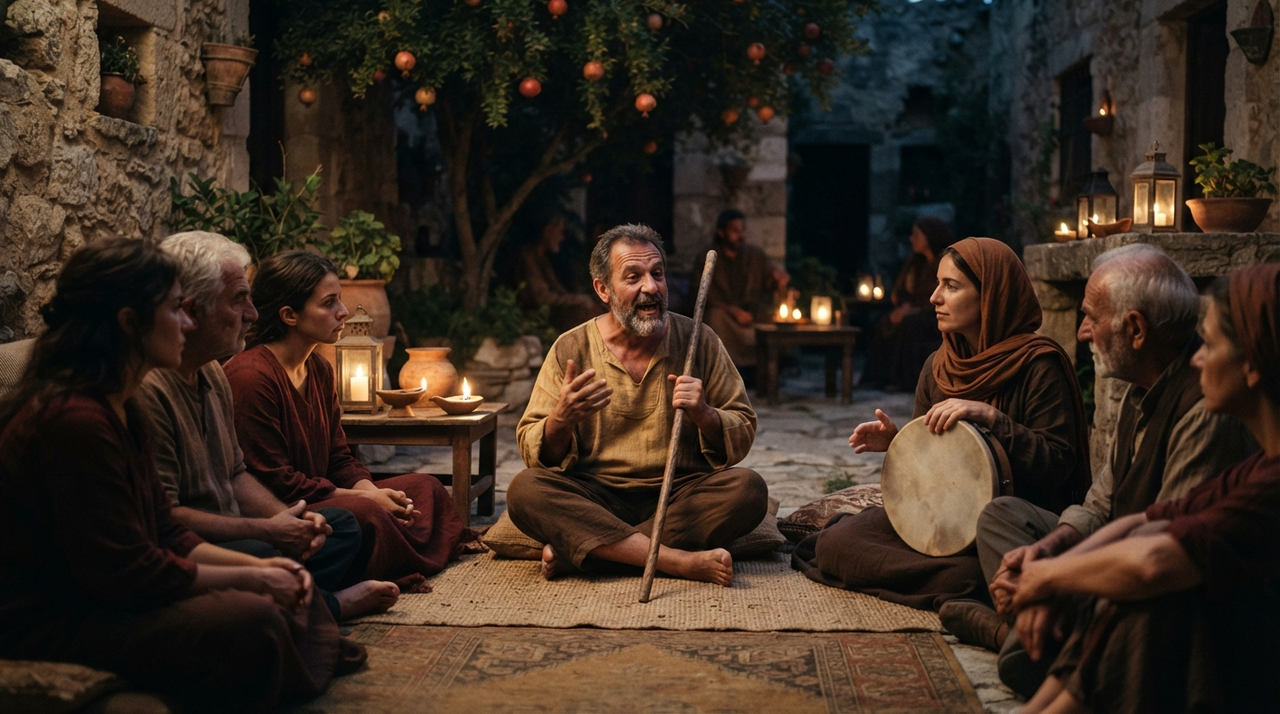
Under a canopy of stars in a Malian village square, a griot strikes the first notes on his kora. The crowd leans in as his voice rises, weaving tales of ancient kings and forgotten battles. Each phrase seems fresh, yet anchored in rhythms passed down through generations. No script in hand, no rehearsal hall behind him. This is composition in the moment, a ritual performance where creativity unfolds live, shaped by audience murmurs and the instrument's insistent pulse.
Such scenes challenge our view of creation as a solitary act yielding polished artifacts. Oral-formulaic composition reveals improvisation history not as wild invention, but as disciplined variation within shared patterns. From the Homeric question to living griot traditions, these practices treat the creative act as ephemeral event, not enduring object.
What Improvisation Conceals and Reveals
Improvisation evokes jazz solos or freestyle rap, boundless flows from the mind. Yet in oral traditions, it names something narrower: composition-in-performance. Singers draw on formulas—stock phrases like "swift-footed Achilles" or melodic motifs—to build epics anew each time. This differs from memorized recitation, where every word stays fixed, or modern concert improvisation, which often breaks from tradition altogether.
Scholars like Milman Parry and Albert Lord did not claim every oral work follows this model exactly. Their work on South Slavic guslars showed how formulas speed composition under real-time pressure, offering a lens for ancient texts rather than universal proof. Oral tradition spans fluid spectra, coexisting with writing, never frozen or lesser.
Three Windows into Oral-Formulaic Worlds
Ancient Greece: The Homeric Question
Did a single Homer compose the Iliad and Odyssey, or did generations of aoidoi shape them through performance? Parry's recordings of Greek songs in the 1930s echoed patterns in Homeric verse: repeated epithets, type-scenes like arming a hero. The poems we read, transcribed centuries later, preserve traces of this process. Yet they cannot confirm one poet's hand or recreate the live voice. The hypothesis illuminates ritual performance in archaic Greece, where audience expectations guided each telling.
South Slavic Epics: Parry and Lord's Field
In 1930s Montenegro, Parry captured guslars like Avdo Mededovic singing nights-long epics on the gusle, a one-string fiddle. Mededovic expanded tales using formulas, stretching a 10,000-line song to 15,000 without faltering. These were not recitations from memory but recompositions, attuned to the coffeehouse crowd. Lord's analysis revealed how formulas—narrative building blocks—freed singers to innovate within meters and themes.
West African Griots: Living Custodians
Among Mandinka griots, or jeli, performance binds history to the present. A griot might recount Sundiata Keita's empire-building, varying genealogies and praises to honor patrons or soothe disputes. The kora's grip, a lattice of strings, enforces modal constraints, much like Homeric hexameter. These traditions thrive today, their practitioners navigating tourist recordings and family lineages with care for communal consent.
Capturing the Unwritten: Transcription's Traps
When Parry's team notated guslars or scribes fixed Homeric lines, they froze fluid events. A griot's performance, laced with calls to listeners, loses immediacy on the page. Scholarly reconstructions blend multiple versions, but risk imposing false unity. Writing serves preservation, yet obscures how each rendition drew vitality from that night's constraints—heckles, nods, silences.
Formulas, Crowds, Limits: Engines of Creation
Creativity here thrives on restriction. Formulas stock the singer's toolkit, enabling speed. Audiences co-author, their reactions steering paths. Constraints—metrical feet, lute tunings—channel invention. Picture the Homeric aoidos pausing as warriors cheer a familiar boast; the griot modulating for a chief's mood. These are not hurdles but scaffolds for variation.
- Formulas as memory aids and creative springs.
- Audience as active shapers, not passive receivers.
- Performance time as the true canvas.
Echoes Across Aetheria Doors
Oral-formulaic composition links to Books Door explorations of text and voice coexistence, Linguistics on formulaic language, Mythology retellings, and music's ritual forms.
Next time a song or story unfolds before you, listen for the variations. Seek not the ur-text, but the living pulse. Through the Aetheria Creativity Door, step into performances where creation breathes in time.