
Consciousness Door #2: Attention, Awareness, Perception & the Global Workspace Mystery
Unlocking the Gates of Perception
Picture this: You're navigating a bustling city street, horns blaring, faces blurring past. Suddenly, a familiar voice cuts through the chaos—a friend's wave from across the road. In that instant, your world narrows. Everything else fades as attention locks onto that one beacon. This is no accident. It's the second door to consciousness, where attention, awareness, and perception dance in a delicate interplay. For seekers mapping the mind visually, understanding this door offers a blueprint to chart your inner spotlight.
In Aetheria AI's journey through consciousness doors, we've passed the first threshold of raw sensation. Now, we peer deeper. Here, neuroscience reveals how your brain filters reality—not just what you see, but what rises to awareness. We'll explore landmark experiments, dissect the global workspace enigma, and equip you with a simple practice to visualize attention's flow.
The Spotlight of Attention: Posner Cuing and the Attentional Blink
Attention isn't passive. It's a dynamic force, sculpted by classic experiments like Michael Posner's cuing paradigm. Imagine a screen with two spots. A cue—a flash or arrow—directs your gaze left or right. If it matches the target's location, you react faster, as if a mental spotlight accelerates processing there. Invalid cues? Sluggish responses. This reveals attention as covert, shifting without eye movement, priming the perceptual field.
When Attention Overloads: The Attentional Blink
Push it harder, and attention falters. In the attentional blink, rapid-fire stimuli stream by—letters in a quick RSVP display. Spot the first target (say, an 'X'), and within 200-500 milliseconds, a second ('Y') vanishes from awareness. It's like your brain's gatekeeper stutters, too busy consolidating the first to register the next. These performance measures—reaction times, accuracy—pinpoint attention's limits, offering seekers a visual metric: plot blinks on a timeline to map capacity.
Awareness Emerges: Masking, Blindsight, and the Perceptual Divide
Attention feeds perception, but awareness? That's the spark of subjectivity. Visual masking buries a brief image under noise or a follow-up pattern, rendering it unconscious. Subjects perform above chance on forced choices—guessing shape or color—yet swear they saw nothing. Blindsight takes it further: patients with damaged visual cortex navigate obstacles or identify emotions in their 'blind' field, all without conscious perception.
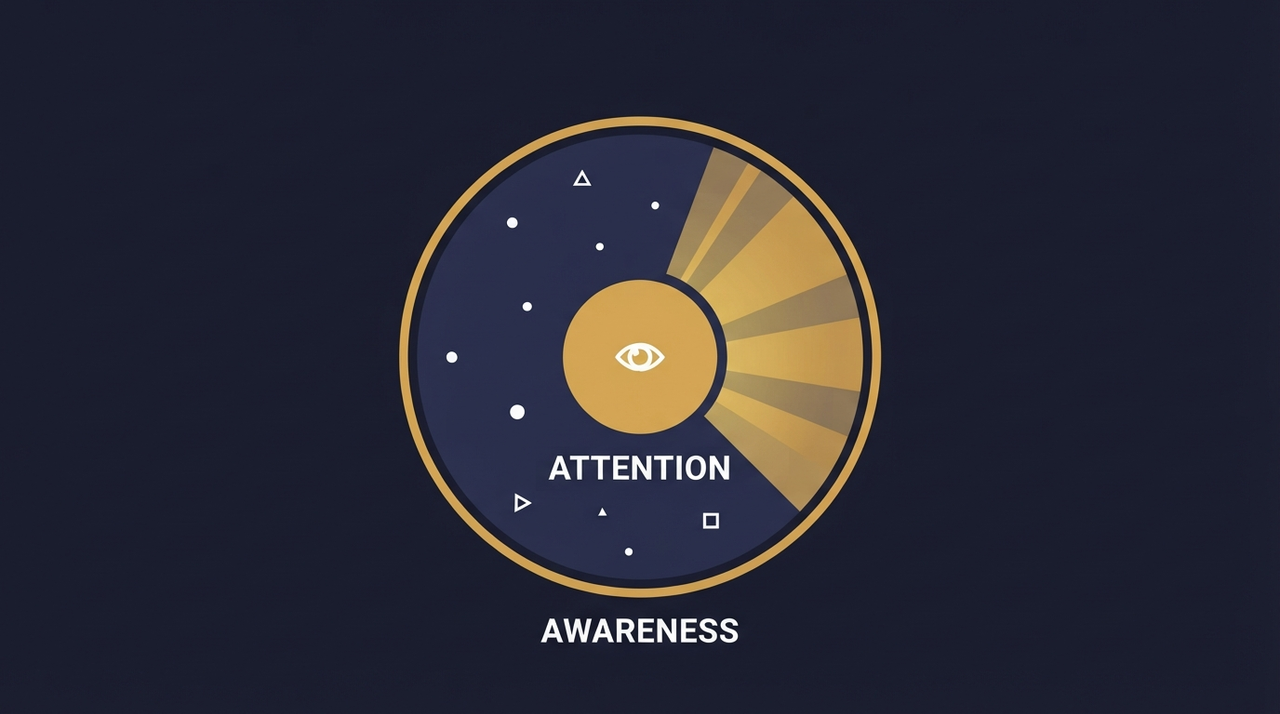
These dissociations highlight the perceptual field: a vast preconscious canvas where most data processes implicitly. Only a sliver pierces awareness. Visually map this as concentric circles—outer haze for unattended input, inner glow for the aware core.
The Global Workspace: Evidence Meets Interpretation
Performance vs. the Conscious Report
Enter the global workspace theory (GWT), Bernard Baars' metaphor turned Stanislas Dehaene's neural model. Consciousness arises when information ignites a 'workspace'—a broadcast across prefrontal, parietal, and cingulate networks. Amplified signals win the competition, entering the global arena for flexible control.
But here's the crux: evidence is behavioral—sensitivity drops sans awareness, neural 'ignition' correlates with reports. Interpretation? GWT explains why, positing workspace access as the conscious threshold. Skeptics note it's one lens; integrated information theory or higher-order views compete. We distinguish raw data (cuing speeds, blink durations) from theory, approaching neural correlates with humility: prefrontal bursts track attention, yet causation eludes us.
Bridging to Neuroscience and the Eye Doors
This door links back to our Eye Doors exploration. Sensory input floods the thalamus and V1, but attention from top-down parietal circuits sculpts it. The perceptual field expands via the eyes' raw feed, narrowed by awareness. Neuroscience humbly charts correlates—fMRI ignitions, EEG P3 waves—but the mystery persists: why does global access feel like 'you'?
For Aetheria AI seekers, visualize as a dynamic graph: nodes for cues, blinks, masks; edges weighted by awareness. Track shifts to demystify the workspace.
Your Practice: Mapping Attention's Shift
Sit quietly. Soft-gaze a neutral scene—wall, window. Notice attention's wander: from breath to itch, face to thought. Jot or sketch: timestamp shifts, rate vividness (1-10). Over days, patterns emerge—a visual map of your global workspace in action. What doors does it unlock?
As you trace these contours, consciousness reveals its artistry. Not a locked vault, but a living theater where attention, awareness, and perception stage reality. Step through—your map awaits.