
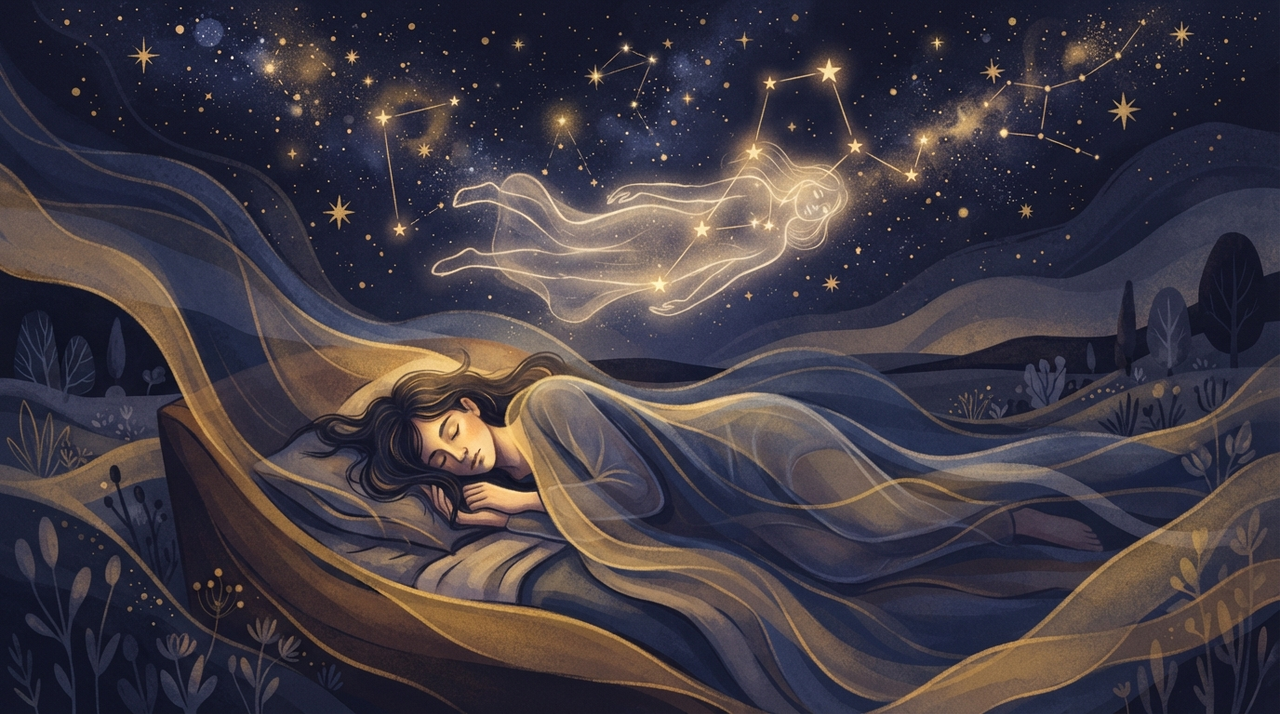
Consciousness in the Shadows of Sleep: Dreams, Selfhood Continuity, and Ancient to Modern Mysteries
Imagine slipping into bed, eyes closing as the world fades, only to awaken in a bustling marketplace where you barter with shadows or soar above jagged mountains on wings of forgotten memory. In these nocturnal wanderings lies one of humanity's oldest riddles: what happens to consciousness during sleep? Dreams challenge our tidy notions of awareness, blurring the line between self and nothingness, reality and reverie. Sleep troubles simple definitions of consciousness because it suspends the vigilant 'I' we cherish by day, yet conjures vivid inner worlds that feel achingly real.
This exploration through Aetheria's cosmic library delves into consciousness sleep dreams, tracing dreaming history from ancient clay tablets to laboratory EEGs. We'll navigate the philosophical puzzle of selfhood continuity—does the same 'you' persist across wakefulness and slumber?—and weigh REM lucid dreaming against cultural lore. Along the way, we'll honor the mystery, distinguishing hard-won facts from enduring interpretations, without chasing false certainties. Join this journey from Mesopotamian omens to modern brain waves, and perhaps glimpse your own nocturnal shadows.
Ancient Threads: Dreaming History and Cultural Dream Interpretation
Long before electrodes tracked brain rhythms, dreams were portals to the divine. In the cradle of civilization, around 2000 BCE in Mesopotamia, scribes etched dream omens onto clay tablets near the lore of the Enuma Elish creation epic. These weren't idle fancies but systematic records: seeing a lion might foretell kingship, a flood disaster. Priests consulted them for guidance, treating dreams as messages from gods piercing the veil of sleep.
Across the Nile, Egyptian dream books from the Chester Beatty Papyrus, dating to around 1300 BCE, cataloged visions with prescriptive wisdom. Dreaming of eating crocodile flesh? Expect triumph over foes. These texts, penned by scribes for pharaohs and commoners alike, framed cultural dream interpretation as practical divination, blending fear and fortune into nightly counsel.
Greek Temples and Philosophical Awakening
By the classical era, Greeks ritualized dreams through incubation—sleeping in Asclepius temples to receive healing visions. Patients arrived feverish or lame, dozing amid incense and whispers, awakening with instructions: 'Bathe in the sacred spring' or 'Offer a white cock.' These weren't psychological therapies but divine interventions, documented in temple inscriptions from Epidauros around 400 BCE.
Aristotle, in his treatise On Dreams (circa 350 BCE), shifted toward naturalism. He described dreams as sensory echoes, remnants of daytime impressions stirred by the sleeping soul. No gods here—just the body's mechanics reshaping perceptions. Yet even he pondered why these phantasms feel so lifelike, planting seeds for inquiries into consciousness sleep dreams.
Modern Eyes on the Night: REM Lucid Dreaming and Sleep Science
Fast-forward to 1953, when Eugene Aserinsky and Nathaniel Kleitman pierced the darkness with science. Observing their young subject's eyes darting rapidly beneath closed lids, they identified REM sleep—rapid eye movement—a stage where brain activity mirrors wakefulness. Awakening people mid-REM yielded rich dream reports: narratives of pursuit, flight, impossible architectures. This established finding reshaped dreaming history, proving dreams cluster in REM but occur across sleep stages.
Continuity vs. Discontinuity: Debating Dream's Fabric
Does dreaming extend waking concerns, or erupt as random neural fireworks? The continuity hypothesis suggests dreams weave daily threads—worries at work morph into surreal boardrooms. Discontinuity counters that bizarre logic stems from brainstem bursts, untethered from self. Evidence tilts both ways: lab studies show thematic overlaps with waking life, yet dream logic defies daytime reason.
Memory consolidation research adds intrigue. During sleep, hippocampus replays day's events, shuttling them to cortex for long-term storage. Dreams might tag along, but this remains an active frontier—not settled proof of purpose. REM lucid dreaming, where sleepers gain awareness and control ('I'm dreaming, let's fly'), spotlights hybrid states. Pioneered in labs by Stephen LaBerge in the 1980s, it confirms volition persists amid reverie, challenging strict sleep-wake binaries.
Yet distinctions matter: we know REM exists and reports vary by recall method. Interpretations—dreams as meaningful portents or neural noise—stray into speculation. No universal symbolic dictionary holds; a falling dream might signal anxiety for one, release for another.
Selfhood Continuity: The Persistent 'I' in Slumber's Abyss
Here the philosophical knot tightens. If consciousness flickers out in deep sleep, what bridges the gap to morning's 'me'? John Locke, in his 1690 Essay Concerning Human Understanding, tied personal identity to memory chains: I am the same self if I remember yesterday's deeds. But dreams disrupt—am I the dreamer of last night's chaos, or a stranger donning my face?
Derek Parfit later refined this in 1984's Reasons and Persons, proposing psychological continuity over bodily persistence. Sleep tests it brutally: blackout voids punctuate awareness, yet we reclaim selfhood seamlessly. Selfhood continuity becomes puzzle: perhaps a core 'witness' endures, or selfhood reconstructs each dawn from memory shards.
Cultural Mosaics of the Dreaming Self
Cultures color this variably, without one true palette. Indigenous Australian traditions see dreamtime as eternal now, linking personal visions to ancestral law. Tibetan Buddhists navigate bardos—intermediate states mirroring sleep-death transitions—cultivating awareness. Western individualism prizes autonomous 'I,' while collectivist views might dissolve self into communal dream lore. These enrich selfhood continuity without flattening to universals.
Echoes Across Doors: Sleep's Kinships
Aetheria's halls connect sleep to deeper mysteries. In the Death & Afterlife Door, ancients analogized sleep to death's little sibling—Homer called it 'twin brother'—both veils lifted at dawn or judgment. Not identical, but resonant invitations to ponder oblivion.
The Ancestors Door whispers of visitations: elders returning in dreams to advise kin, vetted by community elders for authenticity. No solo revelations, but shared authority tempers the ethereal. Psychology Door unpacks cognition's night shift, from Freud's submerged wishes (early 1900s) to today's neuroplasticity views.
Dreams, like stars, guide without commanding—points of light in night's vast sea.
Awakening to Your Shadows: A Reflective Path Forward
We've traversed consciousness sleep dreams from cuneiform to cortex scans, honoring dreaming history and cultural dream interpretation while probing selfhood continuity. Mysteries linger: REM's theater, lucid control's spark, the self's quiet vigil. No panaceas promised—no astral jaunts or instant therapies—just awe at night's artistry.
Step next into your own archive. Keep a bedside journal, noting transition flickers: that hypnagogic haze before plunge, morning fragments before they dissolve. Record as witness, not oracle—colors, emotions, recurring motifs. Over moons, patterns may emerge, not as cosmic code but personal cartography. In this gentle practice, sleep's shadows yield to curious light, inviting you deeper into Aetheria's endless inquiry.
What dreams await your pen?