
Craft Knowledge and Iteration Creativity: The Embodied Power of Experimental Making
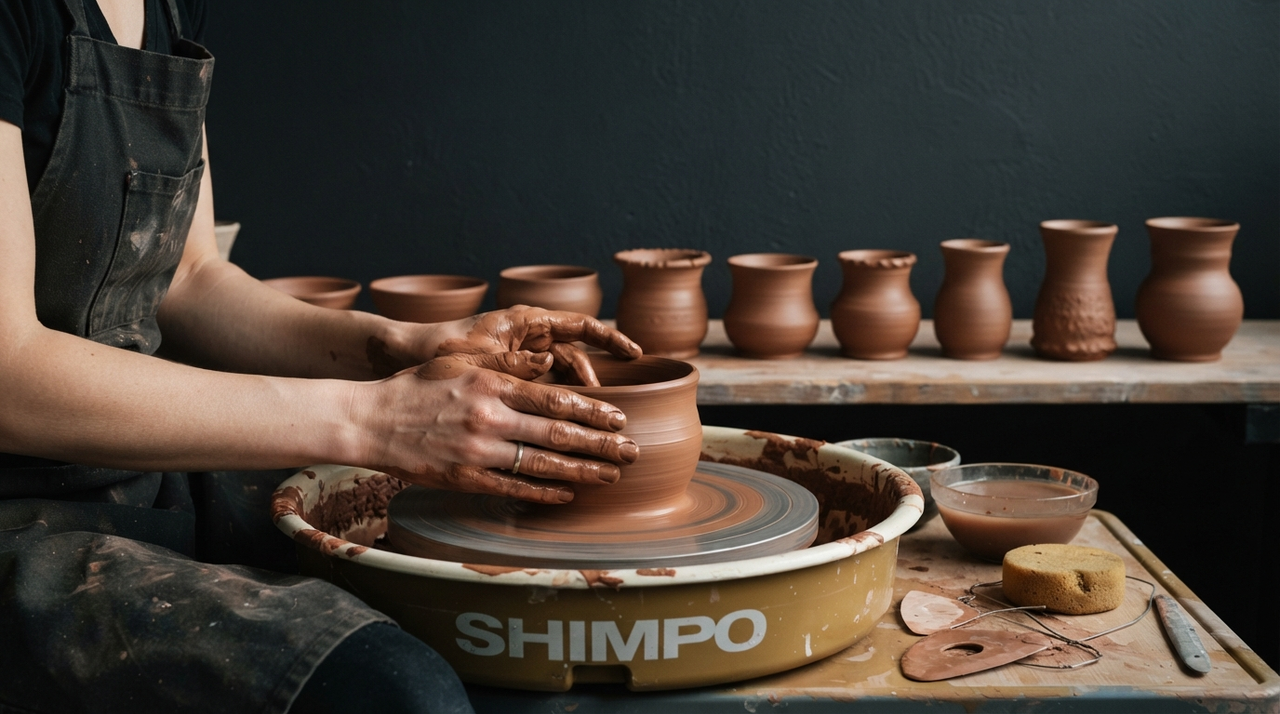
A potter’s thumb presses into wet clay and the wall of the vessel thins just enough to catch the light. Too thin and it collapses. Too thick and the fire will crack it. That single adjustment—felt more than measured—is craft knowledge at work. It is not an idea about creativity. It is creativity enacted through material resistance, repeated failure, and the slow accumulation of judgment that only hands and eyes can store.
On Aetheria’s Creativity Door we have examined imagination as mythic spark, as collaborative dialogue, and as disciplined practice. This companion piece turns toward something quieter and older: the embodied power of experimental making. Here craft knowledge stands apart from abstract psychological theories that treat creativity as a universal mental operation. Craft knowledge is local, material-tested, and earned through iteration creativity—the cycle of test, fail, adjust, keep. It lives in tacit knowledge and material intelligence, the knowing that cannot be fully written down yet can be recognized in the finished object.
Historical Traces of Experimental Making
Fourteen thousand years ago on the Japanese archipelago, Jōmon potters layered cord-marked clay into vessels that still astonish by their scale and surface. Each new coil was a hypothesis. The community tested how deep impressions could go before the wall failed in the open fire. Failures became shards; successes became the next generation’s starting point. Place, period, medium, community: the Jōmon coast, Paleolithic-to-Neolithic transition, earthenware, village potters whose names we will never know. Their iteration creativity left a continuous record of material intelligence.
Twelve centuries later and half a world away, builders in the Islamic world refined muqarnas—those honeycomb vaults that seem to dissolve stone into light. In twelfth-century workshops from Isfahan to Granada, masons prototyped plaster and brick cells on temporary wooden armatures. A cell that cracked under its own weight was dismantled; one that locked cleanly was measured, remembered, and scaled. The geometric elegance we admire today is the visible residue of countless discarded trials. Authority rested with master builders who controlled access to scaffolds and commissions, yet the knowledge itself circulated through the labor of apprentices who felt every imperfect joint.
In the American Southwest, Pueblo potters of the tenth through fourteenth centuries pursued black-on-white ceramics with fierce experimental focus. At sites such as Chaco Canyon and later Mesa Verde, makers altered mineral slips, firing atmospheres, and brush techniques. A design that blurred was scraped away; a carbon-trap black that held its edge became the new standard. Again the pattern is clear: test, fail, adjust, keep. Craft knowledge advanced not by sudden genius but by collective, material conversation across generations.
Tacit Knowledge, Material Intelligence, and the Conditions That Shape Them
What these histories share is the primacy of tacit knowledge—knowing that resides in gesture, timing, and the body’s conversation with matter. Material intelligence is the reciprocal half of that dialogue: clay, plaster, and slip “speak” through collapse, warping, or unexpected sheen. Iteration creativity is simply the disciplined willingness to listen and answer again.
Yet listening requires time and protection. Workshops historically shielded experimental making by allocating unbillable hours, scrap materials, and the right to fail without immediate economic penalty. Commissions could enable the same process when patrons accepted risk—funding a muqarnas trial vault, for instance—or they could choke it by demanding perfect replicas on short deadlines. Access to raw materials, kiln space, or even the authority to decide when a piece was finished has always been unevenly distributed. Craft knowledge therefore cannot be romanticized as pure individual talent; it is inseparable from labor conditions and institutional power.
Crossings: Sacred Places, Writing & Memory
The same experimental making shaped the craft of temple building explored in our Sacred Places Door. There, stone and timber were coaxed into sacred geometry through identical cycles of prototype and revision. Meanwhile, the Writing & Memory Door reminds us how unevenly these techniques were recorded. Some workshop secrets traveled only through bodies; others were codified in pattern books that still freeze living judgment into static diagrams. Both absences and inscriptions matter.
Noticing the Traces
Craft knowledge and iteration creativity remain available wherever someone still meets material on its own terms. They do not require genius or special neural wiring—only attention, repetition, and the institutional grace of time to fail usefully.
Look now at an object within reach: a ceramic mug, a wooden spoon, a stitched notebook. Can you see the faint ridge where a coil was joined, the slight asymmetry of a handle adjusted mid-throw, the place where a tool slipped and was corrected? Those marks are not flaws. They are the visible grammar of experimental making. Sit with them a moment. What iteration do they quietly ask of you next?