
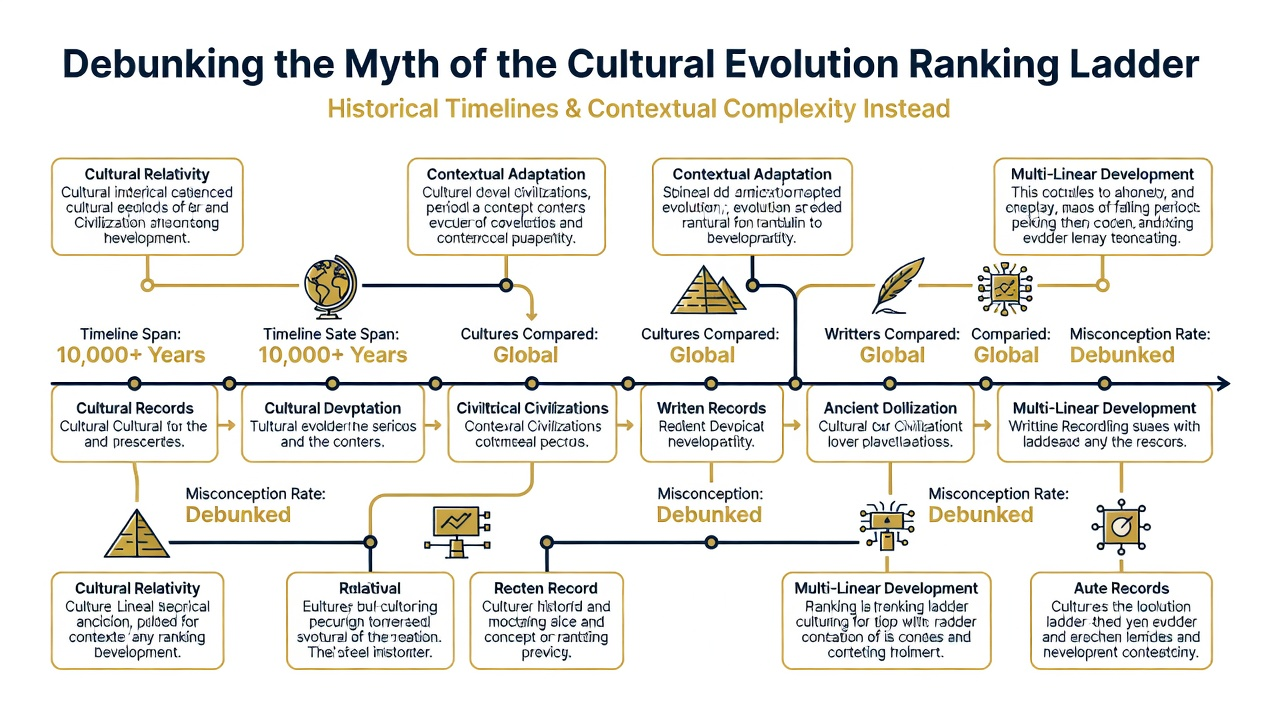
Cultural Relativism vs. Evolutionism: Boas' Historical Particularism Revolutionizes Anthropology Comparisons
Picture a Victorian-era museum hall, shelves groaning under arrowheads, totem poles, and clay pots meticulously arranged from "savage" to "civilized." This was the spectacle of 19th-century anthropology comparison, a unilinear evolutionism that ranked human societies on a grand ladder of progress. European scholars peered from the top rung, deeming their own culture the pinnacle. But what if this ladder was a mirage, built on borrowed artifacts stripped of story?
Enter Franz Boas, the German-born anthropologist who shattered this framework. His Boas historical particularism insisted each culture follows its own path, shaped by unique histories rather than universal stages. This revolution birthed cultural relativism and anti-evolutionism anthropology, urging us to compare not by ranking, but by contextual immersion. For comparative thinkers craving responsible frameworks, Boas offers a compass: navigate with chronology, place, power, and primary evidence.
The Evolutionist Ladder: Critiquing Early Anthropology Comparison
Nineteenth-century evolutionists like Lewis Henry Morgan and Edward Tylor envisioned human cultures climbing identical rungs: savagery, barbarism, civilization. This anthropology comparison treated societies as specimens on a timeline, with Western industrialism as the goal. Artifacts fueled the illusion—spears from Pacific islands labeled "primitive tools," ignoring their makers' sophisticated ecological knowledge.
Yet cracks appeared. Why did some "primitive" groups boast complex art or governance? The ladder crumbled under scrutiny, revealing ethnocentrism masked as science. Boas decried this as pseudoscience, arguing it justified colonial dominance by deeming non-Western ways inferior.
Colonial Collecting: Artifacts Without Stories
European explorers and missionaries amassed global treasures, shipping them to museums sans context. A Haida mask from the Pacific Northwest might sit beside an Egyptian scarab, implying equal "primitiveness." Diffusion—the spread of ideas, technologies, and practices through trade, migration, or conquest—was overlooked. Cultures weren't isolated stages but interconnected webs.
Boas witnessed this firsthand during his 1883 Baffin Island expedition among Inuit communities. He collected not just objects, but songs, myths, and measurements, tying them to local environments and histories. This holistic approach exposed evolutionism's blind spots.
Boas Historical Particularism: The Anti-Evolutionism Anthropology Shift
Each Culture's Unique Trajectory
Boas historical particularism posits no universal ladder. Cultures evolve through particular histories: diffusion from neighbors, environmental adaptations, internal innovations. Working with Kwakiutl peoples on Vancouver Island, Boas documented potlatch ceremonies not as "barbaric waste," but as strategic reciprocity reinforcing social bonds.
This anti-evolutionism anthropology rejected rankings, embracing cultural relativism: judge practices by internal logic, not external yardsticks. A Kwakiutl chief's lavish giveaway mirrored elite European patronage, yet evolutionists slotted it low.
Responsible Anthropology Comparison: Context Over Universalism
True anthropology comparison demands careful context, distinguishing it from the universal ladder. Chronology matters: a practice's age reveals continuity or rupture. Place anchors it—desert nomads' water rites differ from coastal fishermen's. Power dynamics expose biases: who collected, who interpreted? Primary evidence—field notes, oral histories—grounds analysis.
- Map timelines: When did traits emerge?
- Pinpoint locales: How does geography shape form?
- Unpack power: Whose voice dominates records?
- Prioritize primaries: Artifacts alone deceive.
Without these, comparisons devolve into caricature. Boas trained students like Ruth Benedict to immerse deeply, yielding nuanced portraits over hierarchies.
Ethics in Cultural Relativism: Permission, Reciprocity, and Beyond
Cultural relativism isn't license for uncritical acceptance; it's a call for ethical rigor. Comparison requires permission from communities, reciprocity in sharing knowledge. Boas advocated returning data to sources, fostering collaboration over extraction.
Explore deeper in our History Door for chronological tools, or the Ethics Door for reciprocity frameworks. In Aetheria AI's comparative ethos, these guard against neocolonial pitfalls.
A Boasian Method for Anthropology Comparison: Named and Limited
Adopt the Boasian Comparative Method: (1) Gather primary evidence in situ; (2) Reconstruct particular histories via diffusion and adaptation; (3) Compare traits only within shared contexts; (4) Bracket judgments for relativism. Limits? It resists grand theories, demanding endless fieldwork. No quick ladders here—just patient bridges between worlds.
In forgoing rankings, we gain understanding: cultures as constellations, not steps.
This framework empowers responsible thinkers. Dive into anthropology comparison anew, Boas-style.