
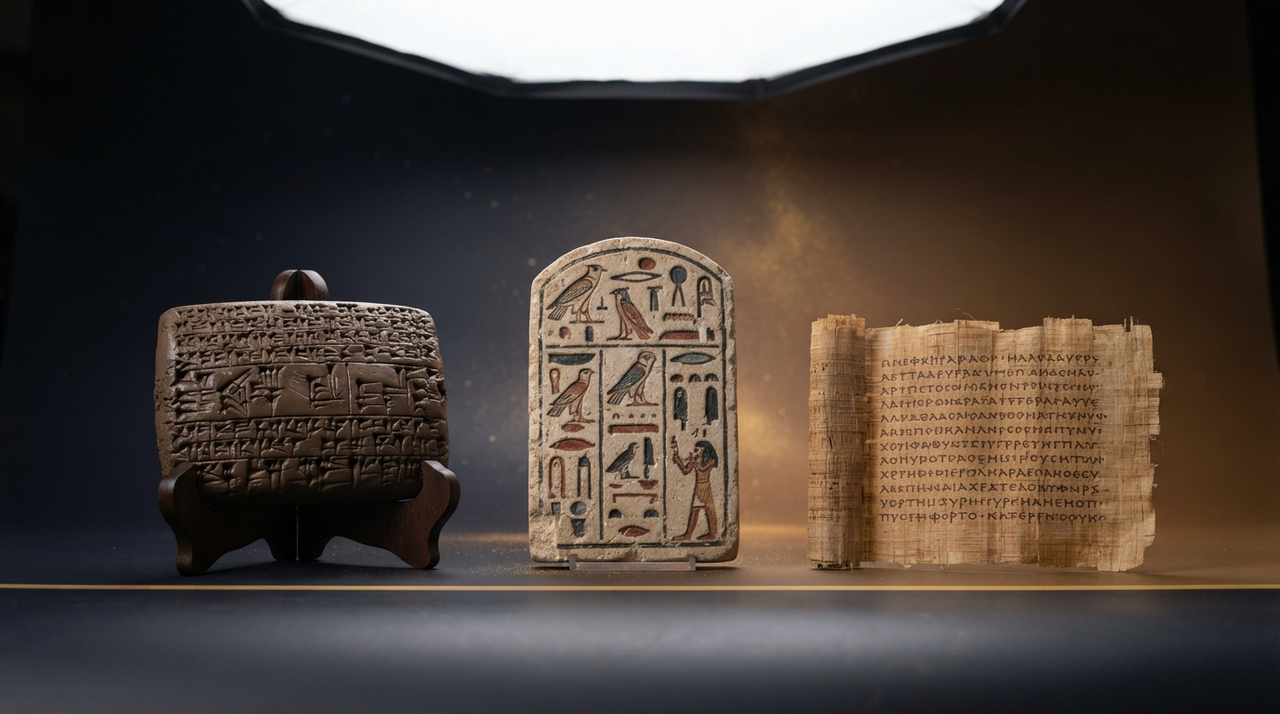
Cuneiform Unveiled: Script vs. Sumerian & Akkadian Languages – Ancient Tablets' Secrets
Picture this: a dusty Mesopotamian dig site, where archaeologists unearth a clay tablet etched with mysterious wedge-shaped impressions. These aren't random scratches—they're cuneiform, one of humanity's oldest writing systems. But here's the twist that trips up even seasoned scholars: cuneiform is a script, not a language. It's a versatile tool wielded by speakers of the Sumerian language, then adapted for Akkadian and beyond. As students of ancient languages, grasping this distinction unlocks the secrets of those ancient tablets, revealing not just words, but worlds.
In the cradle of civilization—southern Mesopotamia around 3200 BCE—cuneiform emerged as a revolutionary writing system. Pressed into soft clay with a reed stylus, its wedge-like signs (from Latin cuneus, meaning 'wedge') started as pictographs for accounting: sheep counts, grain tallies. Over centuries, this script evolved into a logographic-syllabic hybrid, capable of representing ideas, sounds, and grammar. Yet cuneiform itself speaks no tongue; it's the vehicle for the speech communities that shaped it.
Cuneiform: A Script, Not a Language
Think of cuneiform as alphabet soup's ancient ancestor—a toolbox of about 600 signs by its classical peak, each with multiple phonetic or semantic values. This flexibility allowed one script to serve multiple languages, much like Latin script today carries English, French, or Polish. The key? Distinguishing the writing system from the language it encodes. Sumerian, an isolate with no known relatives, was cuneiform's birthplace. Akkadian, a Semitic powerhouse, borrowed and reshaped it.
Sumerian Language: The Original Voice
The Sumerian language hummed through Uruk's bustling streets, agglutinative and alien, stacking morphemes like bricks. Early tablets from Uruk IV (circa 3100 BCE) show proto-cuneiform tallying goods, evolving by 2600 BCE into full texts: myths, laws, hymns. Sumerian scribes used the script logographically at first—signs as words—then syllabically for pronunciation. But Sumerian faded as a spoken language by 2000 BCE, lingering as a liturgical relic, like Latin in the Church.
Akkadian's Bold Adaptation of Cuneiform
Enter Akkadian speakers—Amorites and Babylonians—who conquered Sumerian lands around 2300 BCE. They didn't invent a new writing system; they hijacked cuneiform. Adapting it for their Semitic roots meant tweaking signs: Sumerian MU ('name') became Akkadian šumu, rephoneticized. Tablets from Nippur and Nineveh brim with bilingual texts—Sumerian alongside Akkadian—proving the script's portability. Old Babylonian letters, contracts, and epics like Enuma Elish showcase this evolution, with cuneiform signs now prioritizing syllables over logograms.
- Primary Evidence: Thousands of clay tablets, from mundane receipts to the Epic of Gilgamesh.
- Historical Context: Scribal schools (edubba) trained Akkadian youth in Sumerian classics, fostering diglossia.
- Scholarly Interpretation: Decipherment in the 19th century via Henry Rawlinson's Behistun trilingual.
This adaptation highlights cuneiform's genius: a single script bridging speech communities, from Sumerian isolates to Akkadian traders rippling across the Near East.
Unraveling Tablets: Transliteration and Archaeology
The Art of Transliteration
Transliteration bridges us to these ghosts: converting cuneiform signs (e.g., 𒀭 for AN, 'sky god') into Latin letters like dINGIR. Tools like the Pennsylvania Sumerian Dictionary reveal polyphony— one sign, many sounds—demanding context. Students, master this, and tablets whisper: a 2100 BCE Ur III contract reads lugal-e nam-ti-la-ni-še3 inanna-ra mu-na-sum ('The king gave life to Inanna').
Archaeology's Treasures and Memory Doors
Archaeology gifts us these portals—'Writing-Memory Doors' in Aetheria AI's lens—unlocking collective memory. Excavations at Ebla, Mari, and Hattusa yield Hittite and Hurrian cuneiform variants, proving the script's wanderlust. Scribal training texts detail rote memorization, sign lists, ensuring fidelity across languages. No universal code speculation here; evidence grounds us in adaptive genius.
Why This Matters for Ancient Language Students
Grasping cuneiform's distinction from Sumerian language or Akkadian dispels myths: one script doesn't birth all languages, nor does a writing system equal speech. It's a testament to human ingenuity—Mesopotamians engineered a system enduring 3,000 years, outlasting empires.
From clay to code, cuneiform invites us to decode our shared past.
Ready to peer through these Memory Doors? Dive into Aetheria AI's tools for interactive transliteration, tablet simulations, and archaeological quests. Unveil the secrets yourself—what ancient voice will you hear next?