
Disability History Unveiled: Legal Impairment, Bioarchaeology of Care, and Community Across Eras
This essay provides a historical exploration of disability as a category shaped by law, community, and care practices. It is not medical advice or personal guidance.
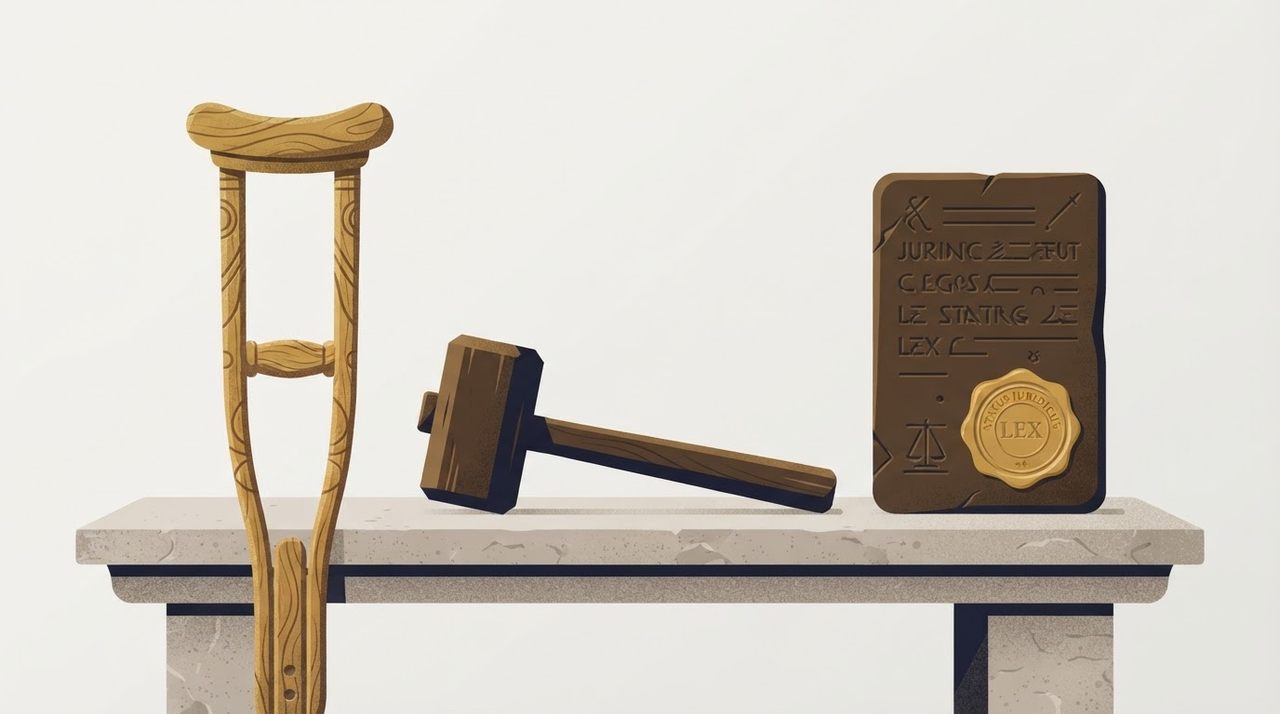
Picture a laborer in ancient Mesopotamia, mid-second millennium BCE, balancing on a crutch carved from olive wood. His right leg bears the mark of a poorly healed fracture, the result of a fall from scaffolding during temple repairs. In his hand, he clutches a clay tablet, freshly inscribed by a scribe. The text exempts him from corvee labor due to his "lame foot," while assigning him lighter duties weaving reeds for baskets. This worker's name appears alongside his impairment, not as a footnote of pity, but as a precise legal descriptor determining his obligations to the palace economy.
Such scenes emerge from cuneiform records, where bodily differences intersect with work and law. They anchor our study of disability history, revealing how societies categorized people not through modern medical lenses, but via practical concerns of capacity, purity, and belonging. This article traces these threads across eras, distinguishing raw impairment from layered social responses.
Distinguishing Impairment from Legal and Social Categories in Disability History
Impairment names a bodily or sensory difference: a shortened limb, diminished hearing, episodic seizures. Yet history rarely stops there. Societies wrap these realities in rules governing action and status. Legal incapacity might bar someone from witnessing contracts or inheriting property. Ritual purity codes could exclude those with visible scars from sacred spaces. Charity frameworks positioned others as recipients, their labor devalued. Only in recent centuries did "disability" crystallize as a rights-bearing language, claimed by communities advocating access and autonomy.
Consider the spectrum. A congenital blindness in ancient Egypt prompted notations in tomb reliefs, signaling priestly ineligibility under purity taboos, yet the same individual might scribe administrative papyri. In contrast, a battlefield amputation triggered compensation schedules, tying value to pre-injury productivity. These distinctions matter. They show impairment as a starting point, reshaped by context into legal status of impairment.
From Bodily Fact to Social Rule
Early texts prioritize function over etiology. Mesopotamian laws assess outcomes: loss of an eye demands equivalent restitution from the injurer, scaled by class. Biblical codes in Exodus and Deuteronomy echo this, mandating support for widows, orphans, and the "lame," grouping them as vulnerable yet communal members. Greek philosophers like Aristotle pondered sensory lacks philosophically, deeming the deaf-and-blind unfit for citizenship, while Roman jurists debated guardianship for the "furiosi" - those with mental wanderings.
Medieval Europe layered feudal oaths atop poor laws, excluding "maimed" beggars from guilds unless they proved skill. By the Enlightenment, bureaucratic tallies categorized "idiots" and "lunatics" for institutional relief, paving paths to modern welfare states.
Legal Status of Impairment: Cases Spanning Mesopotamian Codes to Modern Rights
Legal texts offer genre-bound glimpses. Mesopotamian law codes, like those of Hammurabi or Lipit-Ishtar, detail injury tariffs. A surgeon botching an operation on a gentleman's eye forfeits his hands; success brings fees. These rules limit scope to compensable harms, silent on chronic or congenital conditions. Surviving contracts mention "the one-eyed potter" hiring apprentices, indicating ongoing trade despite monocular vision.
Greek and Roman Realities Beyond Elite Depictions
Greek vase paintings show hunchbacked slaves pouring wine, Hephaestus limping in myths as divine artisan. Yet epigraphic evidence from Athens lists "cripples" receiving state grain allotments, blending welfare with military exemption. Romans erected statues of deformed gladiators who survived bouts, honoring prowess. Digesta fragments rule on "哑巴" - mutes - as ineligible for certain vows, yet capable in trade if gestures sufficed.
Medieval Guilds, Poor Laws, and Exclusionary Work Norms
In twelfth-century England, guild charters barred "lepers" and "blind" from membership, protecting craft monopolies. Poor laws from 1388 targeted "sturdy beggars" but spared the "impotent poor," creating categories for parish relief. Court rolls record "John the Lame" fined less for poaching, his mobility invoked as mitigation.
Twentieth-Century Disability Rights: Community-Led Authority
The mid-twentieth century birthed disability rights as political praxis. Leaders from pulpits and protests reframed "handicaps" as barriers erected by society. The 1973 Rehabilitation Act in the US, pushed by cross-disability coalitions, mandated accessibility. This movement's strength lies in its originators: those living the categories, authoring their legal reclamation.
Bioarchaeology of Disability: Uncovering the History of Care in Skeletal Remains
Skeletons whisper of survival against odds, fueling bioarchaeology of disability. A Neanderthal from Shanidar Cave, Iraq, endured arm amputation, blindness in one eye, and skull fractures, living years post-injury around 50,000 years ago. Roman-era remains from York show a young man with Klippel-Feil syndrome - fused neck vertebrae - who reached adulthood, his diet matching peers' via stable isotope analysis.
These cases index care: modified tools, shared food, accommodated labor. Yet debates rage. Pioneers like Lorna Tilley argue for intentional "osteobiographies," reading investment in the impaired as ethical choices. Critics caution over-romanticizing; survival might stem from passive tolerance or family duty, not altruism. Healed fractures on a Neolithic child's femur from Sunghir, Russia, suggest intervention, but contextualize within kin networks, not universal compassion.
Bioarchaeology reveals not just healed bones, but communal scaffolding enabling lives.
The method probes history of care, distinguishing neglect's absence from active support. A Byzantine monk's skeleton with severe scoliosis, buried with chalices, implies continued ritual role.
Mental Difference Across History: Melancholy, Holy Fools, and Asylums
Mental distress evades bone records, surfacing in texts. Hippocratic humoral theory framed "melancholy" as black bile excess, treatable by regimen. Medieval hagiographies lionized "holy fools" - erratic seers like Basil the Blessed, wandering Moscow in rags, revered for prophetic interruptions.
Renaissance asylums like Bethlem in London housed "lunatics" for public viewership, blending custody with spectacle. Enlightenment reforms shifted to moral treatment, chaining yielding to labor yards. Avoid mapping these onto DSM categories; a "distracted" villager in 1600s Essex court records might wander fields conversing with spirits, community response oscillating between tolerance and restraint.
- Ancient: Divine possession or humoral imbalance.
- Medieval: Sacred eccentricity or demonic trial.
- Early modern: Confinement as civic hygiene.
These narratives highlight fluctuating community membership and disability, where mental difference disrupted yet enriched social fabrics.
Community Membership and Disability: Kinship, Work, and Belonging
Who worked? Egyptian tomb models depict dwarf overseers measuring grain. Viking sagas note one-handed berserkers wielding axes left-handed. Kinship endured: Anglo-Saxon wills bequeath land to "feeble-minded" nephews under guardians.
Intersections Across Doors
Ethics ponders duty to the impaired; Relationships query caregiving webs; Business weighs productive inclusion; Politics contests rights allocation; Archaeology unearths embodied histories. These cross-doors link impairment to existence's broader study.
An Invitation to Historical Inquiry
Next time a source names someone by body-term - "the hunchback fuller," "blind singer" - pause. What work did they hold? Kinship ties? That crutch-bearing Mesopotamian wove on, his tablet securing place in the weave of community. Disability history unveils not deficits, but durable human continuums. Seek these patterns; they illuminate our shared scaffolding.
In this light, past and present converse, urging precise seeing over stereotype.