
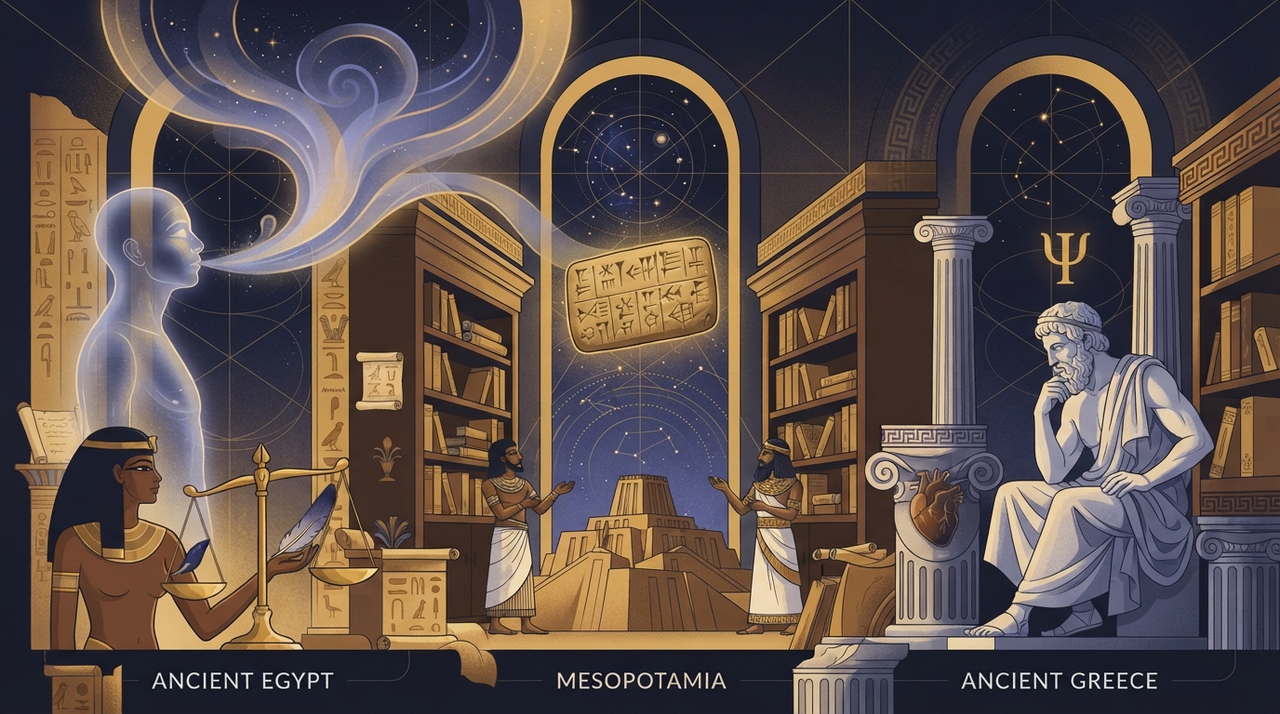
Echoes of Ancient Consciousness: Ba, Ka, Psyche, and the Forgotten Soul Concepts of Egypt, Mesopotamia, and Greece
Picture a scribe in the shadow of the pyramids, chisel in hand, etching symbols that whisper of the self's hidden layers. Not a unified "soul" as we might imagine it today, but a constellation of forces—breath, vitality, personality—struggling against the void of death. Students of existence, welcome to the history of soul concepts, where ancient consciousness stirs not as modern neuroscience retrofitted to papyrus, but as the raw poetry of human wonder.
This piece orients us through the mists of Egypt, Mesopotamia, and early Greece. We tread carefully: no imposing contemporary definitions of consciousness backward onto these terms. Instead, we uncover what the texts themselves reveal—funerary spells, medical incantations, epic laments—and distinguish stark findings from later interpretations. Why does this matter? These early maps of the inner world shaped how humanity has long navigated mortality, identity, and the unseen. As seekers, we protect the journey by honoring their strangeness.
The Egyptian Constellation: Ba, Ka, and Ib in Funerary Cosmos
Our voyage begins along the Nile, circa 2400 BCE, in the Pyramid Texts inscribed within the stone chambers of Unas, the last king of the Fifth Dynasty. These are the oldest religious writings known, uttered by priests to propel pharaohs into eternity. Here emerges the Egyptian Ba, Ka, and Ib—not a singular soul, but interlocking aspects of personhood, each with roles in life and beyond.
Unpacking Ba, Ka, and Ib
The Ka arrives at conception, a divine spark or double, visualized as a human figure with upraised arms (ka hieroglyph). It embodies vitality and needs daily sustenance—bread, beer, incense—via offerings. Texts from the Old Kingdom (2686–2181 BCE) describe the Ka lingering near the mummy, hungry if neglected. Without it, no true existence post-death.
Enter the Ba, depicted as a bird with the deceased's head, mobile and manifesting in dreams or visions. Pyramid Texts spell PT 474 portrays the Ba ascending to the sky, uniting with the sun god Re by day, returning to the body at night. It's the personality's wanderer, bridging earthly and divine realms. By the Middle Kingdom's Coffin Texts (c. 2000 BCE), the Ba gains nuance, manifesting as senses or powers.
At the core beats the Ib, the heart, seat of thought, will, and moral judgment. In the New Kingdom's Book of the Dead (c. 1550 BCE), Spell 30B implores: protect the Ib from being cast out. It's weighed against Ma'at's feather in the Hall of Judgment—truth's balance. Findings are clear: these are not ethereal ghosts but functional necessities for afterlife navigation. Later interpreters, from Plutarch to modern Egyptologists, speculate on psychological parallels, but the texts prioritize ritual efficacy over metaphysics.
Together, they form the Akh, a transfigured being of light. Speculation marks here: did Egyptians intuit a composite self akin to modern multiplicity? Texts don't say; they prescribe spells.
Mesopotamian Whispers: Napistu and Zaqiqu Amid Clay Tablets
Shift eastward to the cradle of cities, Sumer and Akkad, from 3000 BCE. Cuneiform on clay—from medical omens to the Epic of Gilgamesh (standard version c. 1200 BCE)—unveils a breath-centered view of ancient consciousness. No tidy triad, but fluid notions tied to wind, ghost, and life-force.
Breath as Essence: Napistu and Beyond
Central is napistu (Akkadian), or "napāštu," literally "breath" or "nostril-breath," the animating puff from gods at creation. In Atrahasis epic (c. 1800 BCE), Enki molds humans, Mami breathes napistu into clay. It departs at death, leaving a shell. Medical texts like the Diagnostic Handbook (7th c. BCE) link disrupted napistu to seizures—practical, not poetic.
Then zaqiqu (or zaqīqu), the roaming shade or ghost, akin to wind (zaqāqu). Gilgamesh mourns Enkidu's zaqiqu descending to Irkalla's dust. Ghosts haunt if unburied, demanding libations. Etemmu overlaps as personal shade. Sources—tablets from Nineveh's library (Ashurbanipal, 7th c. BCE)—emphasize communal rites: family feeds the shade to prevent unrest. Interpretation caution: these aren't immortal souls but precarious echoes, vulnerable to neglect. No evidence of unified consciousness; breath sustains, death dissipates.
Greek Metamorphoses: Psyche, Pneuma, and Philosophical Refinements
By the 8th century BCE, Homer's Iliad echoes these windswept motifs. Psyche flutters from Hector's lips as death claims him—breath-life, not mind or soul. It's thymos (spirited vigor) that rages in battle; psyche merely animates.
From Homeric Breath to Platonic Immortal
Heraclitus (c. 500 BCE), fragment B45: "You will not find the boundaries of psyche by traveling..." Logos, rational fire-principle, hints at deeper order. Plato elevates: in Phaedo (c. 380 BCE), psyche is eternal, caged in body, recollecting Forms. Republic's tripartite soul mirrors desires, spirit, reason.
Aristotle's De Anima (c. 350 BCE) demotes: psyche as entelechy, body's form—vegetative, sensitive, rational. Pneuma emerges later, Stoics (3rd c. BCE) as fiery breath pervading cosmos and self. Findings: evolution from poetic breath to systematic analysis. Speculation: Platonic psyche owes debts to Orphism, perhaps Egyptian via trade? Texts trace Homeric roots primarily.
Mapping the Echoes: A Comparative Lens on Ancient Consciousness
How do these concepts converse across deserts and seas? Not as proofs of universal energy, but as culturally tuned responses to mortality. Let's compare via function, context, and divergences.
| Concept | Function | Context | Key Sources |
|---|---|---|---|
| Egyptian Ba | Mobile personality, sky traveler | Funerary ascent | Pyramid Texts (2400 BCE) |
| Ka | Vital double, sustenance-needing | Offering rites | Coffin Texts (2000 BCE) |
| Ib | Heart-mind, moral core | Judgment hall | Book of the Dead (1550 BCE) |
| Mesopotamian Napistu | Animating breath | Creation/medicine | Atrahasis (1800 BCE) |
| Zaqiqu | Roaming ghost | Underworld appeasement | Gilgamesh (1200 BCE) |
| Greek Psyche (Homeric) | Life-breath | Poetic death | Iliad (8th c. BCE) |
| Pneuma (Stoic) | Cosmic breath-spirit | Philosophy | Chrysippus (3rd c. BCE) |
Functions converge on animation and post-death persistence, contexts span funerary (Egypt heavy), medical (Mesopotamia), poetic/philosophic (Greece). Pathways? Trade along Levantine coasts might carry motifs—Ba-bird to psyche-butterfly—but differences glare: Egypt's multiplicity vs. Mesopotamia's dissipating breath, Greece's rational ascent. Community authority rested with priests/scribes; no lone mystics dictating.
For deeper dives, cross to Aetheria's Death & Afterlife Door for Akh rituals, The First Gods Door for Enki's breath, or Philosophy Door on Platonic echoes.
Reflections for the Seeker's Code
These echoes of ancient consciousness remind us: humanity has always mapped the invisible with what hands could etch and lips could chant. No settled truth, only invitations. Journal this, seeker: Which aspect—Ba's flight, napistu's puff, psyche's flutter—resonates in your quiet moments? What forgotten fragment stirs your own journey?
Protect the journey. Open the inquiry further in Aetheria's Knowledge Library. The universe unfolds not in answers, but in such ancient whispers.