
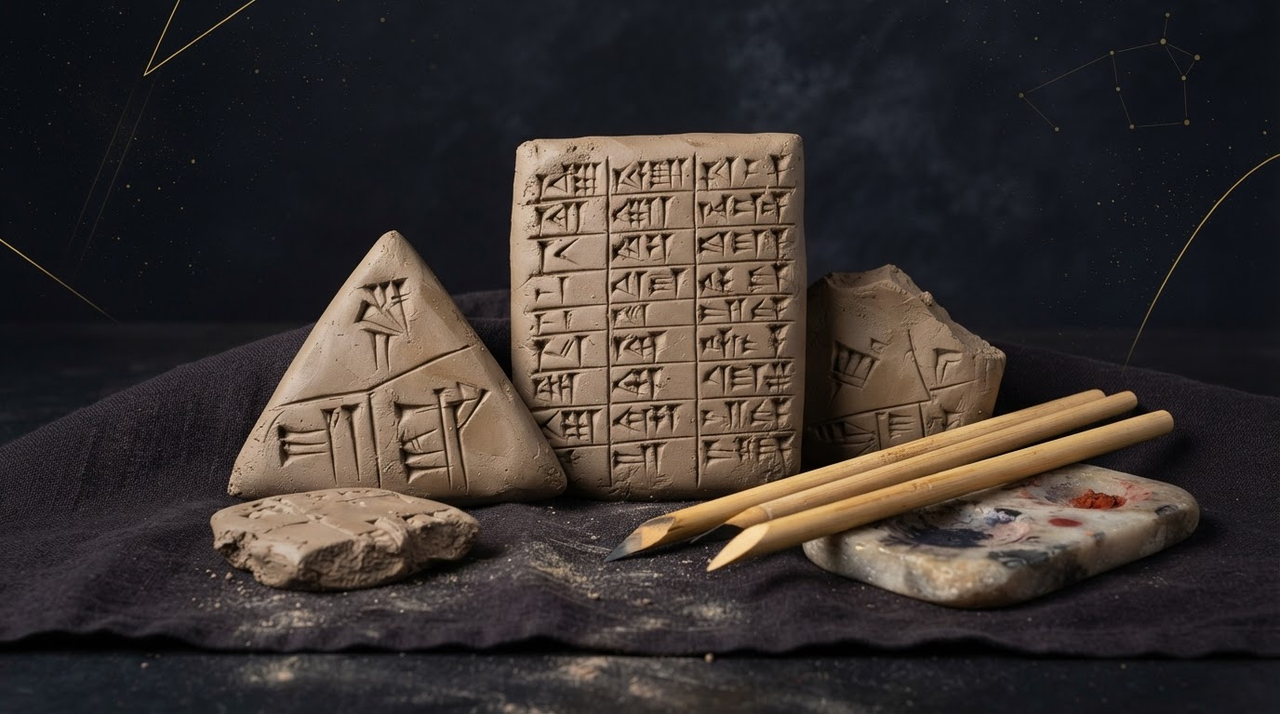
Edubba & House of Life: Inside Sumerian Scribal Schools and Egyptian Ancient Education
Imagine a dusty Mesopotamian courtyard at dawn, where a boy named Enki-nanna hunches over a clay tablet, stylus trembling as he etches his first cuneiform signs. Nearby, in the shadowed halls of a Nile temple, a scribe apprentices copies sacred hieroglyphs under the watchful eye of a priest. These scenes, pieced from archaeological fragments, pull back the veil on the edubba of Sumer and the Egyptian House of Life—institutions that cradled the world's earliest literate elites. Far from modern classrooms, these ancient centers shaped knowledge through rote labor, institutional power, and communal imperatives, forging the scribes who preserved history itself.
The Edubba: Sumer's House of Tablets
In ancient Sumer, around 2500 BCE, the edubba—literally "house of tablets"—stood as the beating heart of a Sumerian scribal school. Nestled in city-states like Nippur and Ur, these schools weren't open forums but selective enclaves, typically admitting sons of elites: priests, landowners, and officials. Access hinged on family status and patronage, reflecting the era's power structures where literacy fueled administrative control over trade, taxes, and temples.
An Ancient Curriculum Forged in Clay
The ancient curriculum unfolded in grueling stages, evidenced by thousands of surviving student tablets. Beginners tackled lexical lists—endless inventories of words for animals, professions, birds—memorizing Sumerian alongside emerging Akkadian. Progress meant copying model letters, contracts, and proverbs, honing skills for bureaucracy. Advanced pupils grappled with math: multiplication tables, geometry for land surveys, even early algebra problems like dividing 9 loaves among 10 men.
Teachers, called um-mia or "master," oversaw this toil. Discipline was harsh; excavated texts lament beatings for sloppy work or tardiness, with one proverb wryly noting, "The scribal art is difficult; the schoolmaster's slipper is strong." Labor defined learning: pupils wedged clay, inscribed, baked tablets, erasing and reusing in endless cycles. This wasn't idle scholarship but practical training tied to community needs—recording harvests, myths, laws.
The House of Life: Egypt's Temple of Knowledge
Across the sands in pharaonic Egypt, the House of Life (per-ankh) emerged within temple complexes from the Old Kingdom onward (c. 2700 BCE). Unlike the edubba's urban focus, this was a sacred scriptorium, blending education with ritual. Scribes here served gods and kings, their literacy a divine gift from Thoth. Attendance favored noble boys, often kin to priests, though some evidence hints at rare female or lower-class inclusions via family ties or talent.
Sacred Scripts and Specialized Learning
Egyptian education mirrored Sumer's rigor but wove in cosmology. The curriculum began with hieroglyphic signs, progressing to hieratic script for papyri. Students copied medical treatises, astronomical calendars, mathematical problems (like the Moscow Papyrus's volume calculations), and funerary texts. Model letters and administrative forms prepared them for court and temple duties.
Priest-scribes taught amid incense and chants, enforcing discipline through corporal means, as ostraca complaints reveal. Copying was laborious—papyrus scarce, ink finicky—tying learning to institutional power. The House of Life produced not just clerks but polymaths: architects of pyramids, physicians, astronomers, their work sustaining pharaonic order.
Parallels, Power, and the Birth of History
Both the edubba and House of Life reveal education as embedded practice: language gated entry, family brokered access, labor built expertise, community goals dictated content. Evidence—tablets strewn like schoolboy litter, papyri rolled in tombs—grounds our view, though later interpretations romanticize or moralize. No linear march to modernity here; these systems prioritized elite replication over broad enlightenment.
- Lexical lists built memory palaces for oral cultures transitioning to writing.
- Copying drills linked individual effort to collective memory.
- Discipline mirrored societal hierarchies.
Through scribes, writing became history's scaffold—Sumerian king lists enduring on clay, Egyptian annals on stone. These schools birthed the archive, intertwining knowledge with power.
Echoes for Today's Inquirers
Delving into the edubba and House of Life challenges us: Who controls literacy today? What labors sustain our curricula? These ancient scribes invite us to probe the institutions shaping thought, urging fresh questions on education's hidden hands.
In clay and papyrus, they etched not just words, but worlds.