
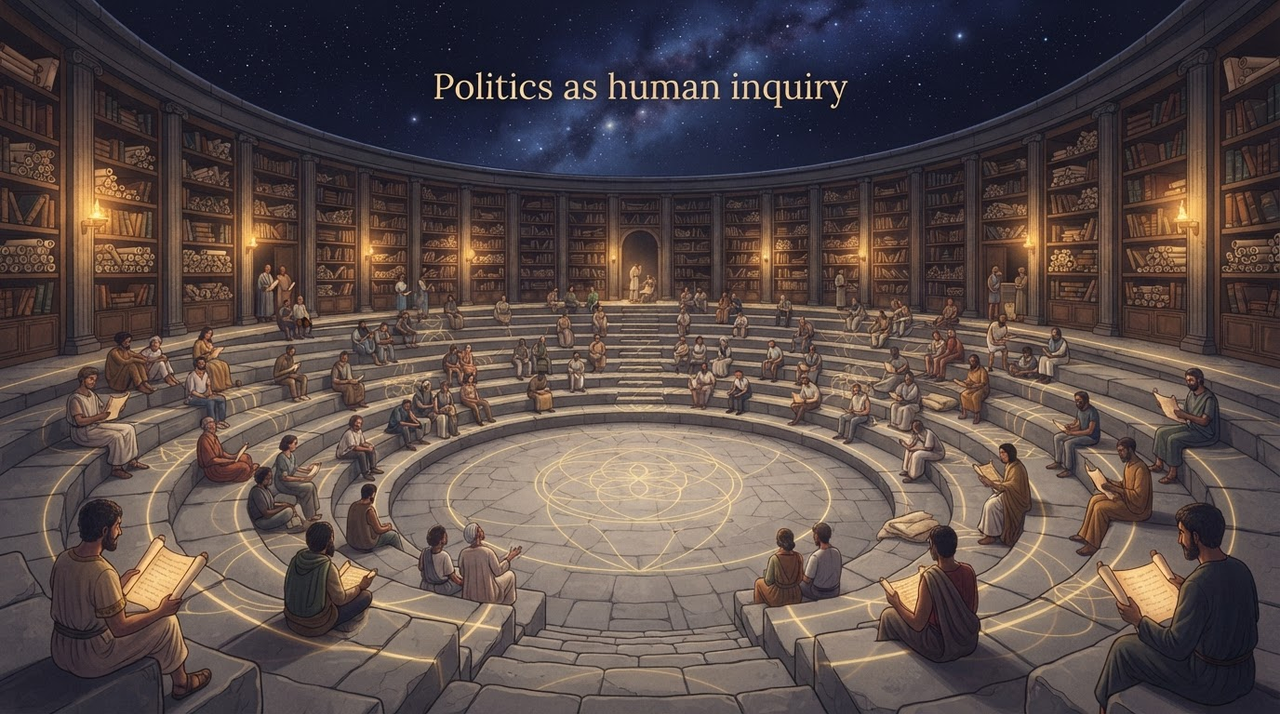
Entering the Politics Door: Power, Institutions, Governance, and Civic Participation in Aetheria's Cosmic Library
Imagine stepping into the Cosmic Library of Aetheria, where shelves groan under the weight of humanity's deepest inquiries. Bathed in the soft glow of indigo hues and shimmering gold accents, you pause before a heavy oak door etched with symbols of crowns, scales, and clasped hands. This is the Politics Door—not a barrier, but an invitation to explore the intricate dance of power, institutions, governance, and civic participation. Students of existence, as you enter, prepare to protect the journey with open inquiry.
In this chamber of the Society cornerstone, political philosophy unfolds not as dry debate, but as the timeless story of how humans organize to thrive amid scarcity, conflict, and aspiration. Here, under the library's eternal light, we distinguish the threads of politics from mere headlines, weaving a map for seekers hungry for context.
What This Door Actually Holds
Beyond the threshold lies no single idea, but a constellation: institutions, power, governance, ideology, civic participation, and even propaganda. Each demands distinction to avoid the fog of conflation.
Institutions are the enduring structures—parliaments, courts, bureaucracies—that channel human action into predictable patterns. Power is the capacity to influence, whether through persuasion, force, or legitimacy, often subtle as a whisper in a council chamber. Governance emerges as the art of steering these toward collective ends, balancing order with freedom.
Ideology provides the lens—visions of the good society shaping debates. Civic participation breathes life into it all, from town halls to petitions, reminding us that politics is not spectator sport but shared authorship. Propaganda, the shadowed sibling, twists truth for advantage, demanding our vigilance.
Picture a ancient agora, voices rising like waves: here, these elements collide, forging the societies we inhabit.
A Brief Lineage of Political Thought
Trace the lineage with care, separating record from later gloss. From the Greek polis—city-state where citizens debated virtue and justice—to Rome's res publica, the public thing managed by senate and people.
Republican thought evolved, emphasizing mixed government against tyranny. Eastward, Confucian statecraft stressed moral rulers harmonizing hierarchies for stability. Ibn Khaldun observed asabiyyah—group solidarity—as the glue binding dynasties, rising and falling in cycles.
Modern constitutionalism crystallized limits on power, codifying rights and separations. These are established markers; interpretations vary, but the record invites scrutiny.
How Seekers Approach the Politics Chamber
Enter by the Seeker's Code: neutrality as shield, protect the journey from bias. Embrace open inquiry, weighing evidence against belief. Ask: What endures beyond rhetoric? Probe structures, not slogans.
- Observe without allegiance.
- Seek primary texts over summaries.
- Test claims against outcomes.
In this way, political philosophy becomes a personal odyssey, humane and rigorous.
Common Misconceptions in the Shadows
Missteps lurk: politics as elections alone ignores daily governance. Power reduced to coercion overlooks soft influence. Ideology as all-explaining eclipses institutions' inertia.
Dispel these; true understanding blooms in nuance.
Connections Across the Cosmic Library
Politics interlaces Society's batch: Economics as resource choices under rules, Business as organized work within frames, Leadership as responsible stewardship. Broader ties bind to Ethics (just order), History (cycles of rise), Psychology (group dynamics), Education (informed citizens).
The library's map reveals no isolates—only echoes.
Concrete Ways to Begin Inquiry
Start simply: compare two constitutions side-by-side, noting institutions and power balances. Attend a local council meeting, witnessing governance unfold. Journal prompts for the Foundation Stone: "What civic participation shapes my world?" "Where does ideology veil reality?"
Open inquiry ignites here.
A Reflective Invitation
Students of existence, the Politics Door stands ajar. Step through, protect the journey, and join the Aetheria Community in charting politics' vast terrain. What question burns in you first?