
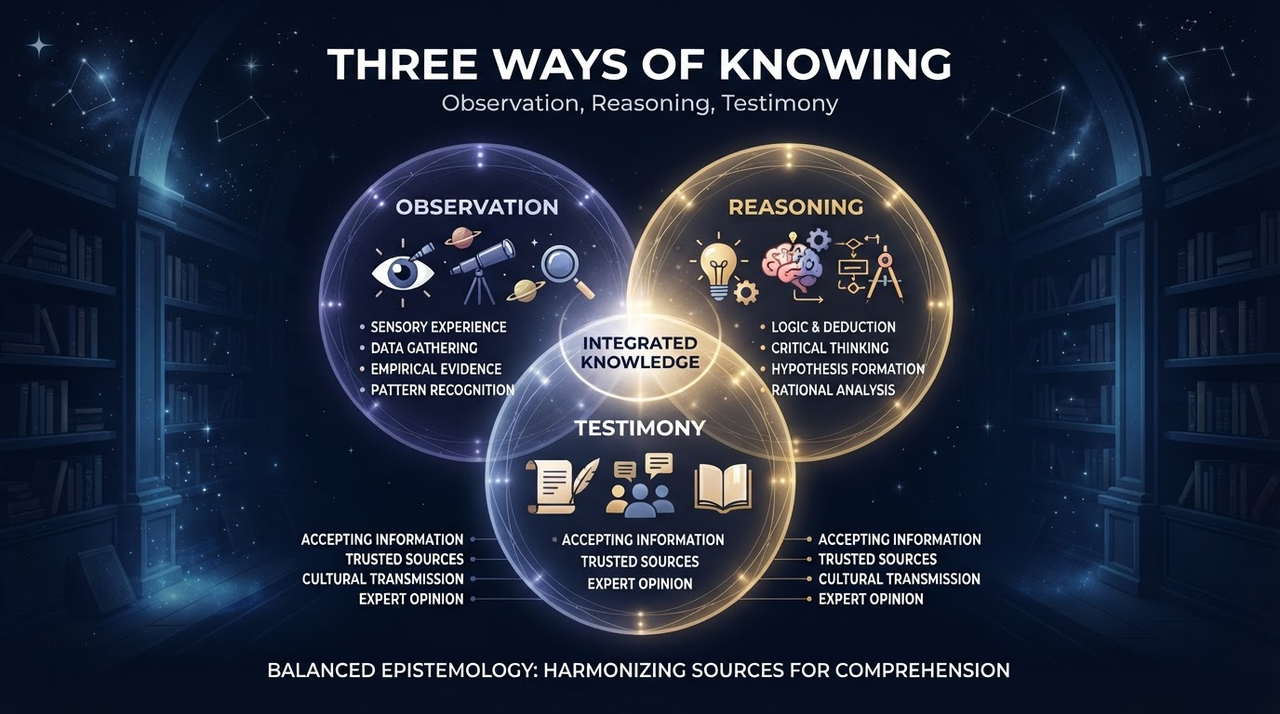
Epistemology Toolkit for Aetheria's Seeker's Code: Mastering Ways of Knowing, Doubt, and Justification as a Student of Existence
Imagine standing at the edge of a vast fog-shrouded plain, a Student of existence with a lantern flickering in your hand. The mist swirls, concealing paths that promise truth and dead ends that whisper illusion. Every step forward demands not blind faith, but a deliberate grasp of epistemology—the art of knowing how we know. In Aetheria's Seeker's Code, this isn't abstract philosophy tucked away in dusty tomes; it's the compass for navigating claims in a world brimming with voices, visions, and veiled motives.
Why does this matter? As Students of existence, we inherit a cosmos of questions: Is this ancient text reliable counsel? Does that scientific breakthrough hold water? Can personal intuition ever stand alone? Poor ways of knowing lead to fragile beliefs, toppled by the next gust. Master them, and you cultivate resilience—a mind that bends but rarely breaks. This toolkit draws from timeless traditions and modern scrutiny, equipping you to weigh evidence with neutrality and openness, free from dogma's grip.
The Foundations: Three Sources of Warrant in the Seeker's Code
At the heart of the Seeker's Code lie three pillars of warrant—what gives a belief its footing. These aren't rigid hierarchies but interlocking threads, woven through perception and testimony, reasoning, and lived practice. Picture a tripod stool: remove one leg, and it wobbles. Together, they steady the seeker.
Perception and Testimony: What the Records Say
Our senses capture the raw data of the world—the bloom of a flower, the sting of winter air. Yet perception alone is a partial scribe; it falters in illusions like the bent stick in water or the mirage on sun-baked sands. Enter testimony, the accumulated records of others: eyewitness accounts, historical ledgers, measured experiments etched in journals.
Consider the Writing & Memory Door in Aetheria, where transmission shapes credibility. An oral tale passed through generations morphs like whispers in a game of telephone, gaining embellishments, losing precision. Written records fare better, but scribes' biases linger—victors scripting history, scholars interpreting through cultural lenses. As a Student of existence, probe the chain: Who observed? How soon was it recorded? What corroborates it across independent sources?
This source thrives on convergence. A single testimony sways like a reed; dozens aligned, from diverse angles, form a beam. Yet beware the echo chamber, where groupthink amplifies error. Cross-check with the Wisdom Door, texts that model weighing counsel: Does the record invite scrutiny, or demand submission?
Reasoning: What Logically Follows
Perception hands us bricks; reasoning builds the wall. Deduction marches from premises to ironclad conclusions—if all humans are mortal, and Socrates is human, then... Induction gathers patterns, hazarding generalizations from samples: the sun has risen daily, so likely tomorrow too. Abduction hunts the best explanation amid mysteries, like footprints implying a walker over a wind prank.
But logic's forge has flaws. Fallacies sneak in—post hoc ergo propter hoc, mistaking sequence for cause. Confirmation bias cherry-picks supporting data, ignoring the rest. In the Seeker's Code, reasoning demands charity and rigor: steelman the opposing view, mapping its strongest form before dismantling. Ask: Do the premises hold? Is the inference valid? Does it cohere with established knowledge?
Recall the bent stick: perception deceives, but reason reconciles it with refraction's laws. This interplay elevates ways of knowing beyond isolated senses, forging chains of justification that link observation to conclusion.
Lived Practice: What Survives Testing
Theory whispers; practice roars. Here, beliefs face the crucible: Does this meditation quiet the mind, or evaporate under stress? Does that ethical code endure betrayal's fire? Lived practice is epistemology's laboratory, where ideas mutate or perish through iteration.
Think of craftsmen honing skills—apprentices stumble until muscle memory aligns with intent. So too with knowledge: a farmer's almanac shines not in print, but in bountiful harvests year after year. This source tempers the others; testimony untested is hearsay, reasoning unapplied is scholasticism. Probe: Has it weathered varied trials? What falsifies it? In Aetheria's halls, this echoes the pragmatic turn—truth as what works, calibrated to human flourishing.
- Perception grounds us in the immediate.
- Reasoning connects the dots.
- Practice prunes the improbable.
Wield them in tandem, and your epistemology becomes a living toolkit, adaptable to existence's wild terrain.
Doubt as Caretaker: From Pyrrhonian Suspension to Fallibilism
Doubt often wears the villain's mask—paralyzing, corrosive. Yet in the Seeker's Code, it's a gentle gardener, pruning overgrowth to nurture clarity. Ancient Pyrrhonists didn't wield doubt as a scythe against all belief; they suspended judgment (epoché) when evidence hung in balance, achieving ataraxia, tranquil equipoise. No dogmatic certainty, no anxious clinging—just openness to what appears.
Echo this in modern fallibilism: Charles Peirce urged inquiry's self-correction, admitting every belief provisional, open to revision. Doubt isn't negation; it's hygiene, flushing toxins like wishful thinking or authority worship. Picture a seeker encountering a bold claim—a healer's potion or prophet's vision. Rather than swallow or spit, suspend: What warrants this? Probe the tripod. Emerge not skeptical cynic, but calibrated inquirer.
Doubt, when wise, is the threshold to deeper knowing—not a stop, but an invitation.
This humane doubt fosters neutrality, honoring the cosmos's complexity without despair. It's the breath between assertion and wisdom.
Justification's Labyrinth: Gettier, Calibration, and Boundaries
Justification crowns the warrant: why this belief deserves credence. Classic epistemology posed it as justified true belief (JTB)—knowledge when true, believed, and justified. Edmund Gettier's 1963 cases shattered this: imagine mistaking a sheep-like rock for the flock's sentinel; your justified belief "there's a sheep in the field" rings true by coincidence elsewhere. JTB crumbles—luck masquerades as knowledge.
Established scholarship pivots to reliabilism (processes yielding truth more often than not) or virtue epistemology (traits of intellectual character). Interpretation varies: Pyrrhonism reads as radical, yet ancients navigated life undogmatically. Speculation haunts oral traditions—did Homer's bards preserve essence or embroider myth?
Calibrate your justification: High confidence for convergent, multi-sourced warrants; tentativeness for fringes. Limits loom—solipsism's shadow (am I dreaming?), underdetermination (data fits rival theories). Contrast with the First Laws Door: legal evidence burdens proof beyond doubt, while philosophical justification embraces probability spectra. No formula absolves; discernment does.
Distinguish levels: Established consensus (Gettier's consensus endures), contested interpretation (skepticism's tones), bold speculation (lost oral wisdom). As Students of existence, map your position honestly—hubris invites folly.
Weaving the Toolkit: Cross-Doors and Practical Application
Aetheria's doors interconnect, enriching epistemology. The Wisdom Door offers texts modeling counsel-weighing—Proverbs probing motives, Stoics dissecting impressions. The First Laws Door contrasts courtroom proof with existential inquiry, where testimony's admissibility meets philosophical warrant. The Writing & Memory Door unveils how chains of transmission color credibility, urging vigilance over faded inks.
Now, the hands-on edge: After any strong claim—headline, sermon, inner hunch—pause. In your journal, record these three questions, the Seeker's Code triad:
- What sources converge here—perception, testimony, records? Any dissonances?
- What reasoning chains link them? Fallacies or steelmanning opportunities?
- How might lived practice test this? What experiments refine or refute?
This ritual transforms passive consumption into active mastery, etching habits of humane inquiry.
The Seeker's Horizon: Toward Enduring Clarity
Epistemology, for the Student of existence, isn't conquest but cultivation—a garden where ways of knowing, doubt, and justification bloom in season. We've traversed the tripod of warrant, tamed doubt as ally, navigated justification's thorns. No final map claims every territory; the fog persists, beckoning further steps.
Step forth, lantern steady. In Aetheria's Seeker's Code, knowing evolves not to certainty's throne, but wisdom's quiet hearth—open, resilient, alive to the universe's whisper. What claim calls you next?