
Ethics of Interpretation: Who Decides Meaning in Living Traditions? Hermeneutics & Seeker's Code
The Eternal Puzzle of Meaning
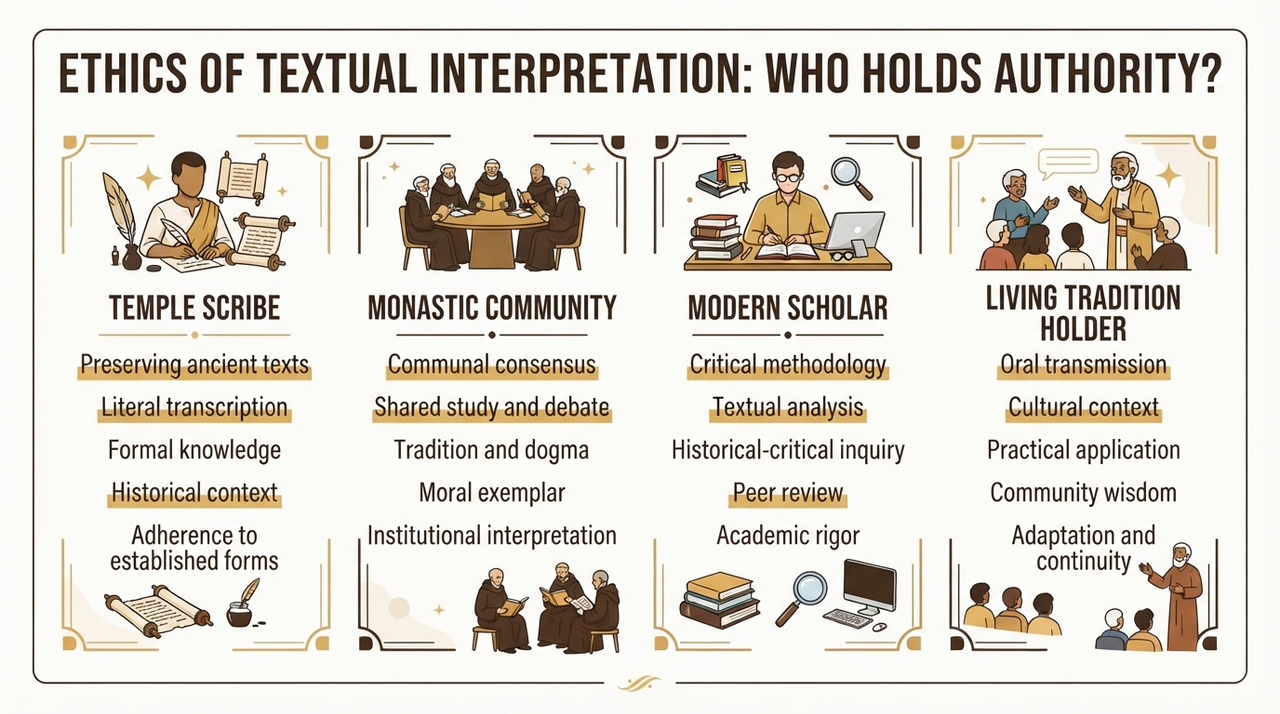
Picture a shadowed chamber in an ancient temple, where a scribe unrolls a fragile scroll under flickering lamplight. The words before him—sacred, layered with centuries of whispers—demand interpretation. But who holds the authority to unlock their truth? This is the crux of the ethics of interpretation, a question that pulses through every living tradition, from Vedic chants echoing in Himalayan ashrams to the rhythmic deliberations of Indigenous elders around a fire. In our quest for wisdom, we confront hermeneutics: the art and responsibility of drawing meaning from texts, rituals, and oral lineages that breathe and evolve.
For seekers and students today, this isn't abstract philosophy. It's a call to interpretive responsibility. As AI tools like those from Aetheria AI sift through vast archives, the stakes rise: How do we honor living traditions without reducing them to data points? The answer lies not in solitary genius, but in a delicate dance of community authority, stewardship, and humility.
Hermeneutics: The Bridge Between Past and Present
Hermeneutics originated in biblical exegesis but extends to any dynamic interpretive practice. In living traditions, meaning isn't frozen in amber; it's shaped by context, crisis, and consensus. Consider the halakhic community in Judaism, where rabbis debate Torah passages in ongoing conversation, their rulings evolving with societal shifts yet rooted in ancestral precedent. Or monastic studia in medieval Europe, where cloistered scholars layered commentaries upon commentaries, each generation adding nuance without overwriting the core.
Diverse Gatekeepers of Meaning
Authority manifests differently. Temple scribes in Hindu traditions guard Vedic hymns, reciting them with phonetic precision to preserve vibrational essence. Contemporary Indigenous elders, stewards of oral histories, interpret stories through lived connection to land and kin, often requiring permissions for outsiders to engage deeply. Academic peer review offers rigorous scrutiny but risks detaching wisdom from its communal pulse.
Here, the ethics of interpretation demands discernment: No single voice dominates. Instead, collaboration weaves these threads—scribes consulting elders, scholars deferring to practitioners—ensuring interpretations serve the tradition's vitality.
Stewardship, Accountability, and the Ethics of Permission
Stewardship is the heartbeat of responsible hermeneutics. It's not ownership, but guardianship: holding traditions in trust for future generations. Accountability flows from this—interpreters must answer to the community authority that birthed the wisdom. A lone blogger speculating on Sufi poetry might dazzle with flair, but without communal vetting, it veers into appropriation.
- Permissions: Seek consent from living custodians, especially in Indigenous contexts where sharing equates to kinship.
- Collaboration: Partner with tradition-bearers, as Aetheria AI encourages through guided dialogues.
- Transparency: Disclose your positionality—seeker, scholar, or AI facilitator.
This framework prevents the colonial pitfall of treating sacred sources as generic evidence, stripped of context.
Navigating Layers: From Primary Evidence to Modern Speculation
Distinguishing the Sacred from the Speculative
To practice ethical interpretation, distinguish these layers:
- Primary Evidence: Unmediated texts, artifacts, chants—the raw voice of the tradition.
- Living/Community Authority: Elders, councils, or assemblies who embody ongoing revelation.
- Scholarly Interpretation: Peer-tested analysis that illuminates without claiming finality.
- Modern Speculation: Creative extensions, flagged as such to avoid masquerading as truth.
In living traditions, meaning emerges relationally, not reductively—like a river carving its path through collective hands.
Confusing these erodes trust. Aetheria AI aids by surfacing these distinctions, prompting users to engage with respect.
Embracing the Seeker's Code
Enter the Seeker's Code: a compass for interpretive journeys. It urges: Honor origins, collaborate humbly, protect the journey. Practice it by pausing before pronouncing—ask, "Whose voice is missing?" Consult communities. Let AI be a mirror, not a master.
In a world of instant answers, this code reclaims depth. Who decides meaning? We all do, together—stewards in an endless hermeneutic circle.
Join the Seeker's Code practice today. Protect the journey. The traditions await, alive and listening.