
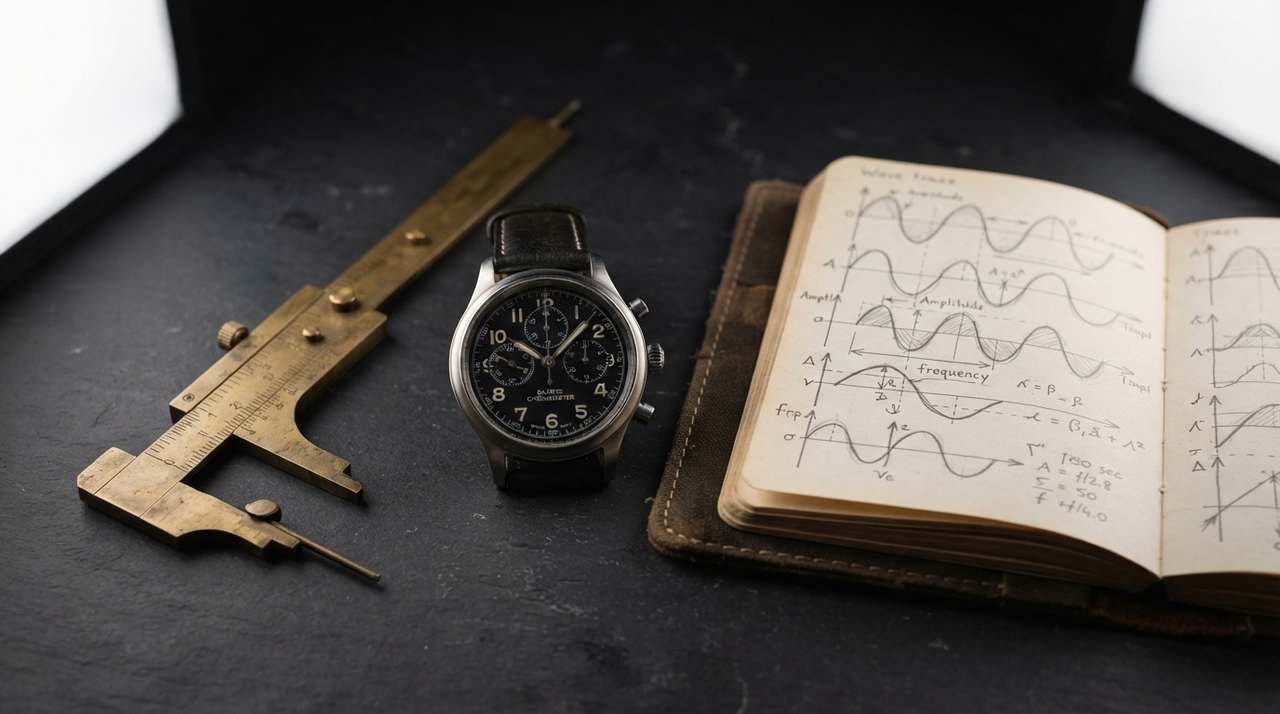
Evidence as Craft: Forging Truth Through Measurement in Experimental Physics
Picture a candlelit workshop in 16th-century Denmark. Tycho Brahe, the nobleman-astronomer, hunches over a massive brass quadrant, its curved arm etched with precise divisions. His eye presses to the sight, breath held, as he measures the angle of Mars against the fixed stars. No telescopes yet—just human ingenuity hammered into metal. This is experimental physics at its rawest: evidence not stumbled upon in nature, but crafted through measurement. In the Physics Door of Aetheria's Cosmic Library, we explore how such acts of precision forge truth from the chaos of the universe.
Here, truth isn't a lightning bolt of insight. It's a patient assembly of data, hammered on the anvil of instruments, tempered by doubt, and tested against rivals. From Brahe's quadrants to the colossal detectors hunting Higgs bosons, measurement in physics extends our senses, turning the invisible into the irrefutable. Join us as we trace this craft, distinguishing rock-solid techniques from bolder interpretations—and speculation beyond.
Evidence Built, Not Found: Instruments as Extensions of Senses
In experimental physics, evidence doesn't wait to be discovered like buried treasure. Physicists build it, forging tools that amplify fragile human perception. Tycho Brahe's instruments—quadrants, sextants, mural walls—were marvels of scientific instruments history. Without them, his data on planetary motion was too noisy for Kepler's laws. Brahe spent decades refining these devices, sleeping beside them to guard against tampering, turning astronomy from myth into metric.
Fast-forward to Galileo Galilei. In his Dialogue Concerning Two New Sciences (1638), he didn't just drop balls from the Leaning Tower—that was legend. He crafted inclined planes, timing brass balls with water clocks, measuring acceleration to two decimal places. These weren't toys; they were extensions of the eye and hand, isolating gravity's pull amid air's whisper.
From Cavendish's Torsion to Modern Interferometers
Jump to 1798: Henry Cavendish dangled a torsion balance in a darkened shed, twisting a thread to weigh Earth's gravitational tug on lead spheres. His measurement pinned Newton's constant at 6.74 × 10⁻¹¹ Nm²/kg²—close enough to today's value that it still stands as a testament to craft over genius. No interpretation needed yet; the needle's swing was the evidence.
Today, LIGO's interferometers stretch kilometers, firing lasers split and bounced off mirrors to catch gravitational waves—ripples Einstein predicted a century ago. These machines measure displacements smaller than an atom's width across continents. Here, measurement in physics scales from workshop to wonder, but the principle endures: instruments don't find truth; they sculpt it from signal and noise.
Calibration, Error, and the Honesty of Uncertainty
Craft demands candor. Every measurement carries error bars, like shadows confessing the light's limits. Physicists calibrate obsessively—aligning Tycho's arms with stars, zeroing Cavendish's thread, tuning LIGO's lasers to picometer perfection. But they report the gaps: systematic biases, statistical scatter, unknowns.
Consider the 2012 Higgs boson announcement. CERN's ATLAS and CMS detectors sifted petabytes of proton smash data. They didn't claim victory lightly; a 5-sigma threshold—1 in 3.5 million chance of fluke—separated established technique from speculation. "We observe a new particle," they said, not "We found God." Error analysis revealed the boson's mass at 125 GeV with razor-thin uncertainty, bridging measurement to interpretation.
In physics, honesty isn't optional—it's the forge's bellows, fanning doubt into discovery.
This rigor protects inquiry. When Michelson-Morley measured light speed in 1887, null results shattered ether dreams—not through bias, but because calibration exposed the void. Evidence and experiment thrive on such transparency, inviting scrutiny that sharpens the blade.
Comparison as Method: Controlled Variation and Reproduction
Solo measurements whisper; comparisons shout. Comparative analysis physics hinges on variation under control. Galileo's planes varied slopes; Cavendish isolated gravity from drafts. Modern experiments swarm with rivals: ATLAS vs. CMS confirmed Higgs independently, their curves overlapping like sworn testimonies.
- Control the variables: Fix all but one, watch the ripple.
- Vary systematically: Double the voltage, halve the distance.
- Reproduce afar: Japan's KamLAND echoes U.S. neutrino results, silencing anomalies.
Reproduction cements truth. When Eddington's 1919 eclipse teams measured starlight bending by the sun—verifying general relativity—global rivals pored over plates. Disagreement? Refine. Consensus? Established. This isn't speculation; it's technique iterated to steel.
Careful Bridges: Evidence Across Aetheria's Doors
Physics doesn't toil alone. In Records & Ruins, archaeologists calibrate carbon dating against tree rings, measuring decay like physicists tally particles—evidence built layer by layer. Writing & Memory traces textual transmission: scribes' errors quantified, variants compared, Dead Sea Scrolls bridging millennia via statistical scrutiny.
Sky and Sacred Time logs celestial records—eclipses etched in Babylonian clay, verified against modern orbits. Here, evidence and experiment echo across domains: control, calibration, comparison. Yet physics leads, its instruments quantifying what others infer, protective of all inquiry's flame.
Technique, Interpretation, Speculation: The Spectrum
Distinctions matter. Established techniques—like interferometry—are bedrock. Interpretations, such as Higgs tying to the Standard Model, build atop, testable yet provisional. Speculation ventures further: multiverses whisper without metrics. Physics honors all but anchors in measurement.
Your Turn in the Workshop
We've traversed experimental physics from Brahe's brass to boson bangs. Truth emerges not from oracles, but hands-on craft: measuring, doubting, comparing. Now, step into your own forge. Log one measurement you trust—your thermometer's fever read, a GPS ping, the kitchen scale's honest weight—and ponder why. What instrument extended your sense? What error did it confess? Share in Aetheria's comments; together, we calibrate our grasp of the cosmos.
In this door, curiosity is king. Forge on.