
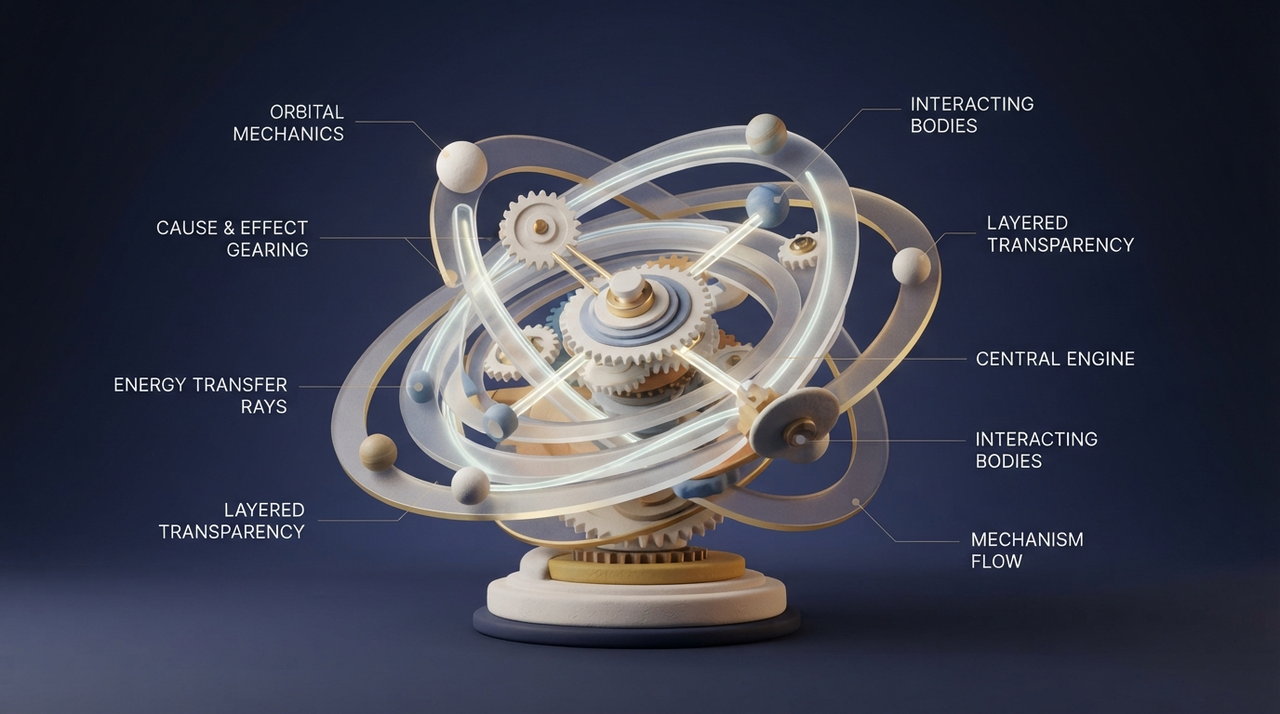
From Descriptions to Causal Models: The Evolution of Scientific Explanations
Imagine gazing at the night sky in ancient Alexandria, where stars trace perfect circles around a stubborn Earth. This was Ptolemy's world—a masterful scientific explanation model that described planetary wanderings with elegant epicycles. Yet it was a description, not a cause. Why did planets loop? Ptolemy offered geometry, not gravity. Science has journeyed far from such descriptive sketches toward causality in science, seeking the hidden mechanisms driving the universe. This evolution—from mere patterns to causal models—lies at the heart of the philosophy of science.
A scientific explanation model starts as observation: what data reveals. It matures into interpretation: the mechanisms inferred. Mechanisms vs descriptions marks this shift. Descriptions fit the facts; mechanisms explain why. Ptolemy described; Newton caused. Let's trace this path through history's pivotal turns.
Celestial Circles to Invisible Forces: The Astronomical Leap
Ptolemy's 2nd-century system predicted planetary positions with uncanny precision using nested circles and epicycles. Data from Babylonian astronomers showed retrograde motion—planets appearing to backtrack. Ptolemy's model described it beautifully, saving Earth's central place. But it multiplied complexities: 40 epicycles by his count.
Enter Kepler in the 1600s. Tycho Brahe's meticulous observations yielded data screaming for ellipses. Kepler's laws described orbits as flattened ovals, slashing complexity. Still descriptive—no why. Newton sealed the causal triumph. His law of universal gravitation inferred the mechanism: planets tugged by an inverse-square force from the sun. Data (elliptical paths) met interpretation (gravity's pull). This causality in science powered predictions beyond sight, from moons to comets.
Evidence showed paths; theory forged the force. A descriptive model predicted; a causal one explained.
From Miasma to Microbes: Germ Theory's Causal Dawn
Shadows of Bad Air Give Way to Invisible Invaders
Nineteenth-century cholera ravaged cities like a fog of death. The miasma theory described it: foul air from rot bred disease. Data—clusters near swamps, open sewers—fit neatly. Treatments? Burn incense, flee the stench. Descriptive, yet powerless against recurrence.
John Snow's 1854 London map pierced the veil. Cholera deaths hugged Broad Street's pump. Remove the handle; cases plummeted. Data screamed contamination. Louis Pasteur and Robert Koch inferred the mechanism: microbes as causal agents. Koch's postulates—grow the germ, infect, re-isolate—cemented it. Germ theory wasn't mere description; it wielded mechanisms vs descriptions, birthing antiseptics and vaccines.
What data showed (disease patterns) met bold causal claim (pathogen invasion). Science advanced by testing the unseen.
Continents Adrift: Plate Tectonics and Earth's Restless Skin
Alfred Wegener eyed jigsaw-fit coastlines in 1912—South America nestling Africa's bulge. Fossils and rocks matched across oceans. His continental drift described puzzle pieces sliding apart. Skeptics scoffed: no mechanism. How?
Mid-20th-century data flooded in: seafloor spreading via magnetic stripes, earthquake chains, volcanic ridges. Harry Hess inferred convection currents in the mantle driving plates. By 1968, plate tectonics emerged—a scientific explanation model causally linking drift to deep heat engines. Now well-supported, like natural selection's gene-level mechanisms, it predicts quakes and rifts with eerie accuracy.
Description spotted the fit; causality churned the plates.
The Philosophy of Science: Embracing Productive Uncertainty
Not all models reach causal certainty. Dark matter explains galactic rotations—stars orbit too fast for visible mass alone. Data demands it, yet its nature (particles? modified gravity?) sparks debate. Here, philosophy of science shines: models as provisional maps, refined by evidence. Well-supported like tectonic drift contrast lively frontiers.
Uncertainty fuels discovery. Hold models lightly: test, question, evolve. Dive deeper into Physics (fields and forces), Philosophy (causation), or The Great Journey (how explanations travel).
Holding the Cosmos Lightly: A Human Invitation
From epicycles to germs to drifting lands, science trades descriptions for causal power. Yet the universe whispers: models illuminate, never exhaust. Embrace the tension—evidence versus interpretation—as invitation to wonder. What mechanism awaits your scrutiny? Gaze upward, question deeply, and let causality unfold.