
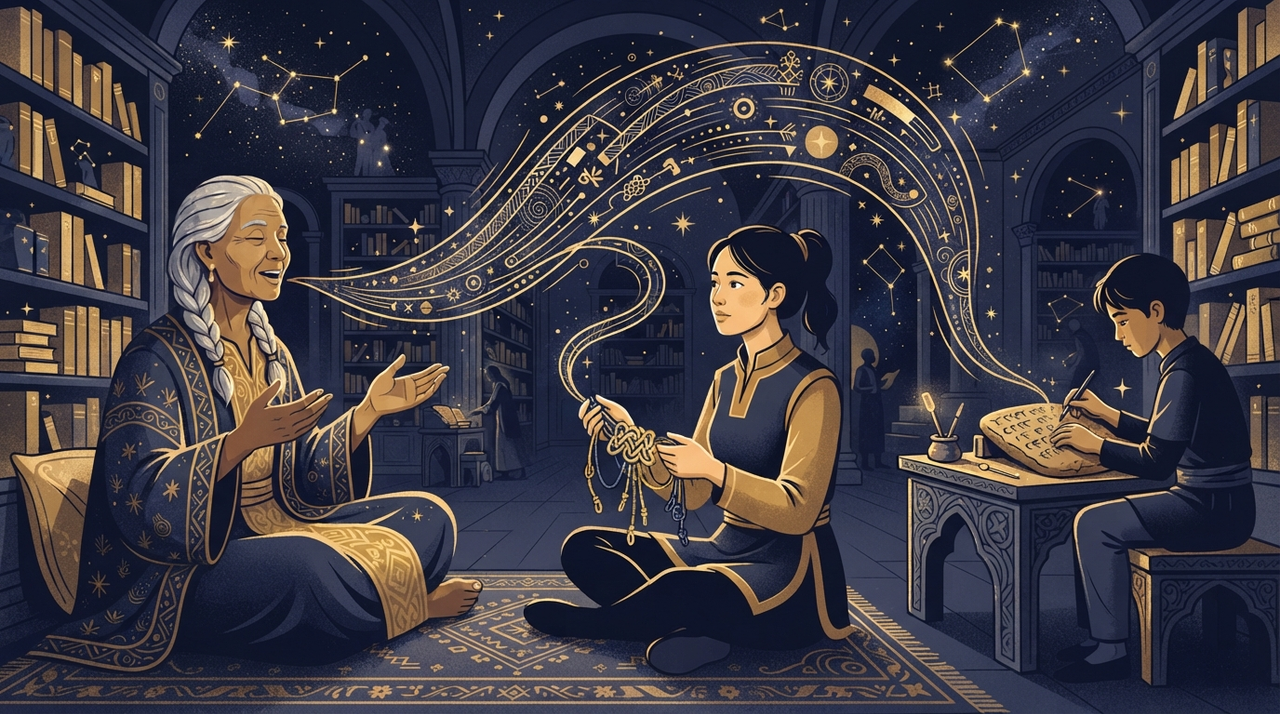
From Griot Chants to Cuneiform Scribes: Oral Traditions, Memory, and the Dawn of Written Transmission
Picture a moonlit village in Mali, where a griot's voice rises like smoke from a fire. His chant unfurls genealogies stretching back centuries, epics of kings and betrayals, all etched not in ink but in the cadences of memory. This is oral tradition in full bloom—a living practice, honed through generations, demanding rigorous training and communal reverence. Far from mere storytelling, it forms a complete linguistic ecosystem, pulsing with genres, institutions, and techniques that rival any library.
The Sophisticated World of Oral Tradition
In West Africa, griots—guardians of history—begin apprenticeship as children. They master formulaic phrases, rhythmic patterns, and mnemonic devices to recite tales like the Epic of Sundiata without flaw. These aren't casual yarns; they're institutional: griot lineages pass knowledge in guilds, blending praise songs, proverbs, and genealogies into a cultural archive. Vedic reciters in ancient India employed even stricter protocols—pathas, or recitation modes, ensuring the Rigveda's hymns survived phonetic shifts through sheer auditory precision.
Across the Pacific, Polynesian navigators chanted wayfinding songs encoding star paths, wave swells, and bird behaviors. These memory palaces were navigational charts in verse, tested on vast oceans. Oral tradition thus reveals language as embodied practice: trained experts, specialized genres, and social structures sustaining it. It documents language not through pages, but through performance, adaptation, and communal verification.
The Reed Pen Emerges: Dawn of Written Transmission
Enter writing, not as language's culmination, but as a distinct technology born of necessity. Around 3400 BCE in Mesopotamia, Sumerian accountants pressed reeds into wet clay to track barley debts and sheep tallies. Cuneiform evolved from pictographs to abstract wedges, the first systematic written transmission. Scribes, trained in edubba schools, spent years copying tablets—mostly elite males, their status marked by literacy's rarity.
Scribes, Schools, and the Barriers of Access
Clay was cheap and durable, fired for permanence, but mastery demanded seclusion: novices copied Sumerian proverbs and math tables under lamplight. In Egypt, hieratic script on papyrus served bureaucracy, yet access hinged on class, gender, and geography—women scribes existed but were exceptional. Literacy's cost? Time, privilege, materials like scarce reeds or papyrus. Writing fixed transactions and laws, yet early tablets' nuances remain uncertain; decipherments grapple with context lost to time.
Preservation's Promise and Its Shadows
Written transmission excels at stasis: a cuneiform contract endures floods, outlasting spoken vows. Yet it falters where oral thrives—in nuance, improvisation, cultural inflection. Language evolves orally; texts lag, preserving archaic forms while dialects dance ahead. Language documentation via writing captures syntax but misses intonation's soul, the griot's pause pregnant with implication.
- Memory fixed: Tablets hoard inventories, not fleeting chants.
- Literacy's gate: Elite scribes controlled narratives, sidelining women's voices or subaltern tongues.
- Textual fidelity vs. linguistic flux: Copies drift; pronunciation vanishes.
Neither superior—oral pulses with adaptability; writing anchors permanence. Together, they illuminate how language lives beyond scripts, in breath and clay alike.
Echoes That Bind Us Still
From griot firesides to Mesopotamian ziggurats, these threads weave our shared humanity. Oral tradition reminds us memory is communal craft; scribes, that transmission demands discipline. In anthropology's gaze, we see no primitive prelude—only diverse paths charting existence.
What stories do you carry unwritten? What marks might you etch tomorrow?
Pause for reflection: Journal a personal memory as oral tale, then commit it to page. Note what shifts, what endures. For deeper dives, explore Writing & Memory or Sacred Places, where language meets the eternal.