
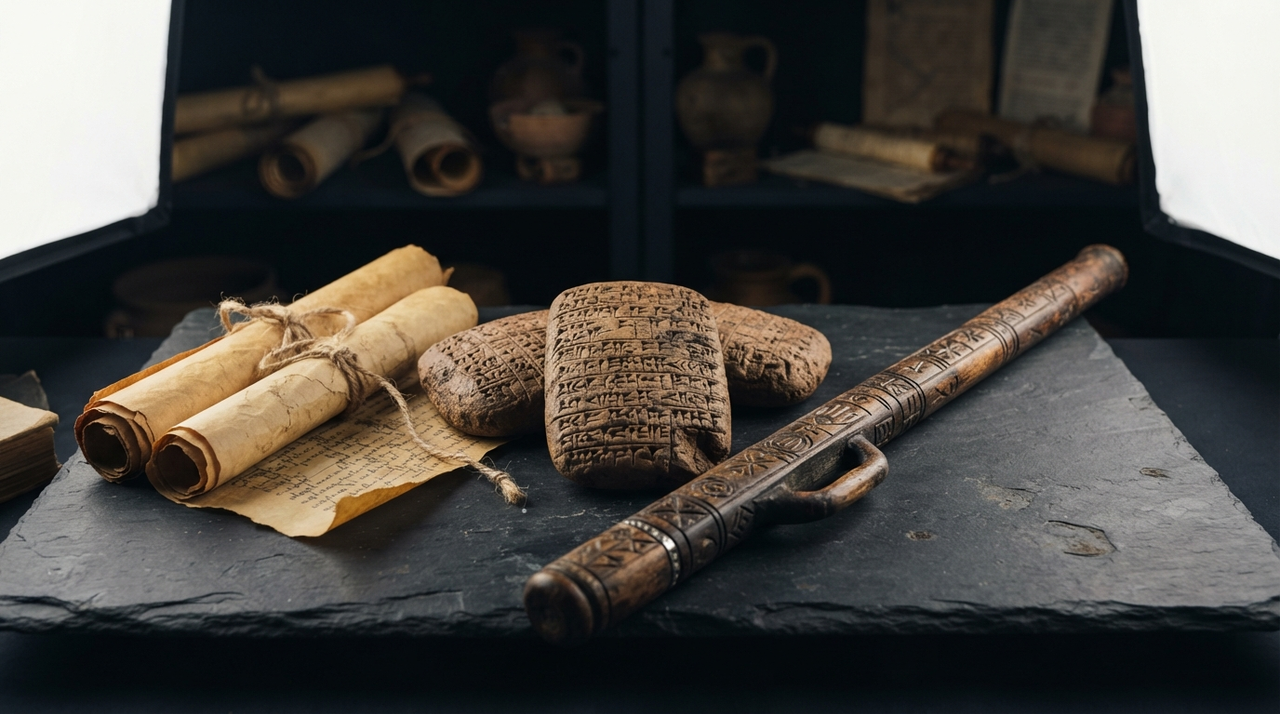
From Oral Whispers to Scribal Scrolls: How Sumerian Myths Evolved Through Transmission
Whispers in the Ziggurat Shadows
Imagine a torchlit temple courtyard in ancient Sumer, around 2500 BCE. A bard, voice rising like the evening wind off the Euphrates, recites the tale of Inanna's descent into the underworld. Listeners—priests, farmers, wide-eyed children—lean in, the words weaving through the air, alive with rhythm and repetition. This was oral tradition mythology at its rawest: not a fixed text, but a social rite, shaped by the performer's flair, the crowd's murmurs, and the moment's mood.
Transmission here wasn't mere repetition; it was communal creation. Stories morphed with each telling— a variant born from a forgotten line, a memorization tweaked for a festival's urgency. Sumerian myths, from creation epics to divine laments, pulsed through these performances, embedding cosmology into daily life. Yet as cities rose and cuneiform scratched into clay, these whispers met the stylus. What happened when breath met tablet?
The Scribe's Hand: Birth of Scribal Culture Myth Preservation
From Performance to Prototype
Sumerian scribes, trained in temple schools called edubba, captured these tales on durable clay. The shift from Sumerian oral to written marked a pivot: oral events were ephemeral, tied to gesture and intonation; written forms aimed for endurance. But scribes weren't neutral transcribers. They memorized repertoires orally first, then etched variants, often blending sources.
Take the temple laments—poetic wails for fallen ziggurats like Ur's. Sung in Sumerian during rituals, they entered writing around 2000 BCE. Scribes copied them meticulously, yet introduced editorial tweaks: streamlined phrasing for pedagogical use, or glosses for clarity. This scribal culture myth preservation stabilized tales amid linguistic flux, as Sumerian waned and Akkadian surged.
Waves of Change: Myth Textual Transmission Across Eras
Language, Locale, and Lineage
Myths evolved like rivers forking through landscapes. Sumerian originals, performed in Emesal dialect for laments, were recopied in Akkadian at Nippur's scribal hubs by 1800 BCE—scholars adapting gods' names, tweaking motifs for Babylonian tastes. Further north, at Asshur, Assyrian scribes curated libraries, their versions emphasizing martial themes absent in Sumerian peace hymns.
- Sumerian: Ritual intimacy, goddess-centered like Inanna's plaints.
- Akkadian at Nippur: Scholarly polish, bilingual glosses.
- Assyrian at Asshur: Imperial flair, heroic expansions.
Contrast this with Greek parallels: Homeric rhapsodes chanted Iliad snippets at festivals, variants clashing until Alexandrian scholars like Zenodotus edited a canonical text around 250 BCE. No single "origin"—just layered transmissions, bounded by evidence from tablets and papyri.
The Tablet's Silence: What Writing Preserves, What It Forfeits
Clay tablets hoard words—lineage of gods, floods, underworld journeys—fueling our grasp of ancient minds. Myth textual transmission locked fluidity into form, enabling cross-generational study. Yet writing couldn't snare the orator's timbre, the audience's gasps, the harvest moon's glow framing the tale.
The scribe freezes the story; the singer sets it aflame.
Performance's occasion—mourning a ruined city or celebrating a king's vow—vanished with the echo. Gestures animating Enki's watery tricks? Lost. This gap reminds us: myths were social glue, not inert artifacts, linking us to Writing & Memory, Ancient Civilizations, and History's deep currents.
Echoes for Today: Transmission's Lasting Whisper
Sumerian myths endure not despite evolution, but because of it—a testament to humanity's drive to remember amid change. As we trace these paths, consider your own: How does a family's retold yarn shift across dinners? Journal this: What voice do you lend ancient tales? Does retelling reshape their truth for your era?
In listening anew, we honor the chain—from oral whispers to scribal scrolls, and beyond. The myths still breathe, if we let them.