
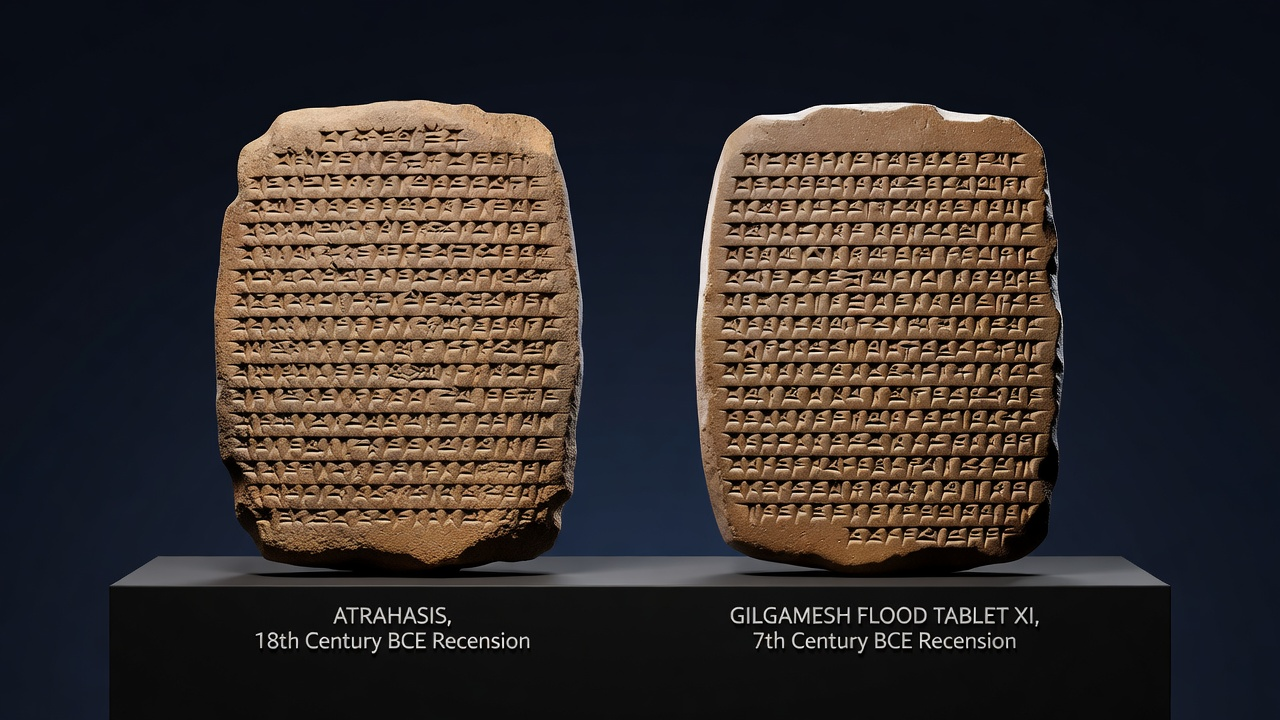
Gilgamesh Flood Tablet XI vs Atrahasis: Decoding Mesopotamian Flood Myths and Akkadian Recensions
Imagine a world where gods weary of humanity's clamor, unleashing a cataclysmic deluge to wipe the slate clean. This isn't a biblical tale whispered in Sunday schools—it's the raw, thunderous heart of Mesopotamian flood myths, etched in cuneiform on clay tablets over 4,000 years ago. At the epicenter stand two towering narratives: the Atrahasis epic and Gilgamesh Flood Tablet XI. These Akkadian recensions, born from the cradle of civilization between the Tigris and Euphrates, invite us to unravel their intricate dance of similarity and divergence.
For comparative flood narrative learners, decoding these texts isn't just academic—it's a portal into ancient wisdom literature, where floods serve as divine reset buttons and human survival hinges on cunning boat-builders. But beware the trap: their echoes across cultures don't scream a single global origin. Instead, they reveal deep textual dependence within Mesopotamia itself.
The Atrahasis Epic: Old Babylonian Roots in Sippar
Our journey begins around the 18th century BCE in Sippar, a bustling Sumerian city sacred to the sun god Shamash. Here emerges the Atrahasis epic, penned in Old Babylonian Akkadian—a fluid, narrative-driven recension that blends creation, overpopulation, and cataclysm into a cohesive whole. Named after its hero, Atrahasis (meaning "exceedingly wise"), this myth functions as wisdom literature, pondering why gods created humans and why they nearly unmade them.
The story unfolds with gods toiling to dig canals until they rebel. Enter humanity, molded from clay and a slain god's blood, to shoulder the labor. But noise from booming populations irks mighty Enlil, sparking plagues, droughts, and finally a flood. Atrahasis, tipped off by Enki, builds a boat, saves life, and negotiates post-flood controls like infertility and infant mortality. Discovered in fragments from Sippar's libraries, this Old Babylonian gem sets the template for later Mesopotamian flood myths.
Gilgamesh Flood Tablet XI: Standard Babylonian Majesty from Nineveh
Unearthed in Ashurbanipal's 7th-Century BCE Library
Fast-forward to 7th-century BCE Nineveh, where Assyrian king Ashurbanipal amassed the world's first great library. Among its treasures: Gilgamesh Flood Tablet XI, the Standard Babylonian recension of the Epic of Gilgamesh. This 12th tablet, penned in polished late Akkadian, shifts genres toward epic wisdom, embedding the flood as Utnapishtim's tale to the grief-stricken king Gilgamesh.
Utnapishtim—clearly Atrahasis by another name—recounts gods' clamor-fatigue, Enlil's flood decree, Enki's whisper, a seven-day deluge, and a bird-testing finale. Sacrifices follow, gods swarm like flies, and Utnapishtim gains immortality. This recension polishes the narrative, amplifying poetic flourishes while preserving core motifs.
Akkadian Recensions Compared: Textual Threads and Divergences
Similarities That Bind Mesopotamian Flood Myths
- Divine motivation: Humanity's noise provokes Enlil.
- Hero's ark: Reed-walled boats smeared with pitch, stocked with animals.
- Duration and signs: Rain for days, mountains grounding the vessel.
- Birds as scouts: Dove, swallow, raven signal dry land.
- Post-flood rite: Sacrifices drawing remorseful gods.
Distinct Flavors in Genre and Function
Yet differences sparkle. Atrahasis, rooted in Old Babylonian Akkadian, is a standalone flood-and-creation saga, functioning as etiological wisdom: explaining barren wombs and stillbirths. Gilgamesh Tablet XI, in Standard Babylonian, integrates into a hero's quest for eternal life, emphasizing mortality's sting. Sippar's pragmatic tale contrasts Nineveh's philosophical depth.
These aren't coincidences but proven textual dependence. Scholars trace Gilgamesh's flood from Atrahasis prototypes, evolving through scribal hands across centuries and cities. Within Mesopotamia, myths flowed like the rivers they tamed—no need for wild global flood claims.
Beyond the Deluge: Echoes in Broader Mythology
These Akkadian recensions link to Mesopotamian creation myths, forming a "Creation Door" of lore. Atrahasis mirrors Enuma Elish's godly birth pangs, questioning divine-human balance. Gilgamesh weaves flood survival into existential quests, influencing later traditions without implying universal origins.
For learners of comparative flood narratives, the lesson is clear: similarities stem from shared cultural soil, not a singular watery cataclysm. As clay tablets crumble, their stories endure, whispering of hubris, mercy, and the fragile ark of human wisdom.
In the shadow of ziggurats, floods weren't ends but beginnings—reminders that even gods regret their tempests.