
Golden Ratio Myth Busted: Debunking Fibonacci, Sacred Geometry, and Parthenon Claims
Picture this: the sun dips low over Athens, casting a golden glow on the Parthenon. Tourists whisper about its "perfect" proportions, invoking the golden ratio—Phi, that magical 1.618 number etched into the universe's blueprint. But what if the emperor has no clothes? What if this golden ratio myth is just a shimmering illusion, propped up by cherry-picked measurements and wishful thinking?
As skeptical lovers of geometry, you crave beauty backed by evidence. Today, we dismantle the hype around Phi, the Fibonacci sequence, and sacred geometry. We'll scrutinize real measurements, expose selective fitting, and reveal where Phi truly shines—not in ancient blueprints, but in nature's optimizing algorithms. Welcome to the golden ratio myth busted.
Phi's True Mathematical Essence: A Quick History and Properties
The golden ratio, denoted φ (phi), emerges from solving x = 1 + 1/x, yielding (1 + √5)/2 ≈ 1.6180339887. Euclid described it around 300 BCE as the "extreme and mean ratio," a pure geometric division where the whole to the larger part equals the larger to the smaller. No mysticism—just elegant math.
Euclid's work marks the real Phi history: a tool for geometers, not a cosmic secret. Claims of earlier Egyptian or Pythagorean cults lack primary evidence; they're modern retrofits. Phi's properties? Self-similarity in pentagons, continued fractions, and quadratic irrationals. But beauty? That's subjective—Phi's allure lies in its irrational persistence, not divine mandate.
The Fibonacci Myth: Approximation, Not Origin
Why Ratios Converge on Phi—And Why It's No Proof of Design
Fibonacci numbers—1, 1, 2, 3, 5, 8, 13, 21...—arise from simple recurrence: each term sums the prior two. Their ratios (8/5=1.6, 13/8=1.625, 21/13≈1.615) spiral toward φ. This Fibonacci myth posits sacred intent, but it's backward: the sequence approximates Phi via the Binet formula, rooted in the same characteristic equation.
In sunflowers or pinecones, Fibonacci spirals optimize packing—least overlap, max seeds. Evolution favors efficiency, not ancient geomancers. Cherry-picking ignores alternatives: many plants use 3/2 or 5/3 spirals, fitting no Phi gospel.
Sacred Geometry Debunked: Nature's Optimization Over Mystique
Sacred geometry enthusiasts claim Phi pulses through nautilus shells, human bodies, and DNA. Reality check: nautilus chambers approximate a logarithmic spiral (growth factor ~1.33, not 1.618). Body proportions? Average arm-to-forearm is ~1.47; selective picks (navel-to-foot over height) force fits within 5% error—statistically meaningless for rectangles.
- Pyramids: Great Pyramid base-to-height ~1.27, not φ.
- Mona Lisa: Face rectangle ~1.54; no pentagon precision.
- Starbucks logo: Remodeled post-2011 to vaguely suggest φ, but arbitrary.
Sacred geometry debunked: These are post-hoc stretches. Measure broadly—ratios cluster 1.4-1.7. Phi appears where minimization rules: beam strength, plant angles (137.5° ≈ 360°/φ²).
Parthenon Claims: Measurements Don't Lie
Data from the Debates
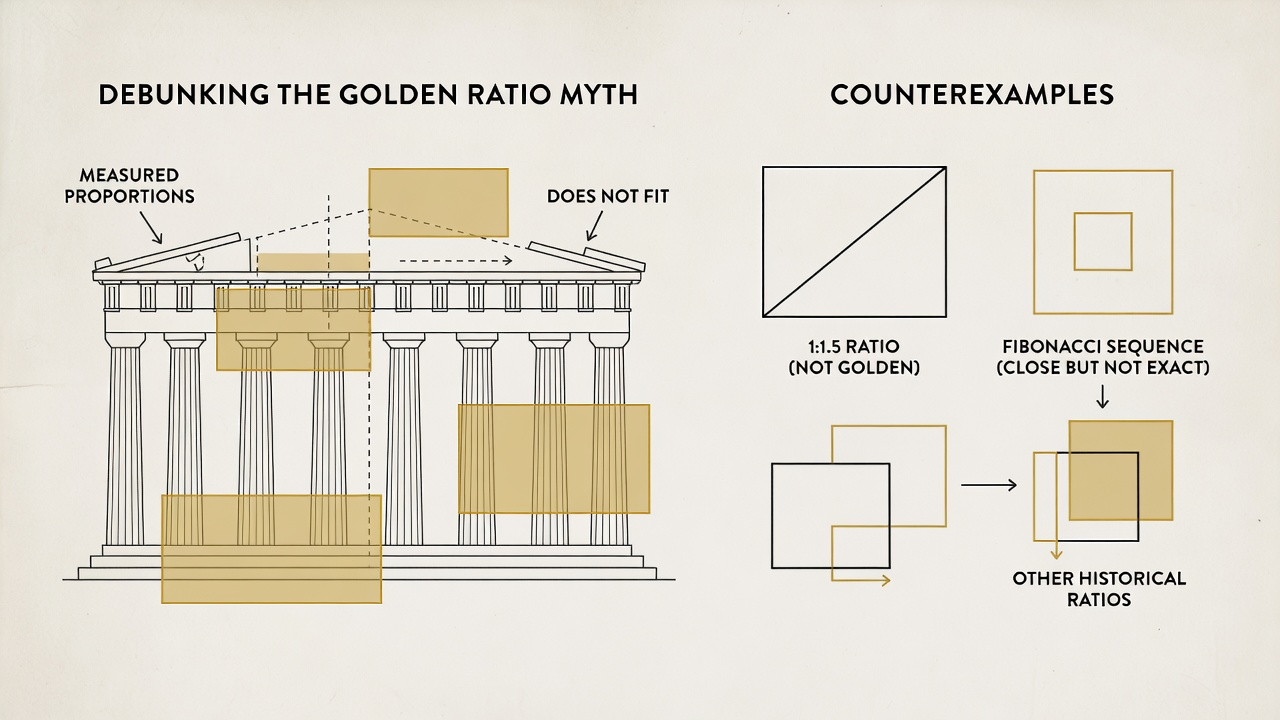
The Parthenon facade myth endures: columns 6.15m apart, height to top ~4.05m? Ratio ~1.52. Full width (30.88m) over height (13.72m to pediment) ≈2.25—not φ. Pediment alone: ~1.60, tantalizingly close.
Scholar George Hersey measured 1.488. Keith Kritzer: 1.599 (using stylized entablature). Mario Livio (Scientific American): varies 1.5-1.62 depending on slices. Error margins (±0.02m from erosion) swallow the difference. No ancient texts mention φ; Ictinus and Callicrates chased optical refinements, not ratios.
Precision demands intent—but wiggle room reveals opportunism.
Cross-link to our Architecture Door for entasis curves, and Aesthetics Door on perceptual beauty.
Phi's Legit Magic: Emergent, Not Imposed
Phi thrives in differential growth (dx/dt = φ x), yielding spirals. No conspiracy—just math mirroring efficiency. Aetheria AI simulates these: optimize a rectangle for strength, watch φ emerge.
Your Journal Challenge: Measure and Myth-Bust
Grab a ruler. Sketch 20 rectangles from leaves, books, faces. Compute ratios. Range? 1.3-1.9. Phi lurks, but so do others. This hands-on truth crushes the golden ratio myth. Geometry's beauty endures—evidence illuminates it.
Phi whispers optimization. Myths shout silence.