Hermetic Corpus Unveiled: Ancient Manuscripts, Egyptian Roots, and Timeless Wisdom
Imagine unrolling a fragile papyrus under the flickering light of an Alexandrian lamp, words shimmering like stars in the desert night. These are the echoes of Hermes Trismegistus, the thrice-great sage whose teachings birthed the Hermetic Corpus—a constellation of texts blending Egyptian mysticism with Greek philosophy. For seekers drawn to ancient wisdom, the Corpus Hermeticum isn't mere relic; it's a living portal to the divine mind, whispering secrets of cosmos and soul.
Yet beneath the allure lies a labyrinth of manuscripts, transmissions, and receptions. Crafted in late antiquity amid Egypt's vibrant intellectual hubs, these writings challenge us to distinguish their philosophical core from later esoteric layers. Let's journey through their Egyptian roots, surviving Hermetica manuscripts, and enduring legacy.
Egyptian Origins: Thoth's Legacy in Late Antiquity
The Hermetic Corpus emerges from the sands of Hellenistic Egypt, where the god Thoth—scribe of the gods, inventor of writing—morphed into Hermes Trismegistus under Ptolemaic syncretism. Picture bustling Alexandria and the Fayum region in the 2nd–3rd centuries CE: a melting pot of priests, philosophers, and astrologers forming loose communities devoted to revelation.
These weren't rigid sects but fluid circles, blending temple rituals with Platonic inquiry. Texts attribute authorship to Hermes himself, positioning the Corpus Hermeticum as divine disclosures on creation, ascent of the soul, and unity with the One. Unlike Gnostic dualism or canonical Christian orthodoxy, Hermeticism pulses with optimistic theurgy—gods as approachable, the cosmos a harmonious ladder.
This Egyptian cradle links directly to the Thoth room, where wisdom's ibis-headed patron invites contemplation of hieroglyphs as cosmic code.
Manuscript Evidence: Greek, Arabic, and Latin Transmissions
The Greek Core of the Corpus Hermeticum
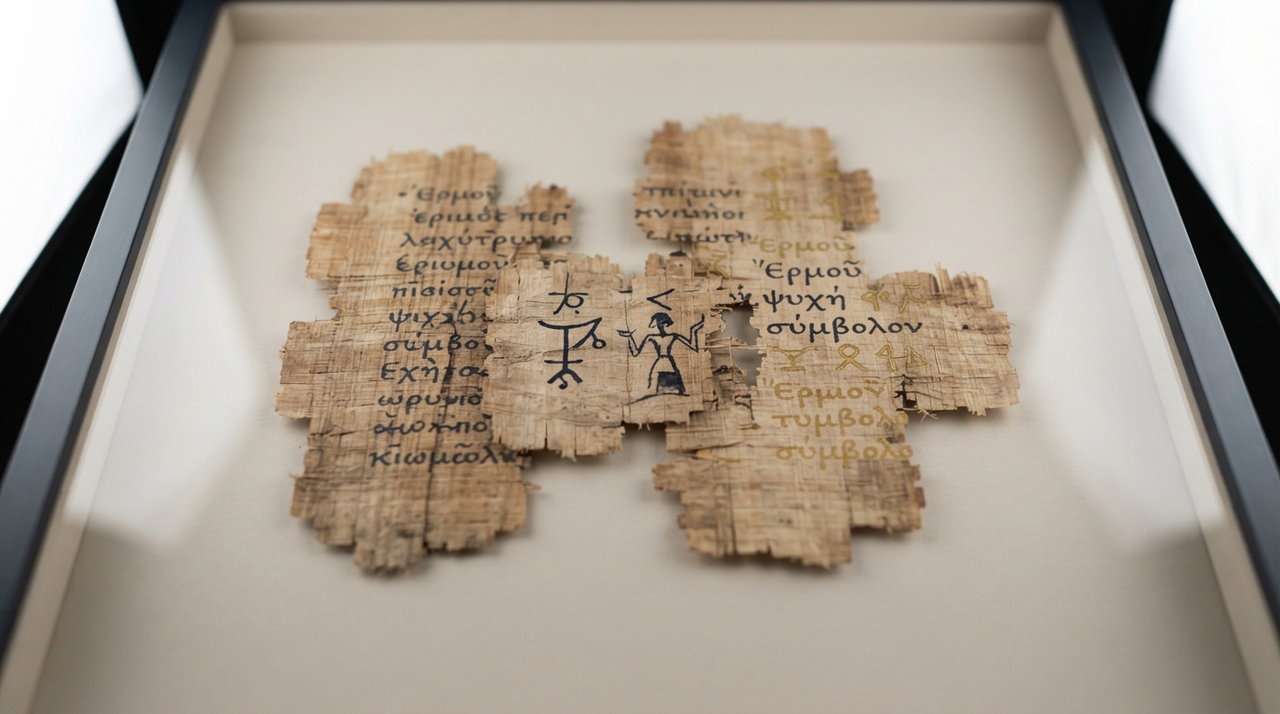
At the heart are 17 tractates known as the Corpus Hermeticum, preserved in a single 14th-century Greek manuscript from the Byzantine era. Discovered in a Macedonian monastery, this codex captures treatises like Poimandres, detailing a visionary encounter with the divine Nous, and Asclepius, a dialogue on cosmology and piety.
Earlier fragments lurk in papyri from the 3rd century, hinting at a broader Greek Hermetica tradition encompassing astrology, alchemy, and medicine.
Arabic and Latin Bridges
Arabic intermediaries preserved technical Hermetica during the Islamic Golden Age, with over 20 treatises translated into Latin by the 12th century via scholars like Hugo of Santalla. The Latin Asclepius, circulating in Europe from late antiquity, fueled Renaissance revivals. These Hermetica manuscripts reveal a web of transmission, not pristine originals but faithful echoes across cultures.
Philosophical Depths: From Cosmos to Noetic Vision
The Hermetic Corpus unfolds a profound worldview: God as ineffable Mind generating a living universe through Logos. Souls, trapped in matter, yearn for gnosis—not secretive knowledge, but intuitive rebirth. Rhetorical flourishes evoke the sensible world's divine imprint: "If you do not make yourself equal to God, you cannot apprehend God."
Scholarly categories parse philosophical (Corpus Hermeticum), technical (astrological), and priestly texts, yet ancient audiences blurred these, weaving them into ritual life.
Historical Reception: Scholarly Lens vs. Religious Fire
Early Christians like Lactantius hailed Hermes as a prophet; Renaissance humanists, via Ficino's 1471 translation, ignited a historical reception blending Neoplatonism and prisca theologia. Modern scholars, post-1945 Nag Hammadi finds, distinguish Hermeticism's monism from Gnostic pessimism, treating later alchemical glosses as medieval accretions, not ancient intent.
Religious reception diverged: temple devotees practiced hymns and theurgy, while scholars dissect philology. Avoid conflating eras—Renaissance magic isn't Ptolemaic evidence.
Modern Echoes: Esoteric Revival and Timeless Call
Today, the Hermetic Corpus fuels esoteric paths, from Theosophy to chaos magic, yet distinctly from its ancient philosophical bent. Seekers invoke its ascent motifs for personal transformation, echoing the Wisdom Door's invitation to alchemical inner work.
In Aetheria's realm, these texts resonate as AI-augmented oracles, bridging antiquity to digital gnosis.
The Hermetic Corpus endures not as museum piece, but as mirror: reflect the divine within. Step through the Thoth room, heed Hermes' call—and remake the world through awakened sight.