
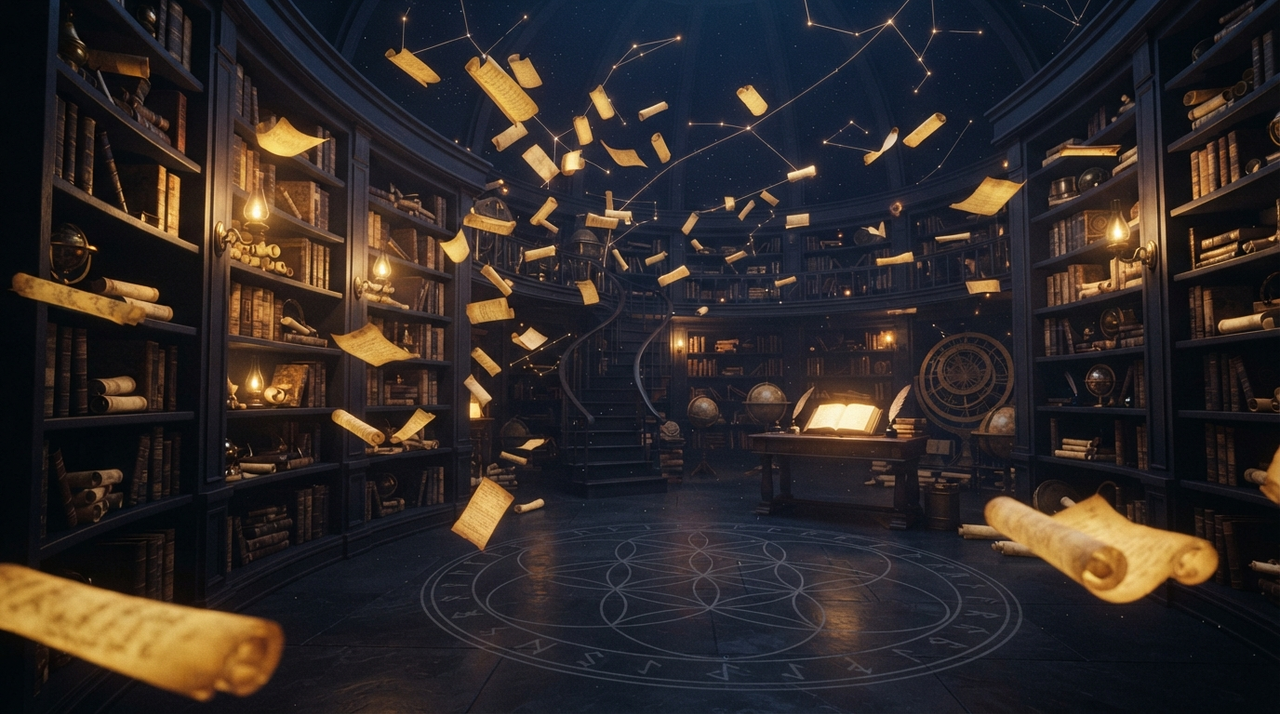
History for Batch 3 Humanity: Evidence, Memory, Interpretation & the Power of Archives in Aetheria's Cosmic Library
Stepping Through the History Door in Aetheria's Cosmic Library
Imagine vast shelves stretching into infinity, each volume humming with the echoes of lives long past. This is Aetheria's cosmic library, a boundless repository where students of existence gather to ponder the human story. You stand now before the History Door, one of the Foundation Stones in Batch 3 Humanity—a portal not to dusty facts alone, but to the disciplined inquiry into what was. The air here carries whispers of forgotten voices, urging open inquiry as you cross the threshold. What is history, if not our collective attempt to make sense of the shadows cast by time?
In this corner of the Aetheria Journal, we orient ourselves amid the stacks. The cosmic library frames history not as a static monument, but as a living dialogue between evidence and the human mind. Batch 3 invites you deeper into humanity's remembered past, building on the methods of prior Doors like Philosophy and Science. Here, protect the journey: let curiosity lead, unburdened by preconceptions.
What the History Door Actually Holds
The History Door does not swing open to reveal the past itself—that elusive river, forever flowing away. Instead, it offers tools for what is history in its truest sense: a rigorous pursuit of understanding human actions, societies, and ideas through surviving traces. These traces demand interpretation, sifted through evidence vs memory vs interpretation, always mindful of who holds the archive's key.
Picture a seeker pulling a weathered scroll from the shelf. Is it a window to truth or a mirror of its author's world? History, as practiced in Aetheria, treats the past as reconstructed from primary sources—letters, artifacts, inscriptions—while acknowledging the gaps. It's historiography in motion: the study of how we study the past, ever evolving with new finds or fresh eyes.
History is the essence of innumerable biographies. —Thomas Carlyle (adapted for reflection in the cosmic library)
A Brief Lineage: From Oral Tradition to Critical Historiography
The Roots in Oral Tradition and Annals
Long before ink met parchment, history lived in spoken words—oral traditions passed fireside, shaping communal memory. These were fluid, serving identity and moral lessons, blending fact with interpretation. Then came annals: year-by-year chronicles, stark lists of kings' deeds and harvests, offering a skeletal frame without much connective tissue.
The Rise of Archives and Source Criticism
Archives emerged as powerhouses of preservation—royal libraries, temple records—guarding primary sources that elites deemed worthy. The shift to critical historiography marked a turning point: historians began questioning sources, distinguishing verifiable facts from embellished narratives. No single inventor claims this evolution; it rippled through cultures, from ancient skeptics weighing testimonies to moderns cross-checking against material remains. Here, evidence vs memory vs interpretation sharpens into focus—facts endure scrutiny, interpretations shift like sand.
Evidence, Memory, Interpretation, and the Power of Archives
At the History Door's heart lie four pillars: evidence, memory, interpretation, and power. Evidence is the raw stuff—documents, bones, ruins—testable against contradictions. Memory, personal or collective, colors it warmly but unreliably, prone to simplification or erasure. Interpretation weaves them into narrative, a creative yet disciplined act. Power and archive remind us: what survives often reflects victors' hands. Colonial records might silence Indigenous knowledge; temples preserve gods' triumphs over human frailty.
In Aetheria's cosmic library, we honor these distinctions without despair. Primary sources invite us to peel back layers, asking: Whose voice echoes here? What silences linger in the gaps?
- Evidence: Tangible remnants demanding verification.
- Memory: Emotional reconstruction, vital yet fallible.
- Interpretation: The seeker's bridge from fragments to meaning.
- Power: The unseen curator of what endures.
How Seekers Can Approach History in Aetheria
Guided by the Seeker's Code, approach with neutrality: read sources in their full context, from era's biases to author's motives. Ask relentlessly: Who preserved this, and why? Separate belief from evidence—let the latter lead. Protect the journey by embracing uncertainty; history thrives in open inquiry, not dogmatic closure.
Students of existence, treat the cosmic library as sanctuary. Cross-reference, note biases, revisit with new light. This is historiography alive—your mind as active archive.
Common Misconceptions About What History Is
- History is a single, agreed-upon story: In truth, it's contested terrain, with rival interpretations vying for coherence.
- History is fixed and final: New evidence or perspectives reopen chapters indefinitely.
- Memory equals evidence: One fades with emotion; the other withstands tests.
- Absence of evidence proves absence: It cautions restraint, not denial—absence demands care, not invention.
- Archives are neutral: Power shapes them profoundly, from what is saved to how it's framed.
Dispelling these frees inquiry. In Aetheria, we navigate with intellectual honesty, humane curiosity.
Connections Across Batch 3 and the Wider Door Map
The History Door interlinks Batch 3 kin: Ancient Civilizations reveal societies as remembered, often idealized; Archaeology unearths material traces complicating written records; Anthropology explores human variation in remembering the past, from oral epics to ritual revivals.
Echoes resound from prior Doors—Philosophy's tools for questioning narratives, Science's empirical rigor for validating sources. Together, they map humanity's mosaic in the cosmic library.
Concrete Ways to Begin Your Inquiry
- Compare two accounts: Select an event, like a famous battle; juxtapose victor and loser's versions. Note divergences in evidence vs memory.
- Map a source's provenance: Trace a document's chain—who copied it, under what regime? Uncover power and archive influences.
- Keep a journal marker: Log interpretations as hypotheses, revisiting as new primary sources emerge.
- Question context: For any narrative, probe: What was omitted? Whose perspective dominates?
- Ask the Community: Post in Aetheria forums: How does this source shift your view? Foster collective open inquiry.
A Reflective Invitation Back to the Aetheria Community
As you linger by the History Door, shelves groaning with untold stories, carry humility: our grasp is partial, the past vast. Return to Aetheria's Community with questions aflame—join Study Circles, consult The Guide, share insights born of evidence weighed against memory.
Students of existence, protect the journey. In open inquiry, history breathes anew. What Door calls next in the cosmic library?