
History of AI: From Symbolic AI and Winters to Neural Networks and Deep Learning
The Spark of Ambition: AI's Bold Beginnings
Picture a humid summer in 1956, Dartmouth College's serene campus buzzing with a cadre of visionaries—John McCarthy, Marvin Minsky, Nathaniel Rochester, and Claude Shannon. They gathered for a workshop that coined "artificial intelligence," dreaming of machines that could reason like humans. This was the birth of the history of AI, a saga marked by soaring hopes, harsh setbacks, and improbable resurgences. What drove this field from rigid logic puzzles to the fluid patterns of deep learning? Let's trace the path, separating the evidence of breakthroughs from the contexts that shaped them.
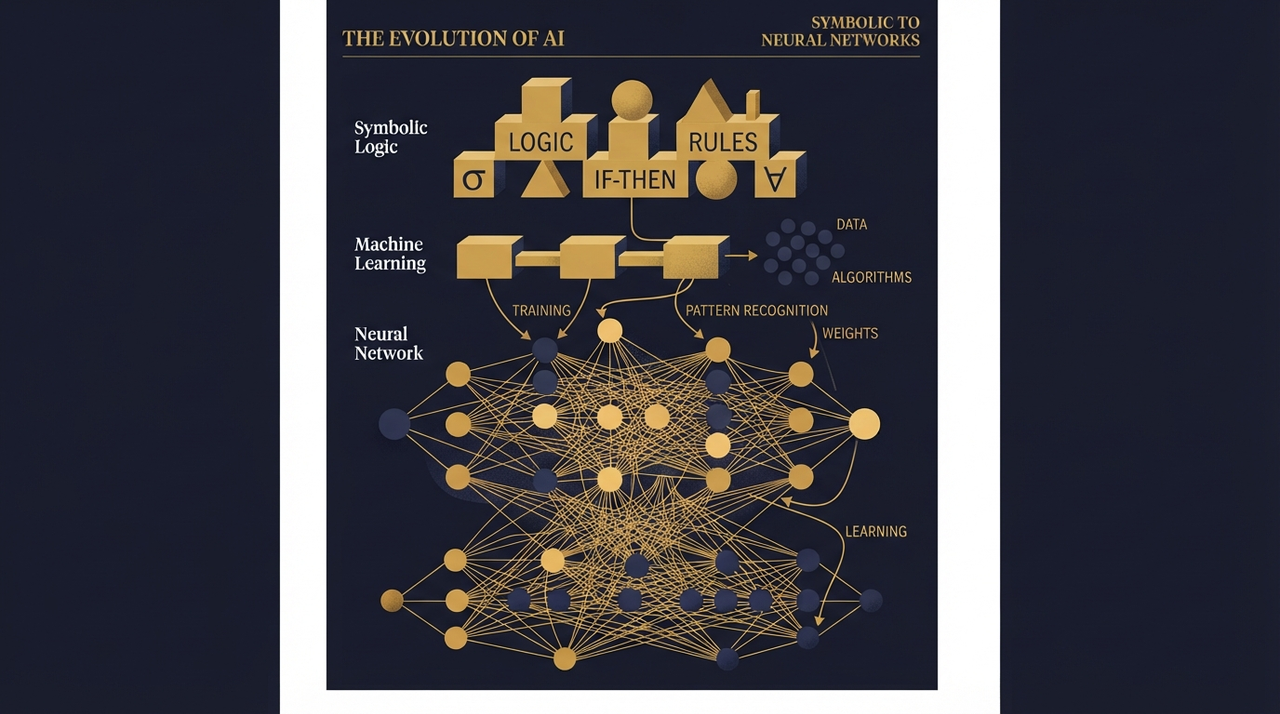
Early AI leaned on symbolic AI, a paradigm rooted in philosophy and logic. Think of it as crafting rule-based systems where knowledge is explicitly encoded as symbols manipulated by algorithms. Alan Turing's 1950 paper laid groundwork, pondering if machines could think, while McCarthy's Lisp language enabled list processing for logical inference. Programs like the Logic Theorist proved mathematical theorems, showcasing what seemed like genuine intelligence.
Symbolic Heights and the Chill of AI Winters
By the 1960s and 1970s, symbolic AI peaked with expert systems—programs mimicking human specialists. Dendral diagnosed chemical structures; MYCIN advised on antibiotics. Governments poured funds in, with DARPA's support fueling U.S. efforts and Japan's Fifth Generation project aiming for logic programming supremacy. Evidence from these systems showed real utility: MYCIN matched doctors' accuracy in controlled tests.
The First AI Winter Descends
Yet cracks appeared. Symbolic systems brittlely handled narrow domains, struggling with uncertainty or vast data. The 1973 Lighthill Report in the UK slammed AI's overpromises, slashing funding. This ushered the first AI winter—a funding freeze lasting into the 1980s. Interpretation matters here: Was it hype, or genuine limits of rule-based reasoning against real-world messiness?
A second chill followed in the late 1980s. Expert systems demanded exhaustive knowledge engineering, and Lisp machines flopped commercially. By 1991, budgets evaporated again, exposing how AI winters stemmed not just from tech limits but economic cycles and mismatched expectations.
Neural Networks Stir: Biology-Inspired Hope
Amid the frost, neural networks flickered to life, drawing from brain-like structures. Frank Rosenblatt's 1958 Perceptron learned patterns via adjustable weights, thrilling onlookers at a Cornell demo where it classified shapes. But Marvin Minsky and Seymour Papert's 1969 book "Perceptrons" revealed flaws—no multilayer handling of nonlinear problems like XOR—triggering skepticism and the second AI winter.
Undeterred, researchers persisted. Backpropagation, popularized in the 1980s by Rumelhart, Hinton, and Williams, enabled training multilayer nets. Yet compute scarcity kept progress glacial. Context reveals the evidence: small-scale successes in handwriting recognition hinted at potential, but without scale, they slumbered.
Deep Learning's Dawn: Scale Meets Insight
The 2010s ignited deep learning, stacking neural layers deep. Pivotal was 2012's AlexNet by Krizhevsky, Sutskever, and Hinton, crushing ImageNet with convolutional nets trained on GPUs. Big data, cheap compute, and algorithmic tweaks—dropout, batch norm—unlocked it. Evidence poured from benchmarks: error rates plummeted across vision, speech, translation.
Attention Mechanisms Reshape the Landscape
2017's Transformer by Vaswani et al. introduced attention, letting models weigh input relevance dynamically. No recurrence needed; parallel training soared. GPT series and BERT scaled this, evidencing context-rich language mastery. Limits persist—hallucinations, data hunger—but the shift from symbols to statistics is stark.
Threads to Reality: Math, Tech, and Philosophy
This history of AI weaves into broader tapestries. Neural networks and deep learning rest on linear algebra and calculus, echoing the Mathematics of Reality Door's quest for universal patterns. Meanwhile, scaling laws mirror Technology Door innovations in hardware and data flows. Philosophically, symbolic AI probed logic's purity; today's empiricism asks if intelligence emerges from statistics alone.
No final triumphs here—AI winters teach humility. Progress blends evidence (benchmarks, papers) with context (compute booms), open to interpretation amid uncertainties.
What Path Calls Next?
From symbolic rigidity to deep fluidity, AI's arc invites wonder: Will hybrids reconcile logic and learning? Which winter's lesson endures? Dive deeper into Aetheria AI's doors, and share below—what facet of this history sparks your curiosity?