
How AI Learns: Supervised, Unsupervised & Reinforcement Learning Explained (Correlation vs True Understanding)
Imagine feeding a machine every answer to every question you've ever pondered, only to watch it spit back predictions that dazzle yet somehow ring hollow. Does it understand the world, or merely dance to patterns in the data? This is the heart of machine learning, the engine powering today's AI explanation of intelligence. Not magic, but methodical training—supervised, unsupervised, and reinforcement learning—each revealing how AI grasps correlations without the spark of true comprehension.
In this exploration, we'll demystify these approaches, peek behind benchmarks that measure prowess but miss profundity, and confront the raw dependencies on data and compute. It's a map of questions as much as answers, bridging to broader inquiries in AI like education's role in learning and the elusive chase for consciousness.
The Foundations of Machine Learning: Patterns Over Insight
Machine learning thrives on vast datasets, where algorithms adjust parameters to minimize errors. Picture a child sorting toys not by innate wisdom, but by trial and endless correction. Yet AI lacks the child's curiosity—it excels at statistical shortcuts, forging links between inputs and outputs without grasping why.
This distinction—correlation versus causation—looms large. A model might link rainy weather to ice cream sales via summer heat, not the logic of sprinklers. Benchmarks like ImageNet for vision or GLUE for language test accuracy, yet they overlook brittleness: swap a panda for a gibbon in a photo, and recognition falters. True understanding? That's the Consciousness Door question we'll circle back to.
Supervised Learning: The Guided Path with Labeled Data
Teaching by Example
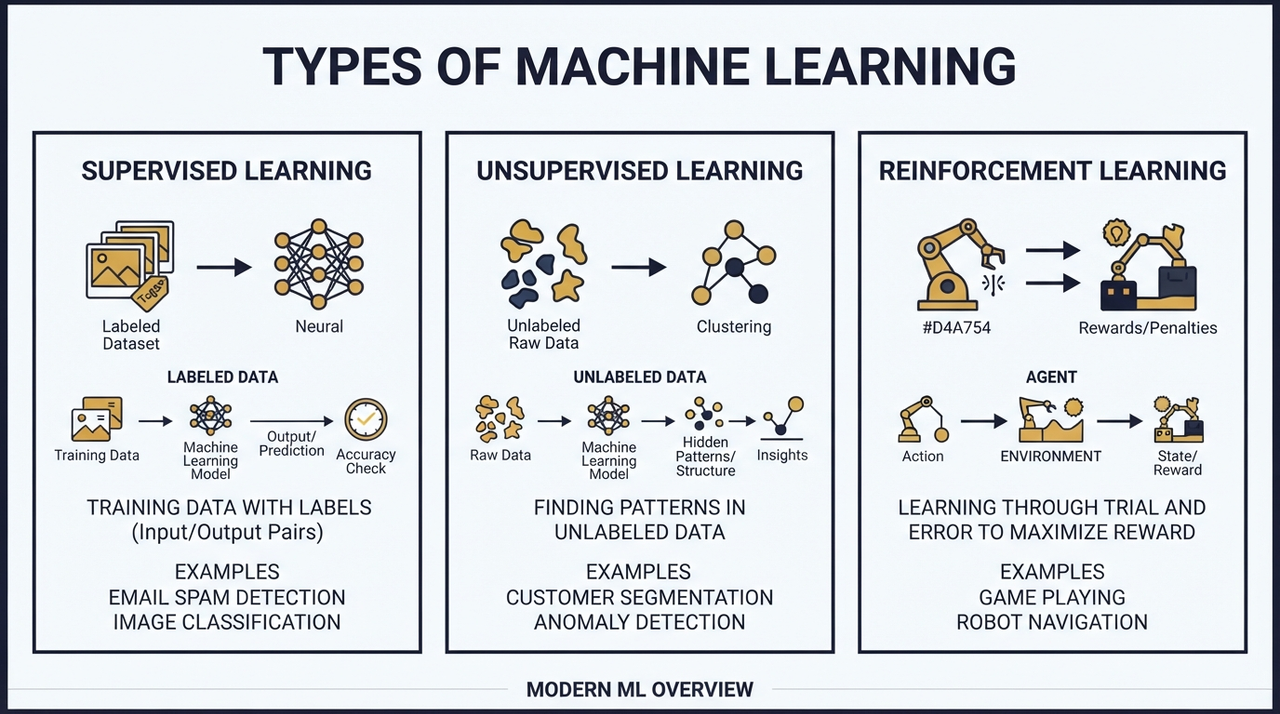
Supervised learning is the most straightforward machine learning technique: provide labeled examples, like photos tagged "cat" or "dog," and the model learns to classify new ones. Neural networks, the backbone here, adjust weights through backpropagation, inching toward precision.
Take medical diagnostics. Feed thousands of X-rays labeled with "pneumonia" or "healthy," and supervised learning spots subtle patterns—cloudy opacities, say—that flag disease. It scales diagnostics, but hinges on pristine labels. Garbage in, garbage out: biased datasets perpetuate errors, mistaking correlation (e.g., demographics) for medical truth.
- Strength: High accuracy on structured tasks.
- Weakness: Needs massive labeled data, costly to curate.
Unsupervised Learning: Discovering Hidden Patterns
No Labels, Just Exploration
Here, unsupervised learning dives into unlabeled data, clustering similar items or reducing dimensions. Algorithms like k-means group customers by spending habits; autoencoders compress images to essentials, aiding anomaly detection.
Consider recommendation engines on streaming platforms. They unearth genres or viewing rhythms without explicit tags, surfacing your next binge. It's pattern-finding prowess, but interpretation remains human—does the cluster mean "thriller fans" or mere coincidence? Benchmarks like clustering purity score efficiency, missing if patterns imply deeper meaning.
Reinforcement Learning: Learning Through Trial, Reward, and Error
The Game of Agents and Environments
Reinforcement learning flips the script: an agent interacts with an environment, earning rewards for good actions, penalties for bad. Policies evolve via Q-learning or policy gradients, optimizing long-term gains. AlphaGo's chess mastery came this way—millions of simulated games honing intuition-like moves.
Robotics benefits hugely: a drone learns to navigate by rewarding stable flight. Yet compute hunger is fierce; training demands GPU clusters running days. Benchmarks track cumulative rewards, but falter on generalization—AlphaGo crushes Go, stumbles elsewhere.
Correlation vs. True Understanding: What Benchmarks Miss
All three paradigms chase correlations, excelling where data abounds. Supervised shines on labeled troves; unsupervised on raw volume; reinforcement on simulated trials. But data quality and sheer compute—trillions of parameters tuned on petabytes—define limits.
AI predicts the apple's fall but knows not gravity's poetry.
Benchmarks measure feats, not comprehension. Enter the Education Door: like students memorizing facts sans context, AI scales knowledge without wisdom. The Consciousness Door beckons—can reward signals birth awareness, or forever mimic?
The Road Ahead: Questions That Linger
Machine learning propels AI forward, yet correlation reigns. Supervised, unsupervised, reinforcement—each a tool, not a mind. As data swells and compute surges, we'll scale predictions, but understanding? That's the horizon, inviting thoughtful pursuit over hype.
What if we blend them with human-like curricula? Ponder that as you explore Aetheria AI's doors to education and consciousness. The universe unfolds not in answers, but in the learning itself.