
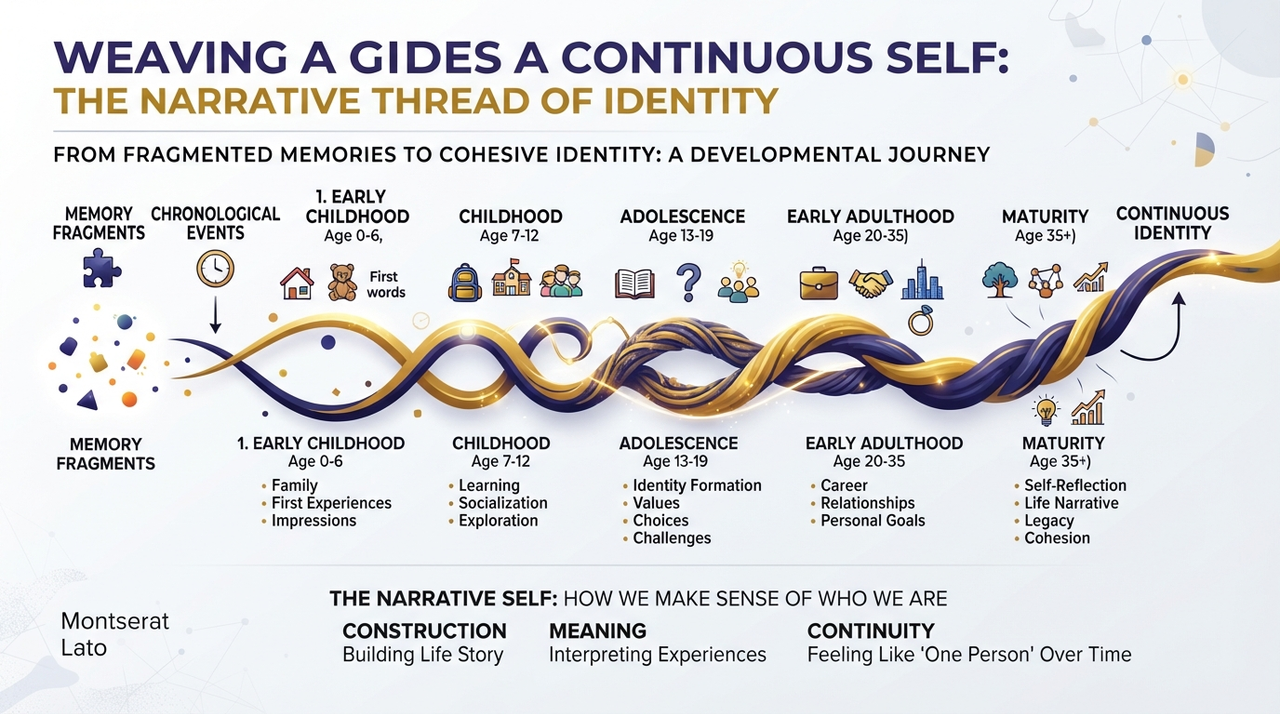
How Memory Stitches Your Narrative Identity: Continuity of Self Revealed
Imagine waking up tomorrow with every personal memory erased—like a blank slate staring back from the mirror. Who would you be? Not just a body moving through the world, but a self woven from stories, triumphs, and quiet regrets. This isn't science fiction; it's the fragile thread of your narrative identity, stitched together by memory. In the second layer of the Consciousness Door, we uncover how memory crafts the continuity of self that makes you feel like "you" across decades of change.
Your journal, that digital confidant from Aetheria AI, holds the key. It captures these threads, inviting you to examine the tapestry of your life.
The Narrative Self Versus the Minimal Self
Picture two versions of you: the minimal self, a raw sense of presence right now—breathing, aware, embodied. It's the immediate "I" that feels hunger or joy in the moment. Then there's the narrative self, the grand storyteller who links yesterday's choices to tomorrow's dreams, creating a coherent life story.
Psychologists distinguish these sharply. The minimal self persists even in fleeting awareness, but your narrative identity emerges from memory's loom. Without it, you're adrift, a collection of moments without plot. Autobiographical memory—those vivid scenes of your first love, a career pivot, or a childhood beach day—binds them into "your story."
How Memory Stitches Your Identity
Every entry in your journal is a stitch. Memory doesn't just store facts; it constructs meaning. Research on autobiographical memory shows we organize life into chapters—"the struggling student era," "the resilient parent phase"—each reinforcing continuity of self. Even as cells renew and beliefs shift, these stories whisper, "This is still me."
Threads of Continuity Amid Change
Life batters us with transformation: jobs lost, relationships reforged, bodies aged. Yet memory insists on sameness. It selectively highlights enduring traits—a stubborn optimism, a knack for empathy—crafting narrative identity that bridges the boy who feared the dark to the man who mentors others.
Scientific Evidence: From Amnesia to Brain Scans
Consider amnesia cases, where patients lose access to personal histories but retain basic skills. Stripped of memory, their sense of a unified self fractures—they know facts about the world but not their story. This reveals memory's role: evidence from these tragedies shows autobiographical recall is essential for narrative identity.
fMRI studies light up the picture. When you relive a life event, the hippocampus and prefrontal cortex dance, weaving sensory details into coherent tales. But here's the nuance: this is evidence of brain processes, not proof that the self is the story. Interpretation varies—some see the self as an emergent narrative, others as a core essence dressed in memory's fabric.
The Limits: Memory's Reconstructive Dance
Don't romanticize memory too much—it's no flawless archive. Classic experiments reveal its reconstructive nature: we tweak details to fit current beliefs, filling gaps with plausible fiction. A journal entry from last week? Already subtly reshaped by today's mood.
This fluidity challenges continuity of self. Your narrative identity evolves, sometimes distorting truth. Yet that's its power: adaptable, it fosters growth rather than rigid stasis.
Weaving Memory into Personal Growth
In Aetheria AI's ecosystem, this ties to the Writing Memory Door—where you externalize threads for clarity—and the Personal Growth Door, transforming stories into action. Journaling fortifies continuity of self, turning chaos into purpose.
What if your self isn't fixed, but a living narrative you can rewrite?
Today, open your journal. Record a memory that anchors your identity—one pivotal scene stitching past to future. What does it reveal about your enduring self? Let the stitching begin.