
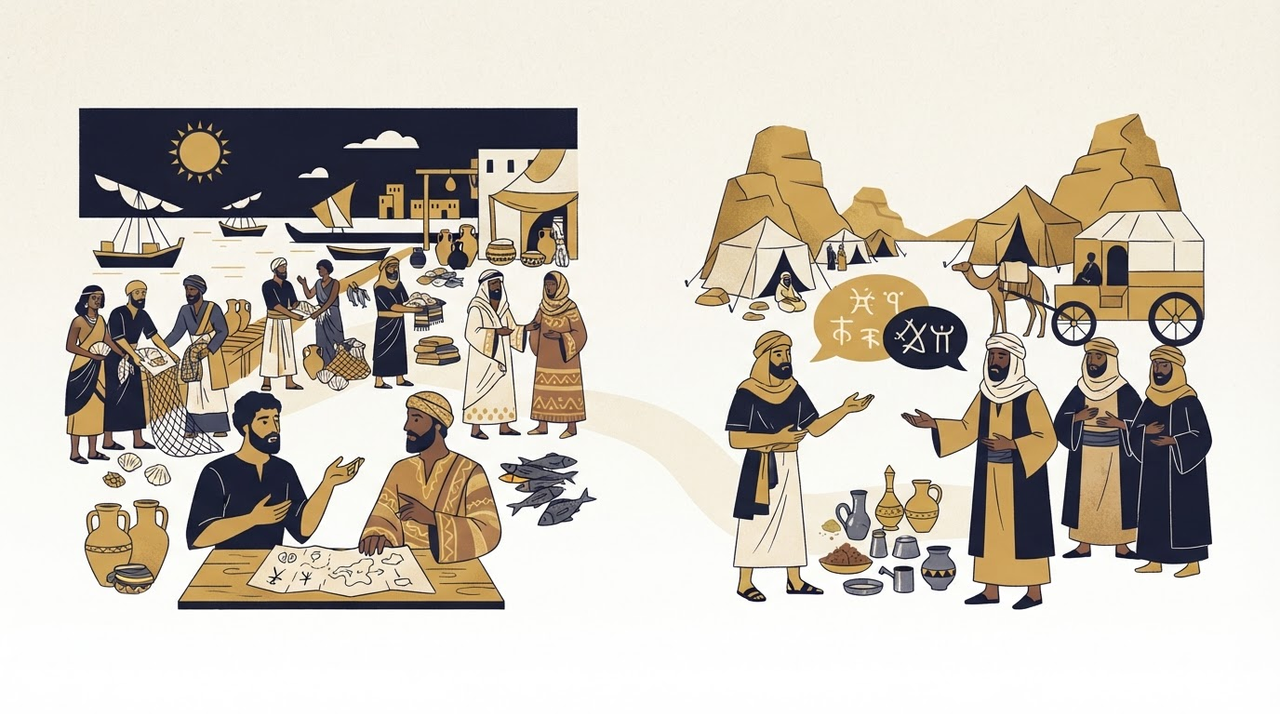
How Trade Routes Sparked Language Contact: Borrowing, Code-Switching, Pidgins, Creoles & Multilingualism
Imagine a dusty caravan halting at a bustling oasis along the Silk Road, where Persian merchants haggle with Chinese traders under the watchful eyes of Bactrian camels. Words tumble across linguistic borders—"silk" whispered in a dozen tongues, "spice" laced with unfamiliar accents. This wasn't mere barter of goods; it was the forge of language contact, where trade routes became conduits for borrowing, code-switching, pidgins, creoles, and vibrant multilingualism. Why does this matter? Because such encounters reveal how human connection reshapes tongues, weaving the fabric of cultural identity through millennia of exchange.
The Essence of Language Contact and Change
Language contact thrives in hubs of movement: ports, markets, crossroads. Here, speakers from distant worlds collide, sparking language change. Traders, migrants, and sailors don't just swap commodities; they lend words, blend syntax, and birth hybrids. This process, rooted in anthropology, underscores our shared humanity—languages as living bridges, not isolated fortresses.
Evidence emerges layered: linguistic patterns hint at forgotten meetings, historical texts preserve echoes, community oral traditions guard nuances, and scholarly reconstructions weigh probabilities. Uncertainties linger—did a word arrive via direct trade or later diffusion?—yet living speakers in port cities today embody enduring legacies.
Borrowing and Code-Switching: The Daily Dance of Trade
Borrowing Words Across Borders
Borrowing happens when speakers adopt foreign elements, adapting them seamlessly. Along Mediterranean ports from the 1st millennium BCE, Greek traders introduced terms like pyros (fire) into Latin, evolving into Romance languages' "fuego" or "feu." No language dominates; each contributes, shaped by contact intensity and prestige of trade goods.
In South Asia, from the 1st century CE, Indo-Aryan tongues absorbed Persian and Arabic lexicon via overland routes—words for "garden" (bagh from Persian) or "market" (bazaar from Arabic)—reflecting spice and textile flows.
Code-Switching: Fluid Tongues in Motion
Code-switching flips between languages mid-conversation, a multilingualism hallmark. Picture Swahili coast vendors in the 8th-15th centuries, mixing Bantu roots with Arabic: "Hapa ni soko la bahari" (Here is the sea market). This pragmatic shift aids negotiation, signaling solidarity or expertise, without erasing origins.
Unlike borrowing's permanence, code-switching is performative, thriving in trade's immediacy.
From Pidgins to Creoles: New Languages Born of Necessity
Intense contact births pidgins—stripped-down bridges for trade, blending vocab from dominant tongues with simplified grammar. On Pacific islands via 18th-century whaling routes, Tok Pisin emerged from English, Portuguese, and local substrates, serving ship-to-shore deals.
Creoles evolve when pidgins gain native speakers, expanding complexity. Haitian Creole, from 17th-century French slave-trade ports, fused French lexicon with West African grammar, now a full-fledged language sustaining communities.
- Pidgins: Transient, trade-focused, minimal morphology.
- Creoles: Generational, rich systems, no "parent" hierarchy.
Distinctions hinge on duration and speaker investment, not purity.
Trade Routes in Focus: Swahili Coast, Mediterranean, and Beyond
Swahili Coast (8th-15th Centuries)
Arab dhows docked at Kilwa and Mombasa, blending Bantu with Arabic via monsoon trades. Swahili's kitabu (book) from Arabic kitab marks this, evidenced in coral mosques and oral epics, though debates persist on exact timings.
Mediterranean Ports and South Asia
Phoenician outposts seeded Semitic loans into Greek; later, Venetian-Genoese rivalry infused Italian with Levantine terms. South Asia's ports like Calicut absorbed Dravidian-Portuguese mixes during spice voyages. Chronology matters: pre-Islamic Arab influence predates European, pathways via sea vs. land alter trajectories.
Interpreting Evidence, Bridging to Today
Scholarly lenses parse textual records against community knowledge—Swahili elders recounting coastal lore counterbalance fragmented chronicles. Counterevidence, like isolated loanword clusters, challenges diffusion models.
Echoes persist: Technology standardizes trade lingo (English APIs mirroring pidgins), while environmental port cities foster migration-driven multilingualism. Anthropology ties these to human resilience amid flux.
Reflect and Journey On
In the weave of words, what trade route calls to your curiosity? Journal: Protect the journey by noting one borrowed word in your speech—trace its path. Open inquiry: How might today's digital silk roads reshape pidgins creoles anew?
Language contact reminds us: Tongues evolve through touch, inviting endless wonder.