
Interoception Uncovered: How Predictive Processing Shapes Pain, Emotions, and Beyond
Picture this: a subtle tightness grips your chest during a tense meeting. Is it anxiety creeping in, or just the aftereffects of that hurried lunch? Your body whispers signals, but your brain crafts the full story. This interplay lies at the heart of interoception—the sensing of your internal bodily states—and how predictive processing turns raw data into lived experience.
In the realm of pain neuroscience and emotion prediction, the brain doesn't passively receive; it anticipates. Drawing from frameworks like predictive processing, we explore how these predictions shape pain, emotions, and more. This isn't about pinning down consciousness—far from it—but observing how physiological shifts, personal reports, and contextual interpretations weave together.
Decoding Interoception: Your Body's Inner Dialogue
Interoception tracks the ebb and flow within: heartbeats accelerating, breath quickening, muscles tensing. It's not mere sensation; it's the brain's ongoing conversation with the body. Signals from organs and tissues stream upward, but they're filtered through expectations shaped by past experiences, current context, and even cultural cues.
Consider the distinction: a measurable spike in heart rate (physiological change), your awareness of it (self-report), and the meaning you assign—like fear or excitement (interpretation). These layers reveal why the same bodily cue can feel worlds apart in different moments.
Predictive Processing: The Brain as Storyteller
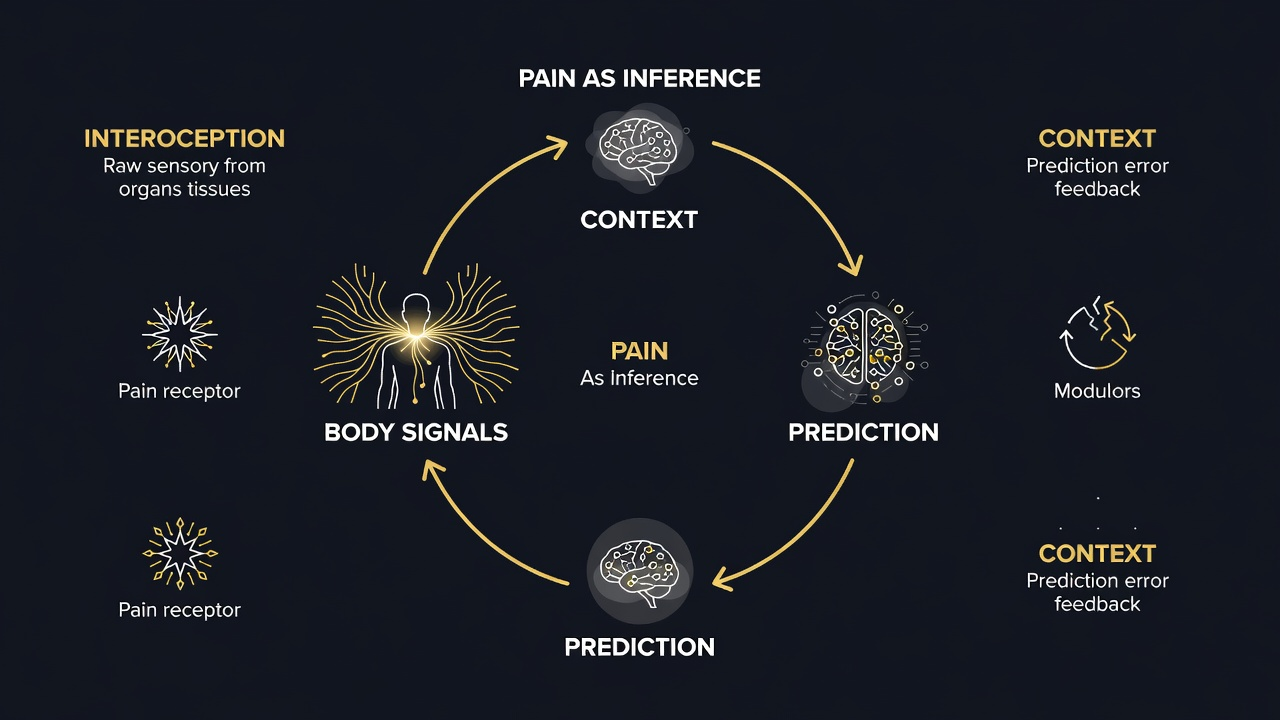
Predictive processing posits the brain as a prediction engine, constantly generating models of the world—including your innards—to minimize surprises. Incoming sensory data, interoceptive or otherwise, serves as error signals when it deviates from forecasts.
In this view, experiences arise from inference, not direct readout. The body provides noisy inputs; the brain refines them with priors from memory and surroundings. No absolute truths here—just refined guesses that guide action, from adjusting posture to seeking comfort.
Why Context Reigns Supreme
A flutter in your gut might predict danger in a dark alley but butterflies before a first date. Predictive processing layers context atop raw signals, constructing nuanced narratives for pain and emotions alike.
Pain Neuroscience Through a Predictive Lens
In pain neuroscience, traditional views saw pain as a straightforward alarm. Enter predictive processing: pain emerges as a constructed inference. Nociceptors fire, but the brain predicts threat levels based on posture, movement history, and emotional state.
Chronic pain exemplifies this. Even after tissue heals, persistent predictions of harm sustain the experience. Clinical evidence from interventions like graded exposure therapy shows recalibrating these predictions can dial down intensity—though limits exist, as not all cases respond uniformly.
- Physiological markers: elevated inflammation or nerve activity.
- Self-reports: subjective scales of hurt.
- Interpretations: "This means I'm broken" versus "It's manageable."
Emotion Prediction: Crafting Feelings from Forecasts
Emotion prediction follows suit. A racing heart isn't inherently "anxiety"; it's interpreted through predictive lenses. Therapies targeting interoceptive awareness, like mindfulness-based approaches, encourage noting cues separately from labels, fostering regulation.
Evidence from emotion regulation studies highlights benefits: training predictive updates reduces reactivity. Yet, challenges persist in disorders where predictions rigidify, underscoring the framework's promise—and its boundaries.
Beyond the Body: Trails to Spirituality and Health
This predictive dance extends to deeper realms. Explore how refined interoceptive tuning aligns with contemplative practices in our Spirituality Door, or practical health strategies via the Health Door.
What if tuning into predictions unlocked freer embodiment?
A Simple Invitation: Note, Contextualize, Label
Pause now. Notice a body cue—a breath, a twinge. Ask: What's the raw signal? What's the surrounding context? What label arises? Treating them as distinct data points invites fresh predictive updates, easing pain's grip or softening emotional storms.
Interoception, unveiled through predictive processing, reminds us: experience is malleable craft, not fixed fate. Step into this awareness with care, and watch your inner world transform.