
Invention Within Tradition: Scribal Training, Lexical Lists, and Copybooks
The Scribe's Repetitive Dance
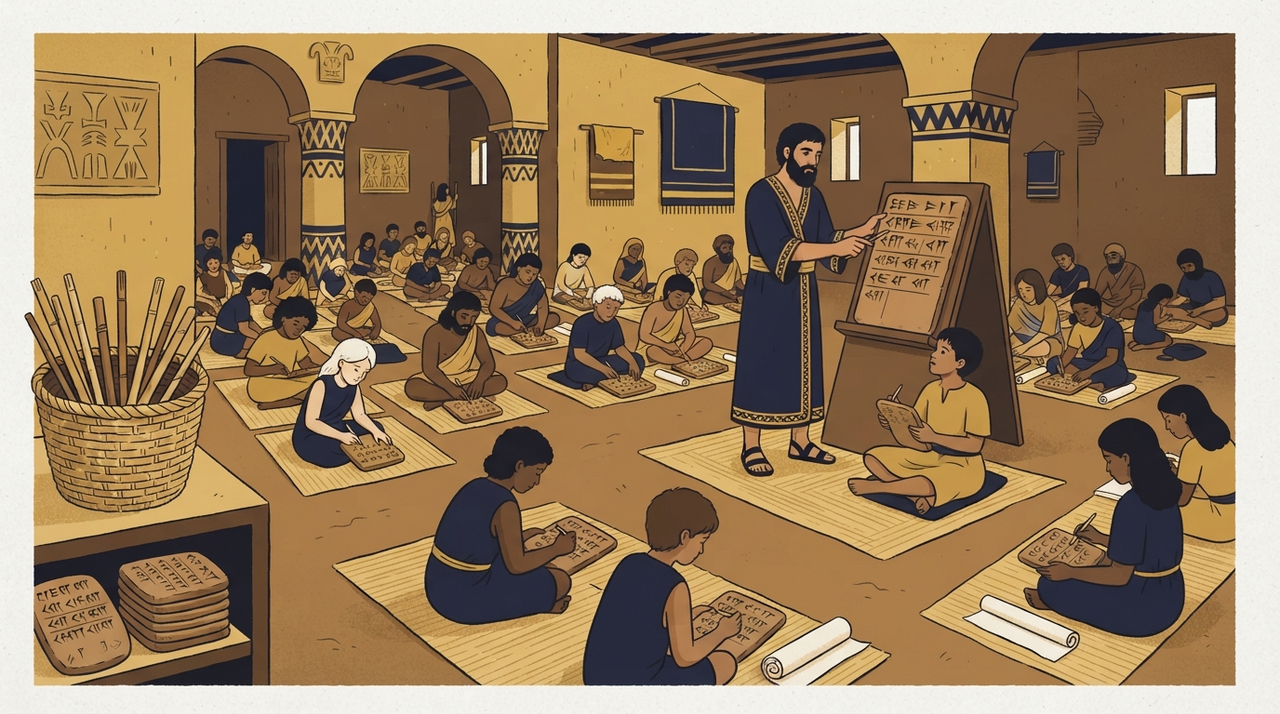
Picture a young apprentice in ancient Mesopotamia, hunched over a clay tablet under the dim flicker of an oil lamp. The master assigns a single line from a lexical list: a word for "horse," repeated fifty times in precise cuneiform wedges. Copy it exactly. Then, on the next tablet, vary the signs just enough to list related terms—mare, colt, chariot. This is scribal training at its core, not a spark of genius but a disciplined grind where tradition cradles the seeds of invention.
Such school copies from the edubba, or House of Tablets, reveal how education forged creativity through constraint. Students memorized lexical lists—catalogs of words grouped by theme, from animals to professions—before tackling proverbs or hymns. Precision ruled: one errant stroke, and the tablet shattered into the kiln's fire. Yet within those rigid forms, space opened for recombination, training scribes to invent within tradition.
Lexical Lists: Building Blocks of Knowledge
From Vocabulary Drills to Conceptual Maps
Lexical lists dominated Mesopotamian scribal training. Unearthed from sites like Nippur, these tablets cataloged reality in Sumerian and Akkadian: trees, birds, stones, even abstract concepts like "trust" or "oath." Beginners copied simple sign lists, progressing to complex versions where words linked by association—fox beside wolf, both under predator.
Why lists? They mapped the world for bureaucrats who tracked grain, troops, and laws. But they also honed variation. A student might copy a base list verbatim, then compose a synonym list, swapping terms creatively yet faithfully. This was no rote drudgery; it was combinatorial play inside tradition's fence.
- Sign lists: Basic stroke practice.
- Word lists: Thematic grouping.
- Synonym lists: Permitted twists on the original.
Historians note uncertainty about intent. Did masters reward clever variations, or punish them as sloppiness? Surviving tablets show both flawless school copies and tentative experiments, hinting at a spectrum from mimicry to mild innovation.
Copybooks: Echoes Across Eras
Model Letters and Repeated Lines
Beyond Mesopotamia, copybooks history unfolds similarly. Egyptian Houses of Life trained scribes with hieroglyphic exercises: copy a model's elegant phrase fifty times, then adapt it for a new context. Model letters offered formulas—greetings, petitions—copied until muscle memory took hold, followed by personalization within formulaic bounds.
Fast-forward to Renaissance Europe or Edo Japan. Calligraphy copybooks demanded tracing master strokes, then improvising flourishes. A pupil wrote "The quick brown fox" in perfect copperplate, line after line, before venturing slight curls on the serifs. Here, invention within tradition thrived: variation rewarded when it honored the model, punished if it strayed too far.
In the scribe's hand, repetition builds not just skill, but the quiet art of recombination.
Where Tradition Permits Variation
These exercises bridge strict copying and subtle creation. A Mesopotamian student tablet might reproduce a proverb identically across rows, then alter one word in the final exercise—testing boundaries under watchful eyes. Oral traditions coexisted, with living masters enforcing norms, yet written drills allowed private tinkering.
Not every school chased "creativity." Practicality drove the edubba: produce reliable administrators. Still, the framework invited new combinations—lexical lists as precursors to poetry, where scribes wove familiar words into fresh hymns. Compare this to modern writing prompts: trace the tradition, then twist.
Examine a repeated exercise today. Where does variation creep in? Allowed? Applauded? In scribal worlds, answers shaped not rebels, but refined inheritors.
Through Aetheria's Doors
This glimpse into scribal training, lexical lists, and copybooks history opens the Aetheria Creativity Door. Here, explore how constraints fuel invention. Wander next to the Books Door for scribes as textual stewards, or the Education Door for apprenticeship's living pulse. Tradition endures; within it, fresh patterns emerge.