
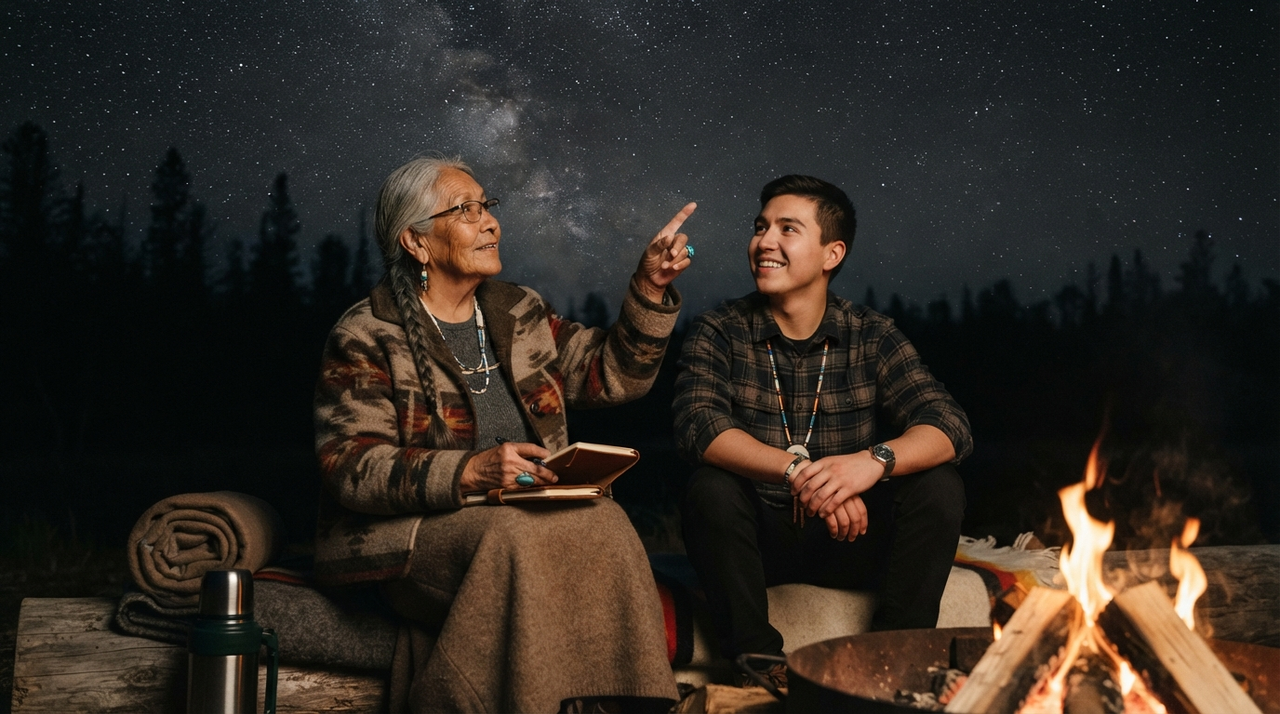
Living Sky Knowledge: Indigenous Astronomy from Navajo Stars to Polynesian Voyages
Imagine a winter night in the Navajo Nation, where the Dilyéhé—the Pleiades star cluster—rises like a flickering campfire, whispering the arrival of frost and the need to shelter. This is no relic of a forgotten past. For Diné (Navajo) people, this Navajo star knowledge lives, taught through stories by elders who guard its moral and seasonal truths. Students of existence, welcome to indigenous astronomy: not a museum exhibit, but a living sky tradition pulsing with consent, ceremony, and survival. Here, we listen without flattening—honoring distinct voices amid colonization's scars and revitalization's triumphs.
Diné Winter Skies: Dilyéhé as Moral Compass
In the high deserts of Arizona and New Mexico, Diné astronomy weaves stars into ethics and ecology. The Dilyéhé, those seven sisters clustered in Taurus, mark winter's grip. Elders recount how their dimming light signals hózhó—balance—urging restraint in hunting and reflection on harmony. Unlike Western charts plotting orbits, this is ceremonial timing: stories passed orally, restricted to those initiated through kinship and language revitalization efforts post-19th-century boarding schools.
Colonization fractured these transmissions, yet Diné knowledge keepers, like those at Navajo Technical University, collaborate with astronomers under strict protocols. Permission precedes publication; outsiders learn only what communities share. This living sky tradition teaches morality—stars as ancestors reminding humanity of reciprocity with the land.
Yolŋu Morning Star: Barnumbirr's Restricted Ceremonies
Aboriginal Australian Songlines and Celestial Protocols
North across the Pacific, in Arnhem Land, Yolŋu people track Barnumbirr—Venus as Morning Star—through Aboriginal Australian songlines. This isn't casual stargazing. During her pre-dawn rise, restricted ceremonies unfold: songs mapping wet-season rains, yidaki (didgeridoo) echoing creation beings. Only initiated men and women, guided by elders like those from the Galiwin'ku community, access full meanings, blending navigation with ancestral law.
Language loss from missions lingers, but Yolŋu-led programs revive these poles—celestial maps etched in memory, distinct from European tools. Stars here enforce Seeker's Code: approach with humility, for the sky holds kin, not data points.
Polynesian Navigation: Hokule'a Revives Ancient Voyages
Hawaiian Wayfinding and Māori Maramataka
Double-hulled canoes slice Pacific swells, guided by stars alone. Since 1976, the Hokule'a—built by Native Hawaiian voyagers like those from the Polynesian Voyaging Society—has sailed 200,000+ nautical miles sans instruments. Captains read Hōkūpa'a (Polaris) and rising constellations for direction, reviving Polynesian navigation crushed by colonial ships and land grabs.
- In Aotearoa New Zealand, Māori maramataka lunar calendars dictate planting: Rākaunui's full moon signals kumara harvest, maintained by iwi elders despite 19th-century suppressions.
- These differ sharply: Hokule'a emphasizes open-ocean routes; maramataka, rhythmic environmental cues.
Collaborative researchers, with pūkenga (experts') consent, document this—not as generic wisdom, but community-specific resilience.
Parallel Patterns, Not Shared Origins: Pleiades Sisters Worldwide
Why do Pleiades appear as sisters—from Diné Dilyéhé to Yolŋu and Māori kin? Not diffusion from one cradle, but human pattern bias meeting common skies. Visible year-round in hemispheres, their fuzzy cluster evokes family amid ecology: faint in winter for Diné restraint, heralding ceremonies for Yolŋu. Functions diverge—no contact routes prove borrowing. Indigenous astronomy thrives on local genius, not universal geometry.
Uncertainty humbles us: Western lenses risk erasure. True understanding demands cross-door bridges—to Relationships (kinship protocols), Environment (sky-tied lands), The Ancestors (living presences).
Seeker's Code: Protecting Living Sky Traditions Today
Students of existence, the stars speak through guardians. Ask before recording; consent guards the journey.
Elders in Navajo chapters, Yolŋu homelands, Hawaiian voyaging centers hold authority. Collaborative projects—like Diné astronomers with NSF grants or Māori apps for maramataka—model ethics. As languages revive, so do skies. Your next step? Embody the Seeker's Code: witness with respect, flattening nothing. In this vast cosmos, humility charts the truest course.